Software Engineer Resume Examples for Every Level
Software engineer resume examples from junior to senior, across frontend, backend, mobile, DevOps, and ML, plus a copyable template and the skills to list.
A software engineer's resume is read twice: once in six seconds by a recruiter checking for the right stack and level, and once more carefully by an engineer deciding whether to interview you. The first read wants your languages, frameworks, and years of experience near the top; the second wants proof that you shipped things that mattered — a feature used by real users, a system you scaled, a bug you killed that was costing money. Below are software engineer resume examples for every level and specialty, from a junior frontend developer to a staff ML engineer, each linked to a live sample you can open, plus the skills, sections, and numbers that get a resume past an applicant tracking system and in front of a hiring team.
The examples come first, then a text template you can copy, then the writing advice behind all of them — a tight technical summary, impact-driven project bullets, the right skills section, and the keywords a company's hiring software scans for. The general rules that apply to any resume are collected in our resume writing guide; this page is the engineering-specific version.
How these examples were made. Each résumé below is a real Prezumi template rendered from a complete engineering profile — the same builder you'd use for your own — not a static mock-up. The names, companies, and numbers are illustrative. The stack and hiring conventions reflect how tech teams commonly screen resumes; they vary by company size and country, so read the posting before you copy anything wholesale.
Software engineer resume examples by level and specialty
Software engineering is not one job. A junior frontend developer polishing a component library and a staff engineer designing a platform the whole company builds on share a title and almost nothing else about their week, and their resumes should look as different as their work does. Each example below is a real resume rendered in a clean, ATS-friendly Prezumi template — so you can see the exact format for your level and stack and then build your own from the same structure. Click any example to enlarge it, or use it as your starter profile with one tap.
Junior frontend developer (entry level)
A junior frontend resume has to prove you can build and ship UI even if you don't have years of paid work behind you. This one leads with the stack — JavaScript or TypeScript, React, HTML and CSS, Git — then makes real projects carry the weight: an internship, a capstone, open-source contributions, and a personal app that's actually deployed and linked. The strongest junior bullets show something shipped and used, not just a tutorial finished, and they link to a live URL and a GitHub repo a reviewer can open in one click.
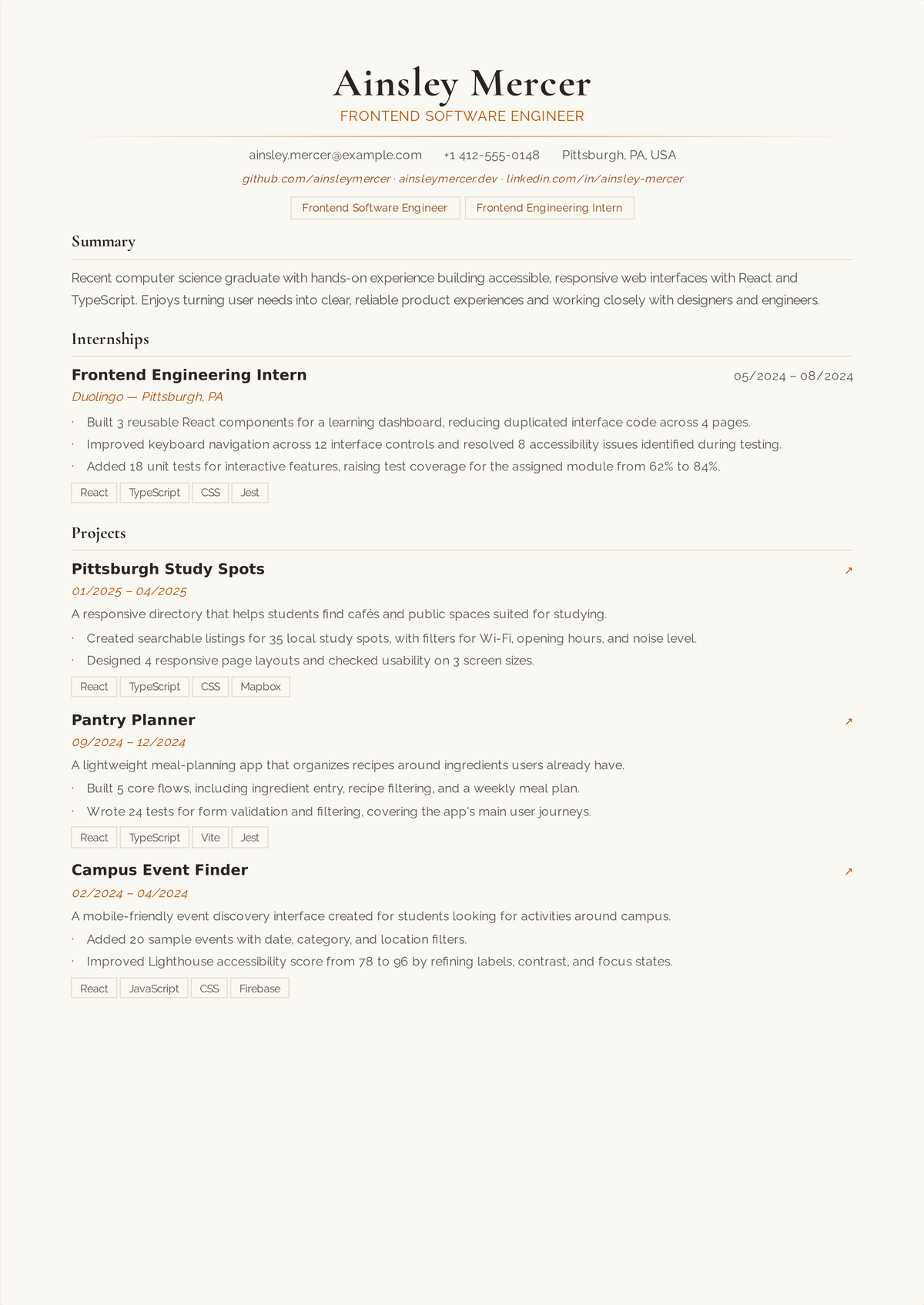
Why this resume works
- The stack sits in the first few lines — languages, frameworks, and tools — so a recruiter sees the fit before scrolling.
- Projects are treated as experience: an internship, a capstone, and a deployed personal app, each with a live link and a GitHub repo.
- Bullets show something shipped and used, with a number — users, load-time improvement, test coverage — rather than "learned React."
- It stays ATS-clean: standard headings, real keywords (React, TypeScript, REST, Git), and no skill bars or two-column graphics to garble the parse.
Backend engineer (mid-career)
A backend resume is about systems that stay up under load, so this one leads with the languages and infrastructure — Java, Go, or Python; PostgreSQL; Redis; a cloud provider — then shows the work: designing APIs, modeling data, handling traffic at scale, and keeping latency and error rates low. The numbers that carry weight are requests per second served, p99 latency brought down, uptime held, and cost cut by an optimization. It names the architecture the engineer actually touched — microservices, queues, caching — rather than listing buzzwords with no story attached.
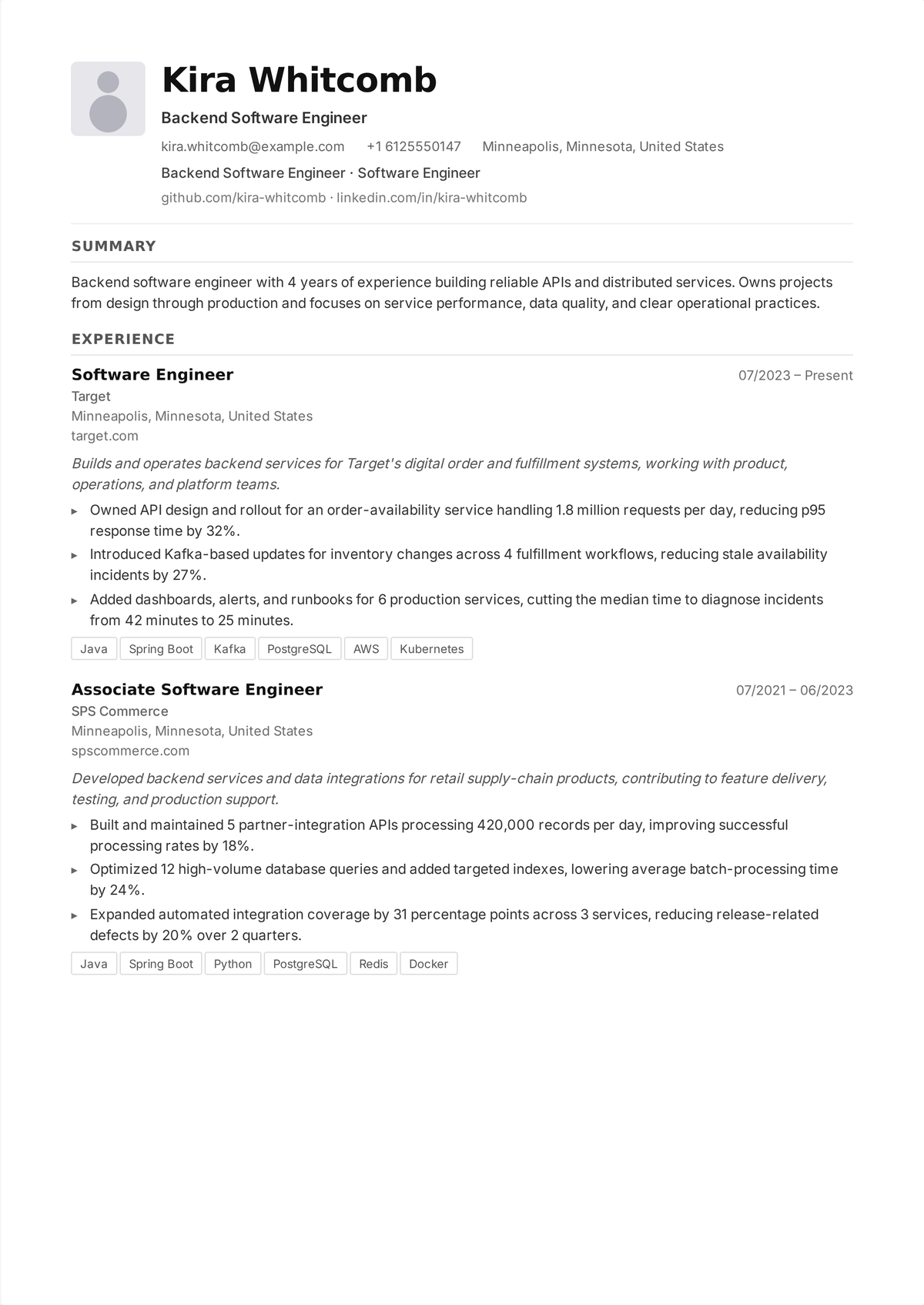
Why this resume works
- It leads with the backend stack — language, database, cache, cloud — that a posting and a parser both screen for first.
- Bullets quantify systems work: requests per second served, p99 latency reduced, uptime held, and infrastructure cost cut.
- It names the architecture the engineer actually built or changed — APIs, queues, caching, data models — with a concrete outcome each time.
- It shows ownership beyond code: on-call rotations, incident response, and a reliability or performance win driven end to end.
Full-stack engineer (mid-career)
A full-stack resume has to show range without reading as shallow, so this one organizes the work by what was shipped rather than by layer. It names a modern stack end to end — a frontend framework, a backend language, a database, and a deploy pipeline — then shows features owned from design through production: the UI, the API behind it, the data model, and the release. The numbers are features shipped and adopted, performance improved across the stack, and ownership of a product area from ticket to deploy. It's the resume of someone who can take a problem all the way.
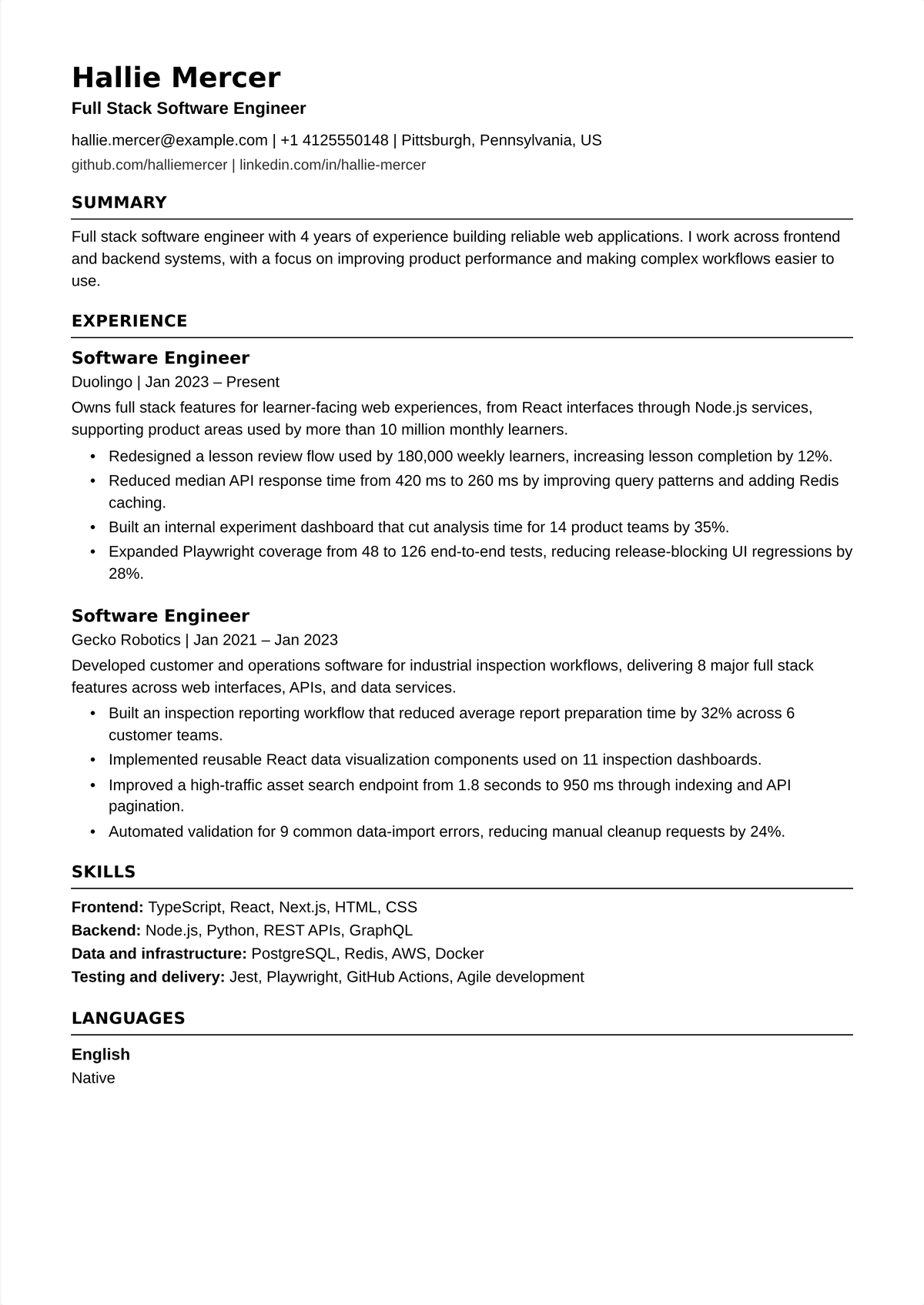
Why this resume works
- It names a coherent stack end to end — frontend, backend, database, deploy — so the breadth is clear without reading as a tool dump.
- It organizes bullets around features shipped, not layers, which is how a full-stack engineer actually works and how a manager reads impact.
- Each feature carries a number: users or revenue affected, adoption, or a performance gain measured across the stack.
- It shows end-to-end ownership from design to production deploy, the signal that separates a full-stack engineer from a generalist.
Mobile engineer (iOS / Android) (mid-career)
A mobile resume leads with the platform and language — Swift and SwiftUI for iOS, Kotlin and Jetpack Compose for Android, or a cross-platform framework like React Native or Flutter — then shows the work that defines the role: shipping to the App Store or Play Store, keeping an app fast and crash-free, and handling the constraints mobile adds (offline, battery, screen sizes, store review). The numbers are app-store rating, crash-free session rate, install and retention figures, and startup or render time improved. Shipping through a store review is itself a signal, so the resume names the releases.
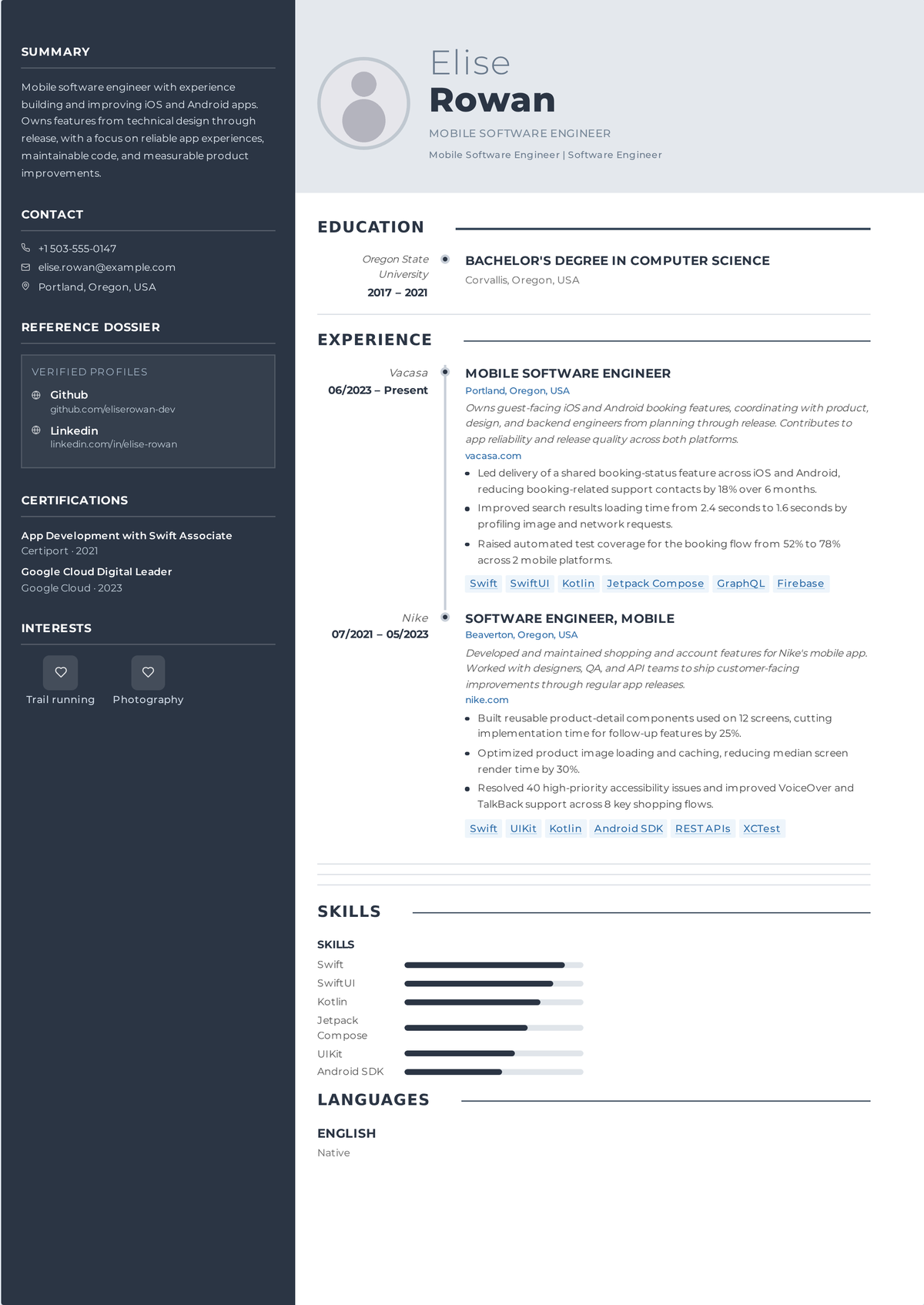
Why this resume works
- It leads with the platform and language — Swift/SwiftUI, Kotlin/Compose, or React Native/Flutter — that a mobile posting screens for first.
- It names real releases shipped to the App Store or Play Store, which is a concrete signal reviewers trust.
- Outcomes are measured in mobile terms: app-store rating, crash-free session rate, install and retention, and startup time.
- It shows the platform-specific work — offline support, performance on low-end devices, and passing store review — that a web resume wouldn't.
DevOps / SRE engineer (senior)
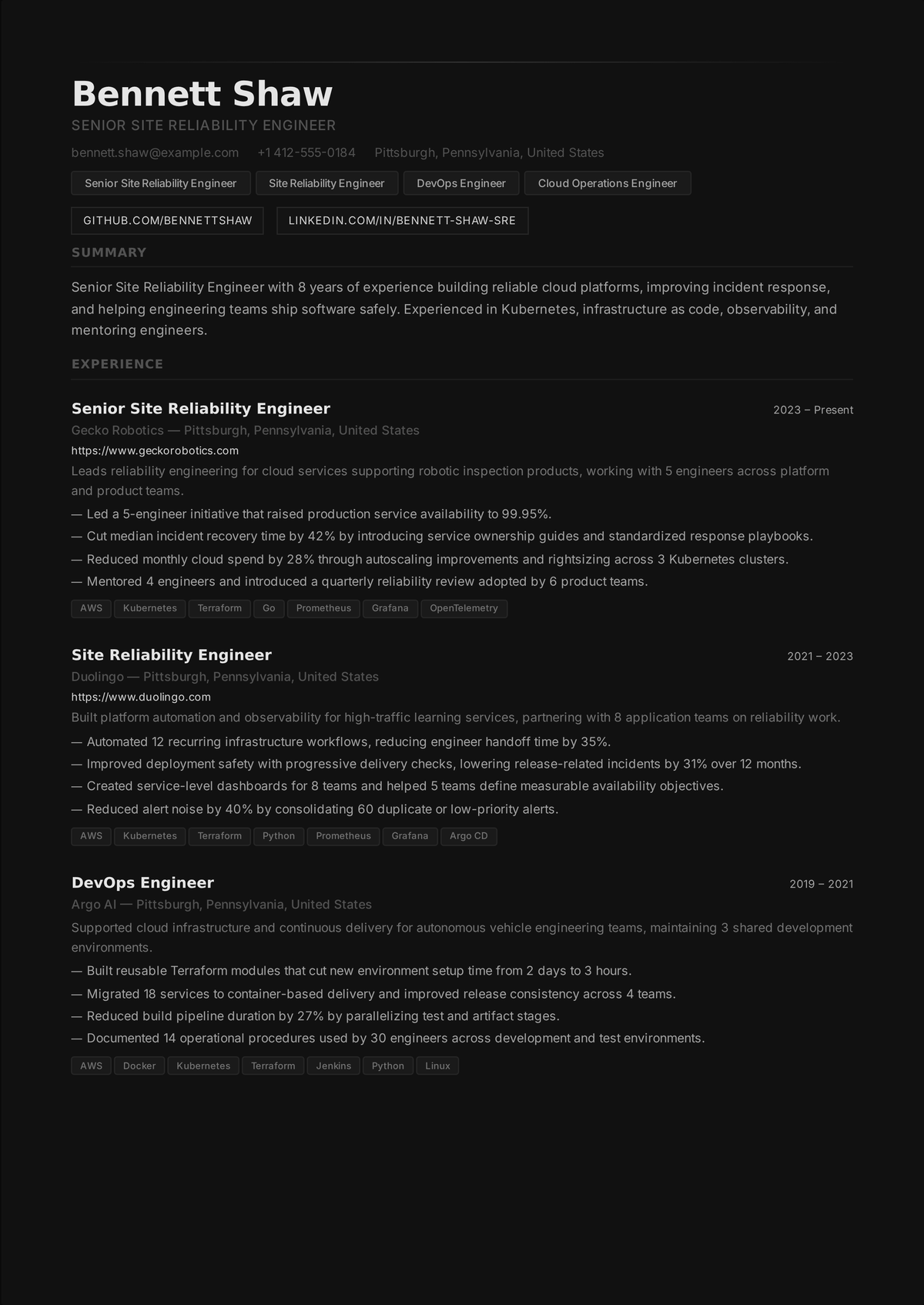
A DevOps or site-reliability resume is about keeping production healthy and shipping safe, so it leads with the infrastructure stack — a cloud provider, Kubernetes, Terraform, a CI/CD system, and an observability suite — then shows the reliability and velocity work: building pipelines, automating infrastructure as code, cutting deploy time, and running incident response. The numbers are uptime and SLO attainment, mean time to recovery, deploy frequency, and cost saved by right-sizing or automation. This is a senior resume, so it also shows systems the engineer designed and standards they set for other teams.
Why this resume works
- It leads with the infrastructure stack — cloud, Kubernetes, Terraform, CI/CD, observability — the exact tools an SRE posting lists.
- Reliability is quantified the way the discipline measures it: uptime and SLO attainment, mean time to recovery, and deploy frequency.
- It shows the velocity-and-safety balance: faster, more frequent deploys without raising the change-failure rate.
- At a senior level it names systems designed and standards set for other teams, not just tasks executed — the signal of staff-track scope.
Machine-learning / AI engineer (senior)
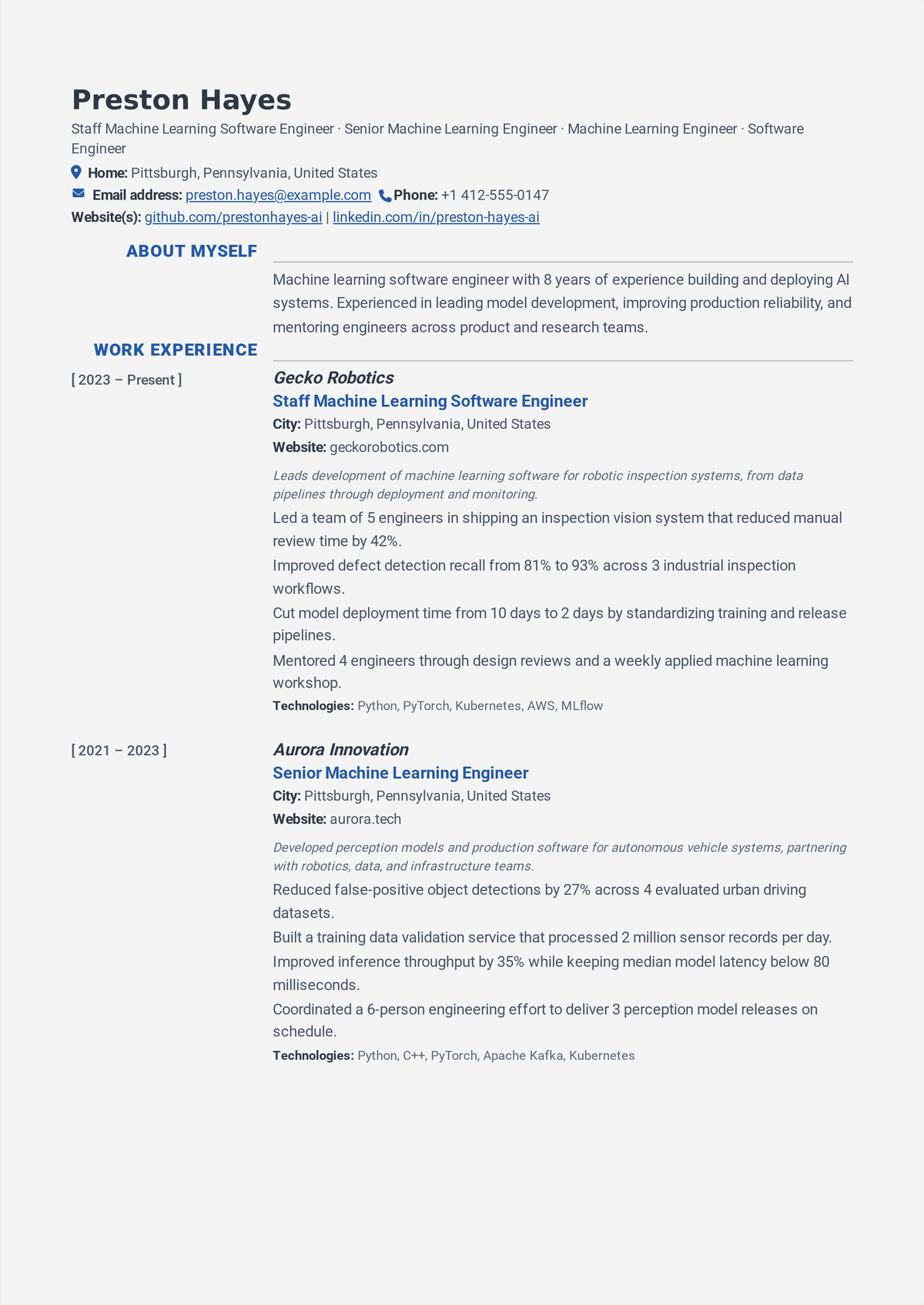
An ML engineering resume sits between research and production, and the strongest ones lean toward production. This one leads with the stack — Python, PyTorch or TensorFlow, and the data and MLOps tooling — then shows models taken from notebook to real users: training and evaluating a model, building the pipeline that serves it, and measuring the business outcome it drove. The numbers are model performance (accuracy, precision/recall, or a task-specific metric) and, more importantly, the downstream impact — revenue, retention, cost, or latency — because a model that never shipped isn't impact. If your path is research-heavy, our academic CV guide covers listing publications in full.
Why this resume works
- It leads with the ML stack — Python, PyTorch or TensorFlow, and the data and MLOps tooling — that the role is screened on.
- It shows models taken all the way to production and real users, not just experiments that stayed in a notebook.
- It pairs model metrics (accuracy, precision/recall, AUC) with the downstream business outcome, which is what actually gets hired.
- It names the engineering around the model — feature pipelines, serving, monitoring, and retraining — that separates an ML engineer from a data scientist.
One more role rounds out the picture: the quality and test-automation work that keeps a shipping product from breaking, and that many engineering careers pass through.
QA / test automation engineer (entry level)
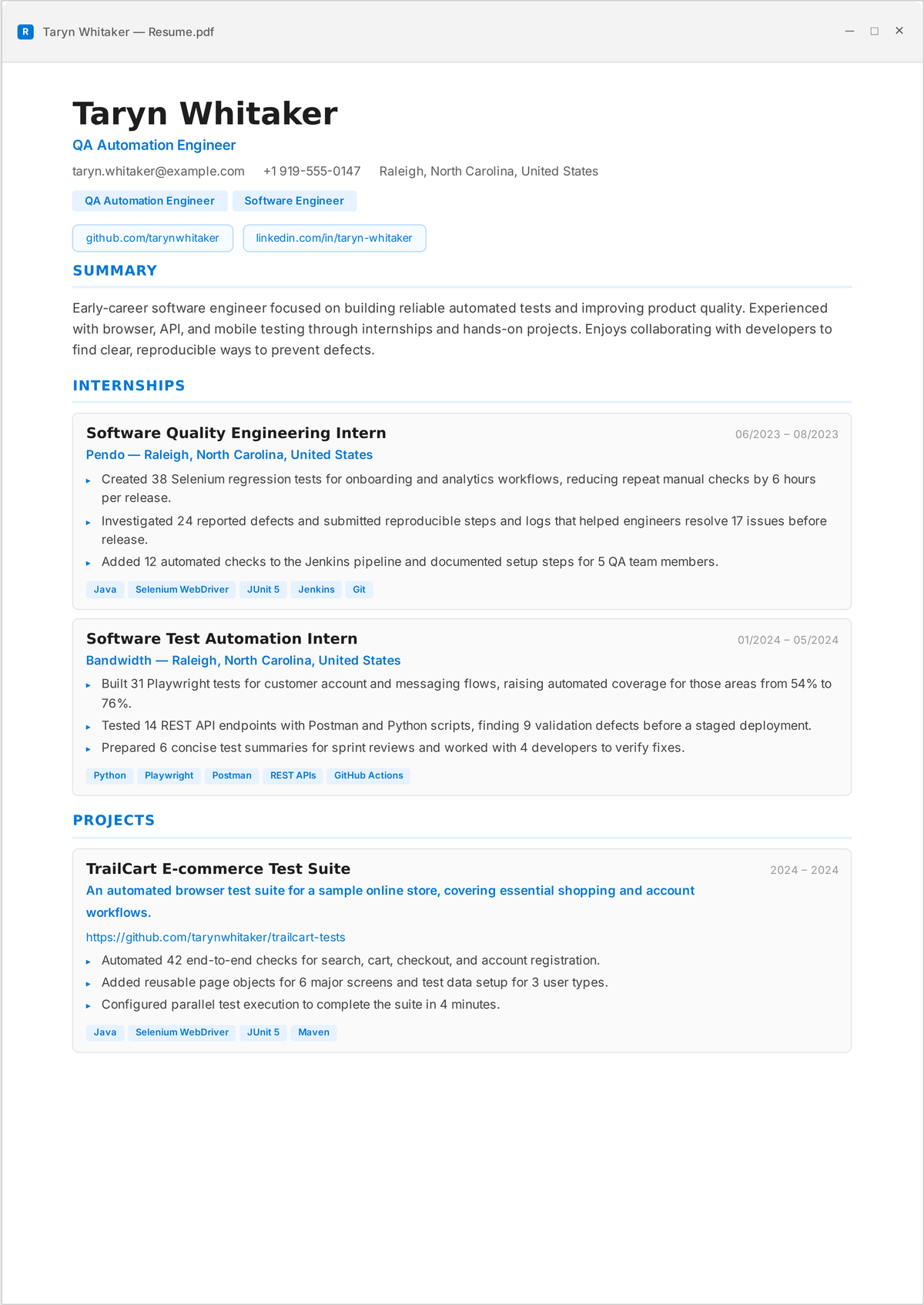
A QA automation resume shows you can stop bugs from reaching users and speed up the team by automating the checks that used to be manual. This one leads with the testing stack — a language, a framework like Playwright, Cypress, or Selenium, and a CI system — then shows the work: writing automated test suites, building them into the pipeline, and catching regressions before release. The numbers are test coverage added, manual-testing hours saved, defects caught pre-release, and flaky tests stabilized. It's a common entry point into engineering, so the resume also signals any move toward broader development.
Why this resume works
- It leads with the test-automation stack — language, framework (Playwright, Cypress, Selenium), and CI — a QA posting screens for.
- It shows automation, not just manual testing: suites written, built into the pipeline, and run on every change.
- Outcomes are concrete: coverage added, manual hours saved, defects caught before release, and flaky tests stabilized.
- It reads as a career in motion, signaling coursework or side projects that point toward broader software development.
A software engineer resume template you can copy
Here is a complete mid-career backend-engineer resume in plain text — single column, standard headings, real numbers. It's a template in the practical sense: swap in your own stack, company, and results, and you have a resume a parser can read and an engineer can scan in seconds.
Jordan Alvarez
Seattle, WA · jordan.alvarez@email.com · (206) 555-0115 · github.com/jalvarez · linkedin.com/in/jordan-alvarez
Summary
Backend engineer with four years building and scaling services in Go and Python on AWS. Cut p99 API latency 45% and reduced infrastructure spend $18k a month by redesigning a hot path and its caching layer. Looking for a backend role on a team that owns high-traffic services end to end.
Skills
Languages: Go, Python, SQL · Data: PostgreSQL, Redis, Kafka · Cloud: AWS (ECS, Lambda, RDS), Docker, Kubernetes, Terraform · Practices: REST and gRPC APIs, CI/CD, observability (Datadog), on-call
Experience
Software Engineer — Northwind Logistics, Seattle (2022–present)
- Redesigned the order-tracking service's hot path and caching layer, cutting p99 latency from 820ms to 450ms and trimming infra cost $18k/month.
- Built an event-driven inventory pipeline on Kafka processing 40M events a day with 99.98% uptime.
- Introduced contract tests and a staged deploy pipeline that dropped production incidents from the service by 60%.
- Carried a weekly on-call rotation and wrote the runbooks that cut mean time to recovery for the team from 45 to 18 minutes.
Junior Software Engineer — Cedar Apps, Seattle (2020–2022)
- Shipped REST APIs in Python/Django for a B2B SaaS product serving 25k daily active users.
- Added automated tests that raised backend coverage from 55% to 82% and caught three data-integrity bugs before release.
Projects
openmetrics-lite — Open-source Prometheus exporter in Go, 600+ GitHub stars, used by 30+ projects. github.com/jalvarez/openmetrics-lite
Education
BS in Computer Science, University of Washington — 2016–2020
Certifications
AWS Certified Solutions Architect – Associate (2023)
What makes this one work: the summary names a quantified win in its second sentence, the skills section is grouped so a parser and a human both find the stack fast, and every experience bullet carries a number an engineer could probe in an interview. The layout is deliberately plain so an applicant tracking system extracts each field cleanly, and the GitHub and project links give a reviewer something to open.
Put a skills section near the top, grouped by category, with the exact names. Recruiters and parsers both scan for "Go," "Kubernetes," "React," "PostgreSQL" — not "backend technologies." Group them (Languages, Data, Cloud, Practices) so it reads fast, list only what you can discuss in an interview, and make sure anything the posting names appears verbatim. Then prove the important ones in a bullet. A skills list no experience backs up is the fastest way to get caught out in a technical screen.
The skills to put on a software engineer resume
Engineering skills group into categories a recruiter and a parser both scan. List the exact names — languages, frameworks, tools — grouped so the stack reads in a glance, and keep it honest: everything on this list is fair game in a technical interview. Match the posting's vocabulary where it's true for you.
| Skill area | What to put on the resume |
|---|---|
| Languages | The ones you'd pass a screen in — e.g. TypeScript, Python, Go, Java, Kotlin, Swift, SQL |
| Frameworks & libraries | React, Next.js, Node, Django, Spring, .NET, PyTorch — the ones you've actually built with |
| Data & storage | PostgreSQL, MySQL, MongoDB, Redis, Kafka, Elasticsearch, and the data modeling to go with them |
| Cloud & infra | AWS, GCP, or Azure; Docker, Kubernetes, Terraform; CI/CD pipelines and observability tools |
| Practices | API design (REST, gRPC, GraphQL), testing, code review, Agile, on-call and incident response |
| Fundamentals | Data structures and algorithms, system design, and version control (Git) — assumed, but name them for juniors |
Skip skill bars, percentages, and star ratings. "TypeScript 90%" means nothing to a parser and reads as padding to an engineer — and it invites the exact interview question you can't answer cleanly. A grouped, honest list plus bullets that show the important tools in action does far more than any graphic.
How to write each section of a software engineer resume
Write a summary that names your level, stack, and one shipped result
Two or three sentences at the top: your level and years, your core stack, and the single strongest thing you shipped. "Backend engineer with four years in Go and Python on AWS; cut p99 latency 45% and infra cost $18k a month on a high-traffic service" tells a hiring team more than a paragraph about being passionate about clean code. Name the domain if it's relevant (fintech, healthcare, developer tools), because experience in the domain is a real signal. Skip an objective statement about what you hope to learn; the summary describes what the team gets.
Turn tasks into shipped impact
"Worked on the payments service" describes a seat. "Rebuilt the payments retry logic, cutting failed transactions 30% and recovering ~$200k a year in revenue" describes an engineer worth interviewing. Engineering impact is measurable, and a resume that names it stands out in a stack of responsibility lists. The numbers that carry weight: users or requests served, latency and performance improvements, uptime and reliability, revenue or cost moved, and test coverage or incident reductions. Use the shape "did X, which produced measurable Y," name the technology you used, and only claim what you can defend in a technical interview.
Before: Responsible for improving application performance. After: Cut homepage load time from 4.1s to 1.3s by code-splitting the React bundle and adding a CDN cache, lifting conversion 8%.
Before: Worked on the team's testing and deployment. After: Built a CI pipeline with contract tests and staged rollout that cut production incidents 60% and let the team deploy 5x a day.
Lead with projects and open source when experience is thin
For a junior or career-changer resume, a deployed project does the job that years of work would. Give your two or three strongest projects real entries — what it does, the stack you used, a number if you have one (users, stars, performance), and a live link plus the GitHub repo. A reviewer will click, so make the repo presentable: a clear README, a working demo, and readable commits beat a half-finished clone of a popular app. Open-source contributions, a capstone that shipped, and internship work all count as experience; label the section "Projects" or "Experience" and treat each entry with the same rigor as a job.
Use the keywords the posting and the ATS scan for
Most companies run applications through an applicant tracking system that parses your resume and matches it against the posting. Systems vary — some screen out a missing must-have, many just rank candidates for a recruiter — but a parser-safe file written in the posting's own words gives you the best odds either way. Reuse the posting's exact technology names where they're honest: if it says "Kubernetes," "TypeScript," or "gRPC," use those exact terms, not "container orchestration" or "typed JavaScript." Keep the layout parser-safe: single column, standard headings (Summary, Skills, Experience, Projects, Education), a real-text PDF, no photo, no two-column graphic that scrambles the parse. You can check what a parser actually pulls from your file with Prezumi's free ATS resume checker, and the ATS-friendly templates start you from a layout that already passes.
Software engineer salary insights
Engineering pay is driven by level, company tier, and location more than by title, and total compensation often includes stock that dwarfs the base. The ranges below are illustrative U.S. base-salary figures meant to show how compensation scales with seniority; your actual figure depends heavily on the company, the market, and whether equity is in the mix. For current national medians, the U.S. Bureau of Labor Statistics Occupational Outlook Handbook is the citable source.
| Engineering level | Typical U.S. base salary range (illustrative) |
|---|---|
| Junior / entry-level engineer | $75,000–$110,000 |
| Mid-level engineer (SWE II) | $110,000–$150,000 |
| Senior engineer | $150,000–$200,000 |
| Staff / principal engineer | $190,000–$280,000+ |
| Specialized (ML, security, infra) | $140,000–$250,000+ |
| Engineering manager / lead | $170,000–$260,000+ |
Two things move these numbers most: the company tier and the level you interview into. Base pay at a large tech company or a well-funded startup runs well above a traditional enterprise, and total compensation can double once equity and bonus are counted. Leveling matters as much — the same work titled "senior" versus "mid" is a large pay gap — so on the resume, foreground the scope and ownership that justify the level you're targeting: systems designed, teams influenced, and impact measured in users, revenue, or reliability.
Build your software engineer resume in Prezumi
Prezumi holds your engineering history as one profile and renders it into any of 55+ templates, so you write the stack, the projects, and the shipped results once. Import an existing resume to skip retyping, pick an ATS-friendly template that keeps a clean single column, and export a text-based PDF for free. When you apply to a specific role, the AI editor rewords your real entries to match that posting (it can only reshape the details you entered, so it won't invent a latency number), and the ATS checker confirms the file parses before you send it. If this is your first engineering job, our first-job resume guide shows how to fill a resume with projects, internships, and coursework instead of years on the job, and the student CV examples use the same one-page approach. Want to show the work itself? A portfolio website linked from the resume lets a reviewer open your projects in one click. For the letter that goes with the application, the free cover letter generator works from your resume and the posting.
FAQ
How long should a software engineer resume be?
One page for juniors and most engineers with up to roughly ten years of experience; two pages are justified only when a decade or more of directly relevant work, with real scope and impact, genuinely fills them. A dense, specific one-pager beats a padded two-pager every time — a hiring engineer is scanning for your stack and your shipped impact, not reading a biography. Trim old or irrelevant roles to a line, and don't list every technology you've ever touched.
Should I put a skills section on a software engineer resume?
Yes, near the top, grouped by category (Languages, Frameworks, Data, Cloud, Practices) with the exact names. Recruiters and applicant tracking systems both scan for specific terms like "Go," "Kubernetes," or "React," so a grouped, scannable skills section helps both. Keep it honest — everything on it is fair game in a technical interview — and make sure anything the posting names appears verbatim where it's true for you. Then back the important skills with a bullet that shows you using them.
How do I write a junior software engineer resume with no experience?
Let projects and internships carry the weight. Give your two or three strongest projects real entries with the stack, a number where you can (users, GitHub stars, a performance improvement), and a live link plus the repo. Add internships, open-source contributions, a capstone, and relevant coursework, and lead with a skills section and a summary that names your stack. Make your GitHub presentable, because a reviewer will open it. Our first-job resume guide walks through filling a resume without years of paid work.
Should I include a GitHub or portfolio link?
Yes, if it's presentable, and it matters most early in your career. Put your GitHub and portfolio URLs in the header, and make sure what a reviewer finds there backs up the resume — a clear README, a working demo, and readable code beat a profile full of half-finished forks. For frontend and full-stack roles especially, a live portfolio that a reviewer can open in one click is a strong signal. A portfolio website linked from the resume lets you show the work itself rather than just describing it.
How do I quantify impact on an engineering resume?
Use the shape "did X, which produced measurable Y," and name the technology. The numbers that carry weight are users or requests served, latency and performance improvements, uptime and reliability, revenue or cost moved, and reductions in incidents or test gaps — "cut p99 latency 45%," "recovered ~$200k a year in failed payments," "raised test coverage from 55% to 82%." Pull them from dashboards, postmortems, and your own PRs, and only claim what you can defend when an interviewer asks how you measured it.
What's the difference between a frontend, backend, and full-stack resume?
A frontend resume leads with UI languages and frameworks (TypeScript, React) and is measured on performance, accessibility, and shipped user-facing features. A backend resume leads with a server language, databases, and cloud infrastructure and is measured on throughput, latency, and reliability. A full-stack resume names a coherent stack end to end and organizes bullets around features owned from design to deploy, showing range without reading as shallow. Lead with the specialty the posting is hiring for.
Should a software engineer resume include a photo?
No, for jobs in the US, UK, Canada, and most of Europe. Tech companies don't need a photo, many prefer applications without one to avoid bias, and a photo can trip up an applicant tracking system. A few countries do expect a photo on any CV; follow local convention if you're applying somewhere that clearly asks for one, but leave it off by default.
How do I make my software engineer resume ATS-friendly?
Use a single-column layout, standard section headings (Summary, Skills, Experience, Projects, Education), and a PDF that contains real extractable text rather than an image. Reuse the exact technology names from the posting where they honestly apply — "Kubernetes," not "container orchestration" — and leave out two-column graphics, skill bars, and icons that scramble parsing. Prezumi's free ATS resume checker runs real text extraction on your file and shows you what a parser pulls out, so you can confirm your stack reads cleanly before you send it.
Do I need a degree on a software engineer resume?
List it if you have one, with the school and graduation year; include your GPA only as a new graduate and only if it's strong. But a computer science degree isn't the only path, and many teams hire on demonstrated ability. If you're self-taught or came through a bootcamp, lead with projects, open-source work, and shipped results, and list the bootcamp or relevant certifications in an Education section. What a reviewer cares about most is whether you can build and ship, and the resume should prove that directly.
Should I list certifications like AWS on an engineering resume?
They're a modest plus, worth a short Certifications section, and they matter more for infrastructure, cloud, and security roles than for general software development. An AWS, GCP, or Azure certification, a Kubernetes (CKA) credential, or a security cert signals breadth and can tip a decision, but it won't carry a resume on its own — shipped systems and measured impact do that. List the ones relevant to the role you're targeting and skip the rest.
How do I target my resume to a specific engineering job?
Read the posting for the stack and the level, then make the resume reflect both. Put the languages, frameworks, and tools the posting names into your skills section where they're true for you, lead the experience with the work closest to what the role does, and adjust the summary to name the right level and domain. Don't fabricate a technology you haven't used, but do reorder and reword your real experience so the match is obvious. Prezumi's AI editor reshapes your real entries to a posting without inventing anything, and the ATS checker confirms the file still parses cleanly.
About the author
Zubair Baqai is an AI engineer and the founder of Prezumi. He started it after researching what gets candidates interviews at companies like Google, Meta, Microsoft and Amazon. He writes Prezumi's guides on resumes, ATS screening and CV formats. About Prezumi
Your job-search toolkit
Free tools for every step of a job application. No signup.
- Write a tailored cover letter — Upload your resume, paste the job description, pick a style, and get a cover letter matched to the role in under a minute.
- Turn your resume into a website — Convert your resume into a live personal website with a matching online resume and one shareable link for recruiters.
- Check if ATS can read your resume — Upload your PDF and get an instant score for text extraction, reading order, sections, contact info, and content strength.
- Write a resignation letter — Fill in your name, role, and last day, pick a tone, and get a clean, professional resignation letter to copy or download as a PDF.
- Convert to a Harvard resume — Reformat any resume into the Harvard career-services layout used by students and recent grads — preview instantly, download the PDF free.
- Translate your CV — Translate your resume between English, Spanish, German, French, Italian, Portuguese, Turkish, and Arabic — layout and dates kept intact.
- Fix weak resume wording — Find buzzwords, weak verbs, vague bullets, and missing metrics. Get a 0–100 wording score and stronger rewrites.
- Convert to a Europass CV — Turn any resume into the Europass-style format European employers expect — preview instantly, download the PDF free.
- Convert GPA & grades — Convert between US GPA, percentage, letter grades, UK honours, ECTS, and 10-point CGPA — and see if you graduated cum laude.
