Academic CV for PhD Students: How to Write One That Shows Your Publications and References
How PhD students and graduates write an academic CV: structure every section, format publications the way committees expect, and choose strong references.
Canonical: https://www.prezumi.com/blog/academic-cv-phd-students
An academic CV for a PhD student or recent graduate is a longer, evidence-first document built around two sections most other CVs never have: publications and references. It still opens with your name, contact details, and research interests, and it still lists education and experience. But where a one-page industry resume stops, the academic CV keeps going — every paper you have authored, every talk you have given, every grant and academic honor, and the names of scholars who will vouch for you. Length is allowed here. A second-year PhD might run two pages; someone finishing a postdoc can run six or more. What the hiring committee wants is the full record, laid out so they can scan it in the order they care about.
This guide walks the whole document, then spends most of its time where the marks are won: how to format a publications list so a committee reads it correctly, and how to present references so they actually help you. There are example blocks you can copy the pattern from, and a section on turning the same CV toward industry when you leave academia.
How an academic CV differs from a resume
A resume is a marketing document trimmed to one page and aimed at a recruiter who reads for seven seconds; if that shorter document is what you actually need, our resume writing guide covers it section by section. An academic CV is a record. The reader is usually a professor on a search committee who will spend real time on it and expects completeness — Cornell's Graduate School careers guidance draws the same line between the two documents. Three differences follow from that:
- Length is not capped. Include everything relevant. A committee reading for a postdoc wants the full publication list, not a highlight reel.
- Order is reversed by importance, then by date. Research interests, education, and publications come near the top. Teaching, service, and references follow. Within each section, most recent first.
- Publications and references are required sections, not optional extras. Their absence reads as inexperience even when the rest of the CV is strong.
One caution: if you are applying to a university teaching or research post, the human committee is your audience and you have room to breathe. If you are applying to industry, a lab in a company, or anything that routes through an applicant tracking system, you will compress this into a two-page version that an ATS can parse. Run that version through a free ATS resume checker — and start from an ATS-friendly template — before you send it, because most academic formatting habits (multi-column layouts, publications in a footnote font) break text extraction.
The sections, top to bottom
A complete academic CV runs in roughly this order. Drop any section you have nothing for, and move the strongest ones up.
- Header — name, email, phone, city, and links to your Google Scholar, ORCID, and personal site.
- Research interests — three or four lines naming your field, methods, and the questions you work on.
- Education — degrees in reverse order, with your thesis or dissertation title and your advisor's name.
- Publications — the heart of the document. Covered in detail below.
- Conference presentations — talks and posters, with the venue and year.
- Grants, awards, and honors — funding you won and competitive distinctions.
- Teaching experience — courses, your role, and the institution; if you are applying for a classroom teaching post rather than a research one, our teacher resume examples show the credential-first version.
- Research and professional experience — labs, positions, and what you did.
- Skills — methods, software, lab techniques, and languages, grouped by type.
- Service and memberships — review work, committees, and professional societies.
- References — covered in detail below.
The publications section: where the CV is won
This is the section a committee reads first and remembers. Get the formatting right and it signals you understand the field's conventions. Get it wrong and a strong record looks amateur.
Use one citation style and keep it exact
Pick the style your field uses — APA in much of the social sciences, IEEE in engineering, Vancouver in medicine, a Chicago variant in the humanities — and apply it to every entry without drifting. Each entry needs authors in published order, year, title, venue, volume and pages, and a DOI or stable link. The official style manuals settle every edge case (seven authors, no page numbers, an online-first article), so check them rather than guessing. Consistency here is the whole point; a committee in your field will spot a mangled citation immediately.
Make your own name findable
Your name should be easy to locate in a long author list. The accepted way to do that is to put it in bold in every entry. It lets a reader see your authorship position at a glance, which matters because position carries meaning: first author is usually the person who did the work, and last author is often the senior lead.
Group by type and order within each group
Split the section into labelled subgroups and order them by how much weight the field gives them. A typical order:
- Peer-reviewed journal articles (the most valued in most fields)
- Peer-reviewed conference papers
- Book chapters
- Preprints and manuscripts under review
- Other — technical reports, popular-science writing, datasets
Number entries within each group and list most recent first. If a paper is not yet published, say exactly where it stands: "under review at *Journal Name*", "accepted, in press", or "preprint". Never imply a manuscript is published when it is not — a committee that checks will stop trusting the rest of the list.
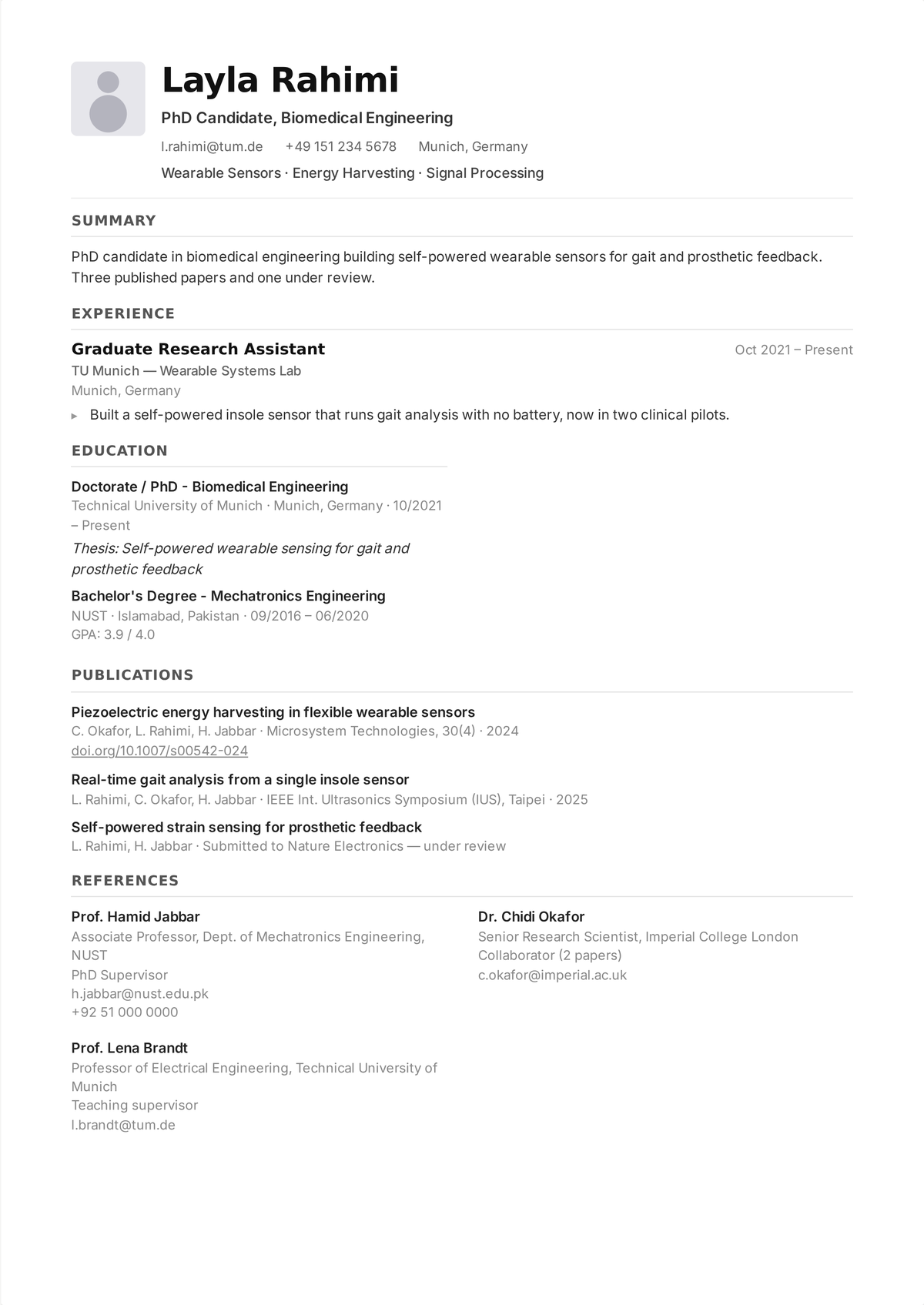
Here is how a clean, well-grouped block looks for an engineering PhD:
Publications
*Peer-reviewed journal articles*
1. Okafor, C., Rahimi, L., & Jabbar, H. (2024). Piezoelectric energy harvesting in flexible wearable sensors. *Microsystem Technologies*, 30(4), 511–524. https://doi.org/10.1007/s00542-024-xxxx
2. Rahimi, L., & Jabbar, H. (2023). A low-power readout circuit for MEMS pressure sensors. *IEEE Sensors Journal*, 23(9), 9402–9411. https://doi.org/10.1109/JSEN.2023.xxxx
*Peer-reviewed conference papers*
3. Rahimi, L., Okafor, C., & Jabbar, H. (2025). Real-time gait analysis from a single insole sensor. *IEEE International Ultrasonics Symposium (IUS)*, Taipei.
*Under review*
4. Rahimi, L., & Jabbar, H. Self-powered strain sensing for prosthetic feedback. Submitted to *Nature Electronics*, under review.
When you have one paper, or none yet
Most PhD students in their first two years have a short list, and that is expected. Three moves help. Include conference posters and abstracts under a clearly labelled "Presentations" heading so the section is not empty. List manuscripts in preparation honestly as "in preparation" if the work is genuinely underway. And put a Google Scholar and ORCID link in your header so a reader can confirm the record themselves — ORCID is the persistent researcher ID most journals and funders already use, so committees know exactly what to do with it. A short, honest, correctly formatted list reads far better than a padded one.
How to highlight the publications that matter
A committee skims the list, then looks closer at the entries that stand out. Help them by surfacing the signals that carry weight, without inflating anything:
- Authorship position. Bolding your name already shows it. If most of your output is first-author, that pattern speaks for itself.
- Venue quality. A respected journal or a top conference in your field is its own credential; the venue name does the work, so cite it accurately.
- Citations, used carefully. If a paper has genuine traction, a quiet "(cited 40+ times)" after the entry is fair. Skip it for everything else.
- Awards on a paper. "Best Paper, [Conference] 2024" belongs right on the entry.
Compare a weak line with one that gives a committee something to hold onto:
Before: Published a paper about wearable sensors that did quite well. After: Rahimi, L., et al. (2024). "Piezoelectric energy harvesting in flexible wearable sensors." *Microsystem Technologies* 30(4): 511–524. (first author; Best Paper, IEEE IUS 2024)
The references section: choose well, format clearly
References on an academic CV are usually listed in full, not held back with "available on request". Committees expect three to five referees, and who you list says as much as what they will write. Choose people who know your research closely: your PhD supervisor first, then a thesis committee member, a collaborator on a published paper, or a professor who supervised your teaching.
For each referee, give enough that the committee can reach them and understand the connection:
- Full name and title (Prof., Dr.)
- Position and institution (and department)
- Email, and a phone number if the referee is comfortable with it
- Relationship to you — one line, so the committee knows the angle each reference brings
A clear references block:
References
Prof. Hamid Jabbar — PhD Supervisor
Associate Professor, Department of Mechatronics Engineering, NUST
h.jabbar@nust.edu.pk · +92 51 000 0000
Dr. Chidi Okafor — Collaborator (co-author, 2 papers)
Senior Research Scientist, Imperial College London
c.okafor@imperial.ac.uk
Prof. Lena Brandt — Teaching Supervisor
Professor of Electrical Engineering, TU Munich
l.brandt@tum.de
Two rules make references actually work for you. Ask every referee before you list them, and send them your CV and the post you are applying for so their letter can speak to it. And keep the contact details current — a bounced email to a referee can quietly sink an application.
"Available on request" — when it is fine
For an academic post, list referees in full; it is the norm and it saves the committee a step. The "available on request" line is acceptable on a shorter industry-facing CV where space is tight and references are taken up later in the process. If you use it, have the same three to five people briefed and ready.
Turning your academic CV toward industry
When you leave academia, the same material gets re-pointed. The committee-facing CV becomes a two-page resume for a hiring manager and an ATS. Publications do not disappear, but they compress: a "Selected Publications" line with three or four of your strongest, plus a Google Scholar link, instead of the full list. The dissertation becomes one line that names the problem and the result in plain terms. Methods and software move up into a prominent skills section, because that is what an industry reader scans for. Pick a single-column, ATS-friendly resume template for this version so the text extracts cleanly, and keep the full academic CV as a separate document for academic applications.
Build both versions from one profile in Prezumi
Prezumi keeps one profile and renders it into whatever the application needs. Your publications and references live as their own sections — import them straight from an existing CV and they are parsed into structured entries you can edit, reorder, and reuse. The resume templates that support these sections (minimal, plain, and glass) render them cleanly and export to an ATS-friendly PDF for free, so a recruiter's parser and a hiring committee both read them in the right order. When you need to tailor wording for a specific post, the AI editor rewrites a summary or a publication line in plain language while you watch the page update. Start from your existing CV, fix the formatting once, and keep both the long academic version and the tight industry version in sync.
FAQ
Should I list references on an academic CV or write "available on request"?
For academic positions, list three to five referees in full with their titles, institutions, emails, and relationship to you — committees expect it. "Available on request" is acceptable only on a shorter industry-facing CV where references are collected later in the hiring process. Either way, ask each referee first and send them the job posting.
How do I list a publication that is not published yet?
State its exact status on the entry. Use "under review at *Journal Name*", "accepted, in press", or "preprint" with a link. List work that is genuinely underway as "in preparation". Never format an unpublished manuscript as though it appeared in a journal — committees check, and one inflated entry undermines the whole list.
How long should a PhD student's academic CV be?
As long as the record honestly fills, with no padding. A first- or second-year PhD often runs two pages; later-stage students and postdocs run four to six as publications and teaching accumulate. Length is not a virtue on its own — completeness and accurate formatting are what the committee reads for.
Do academic CVs need to be ATS-friendly?
Not for academic search committees, who read the document themselves. But the moment you apply to industry, a company lab, or anything that routes through an applicant tracking system, you need a single-column version whose text extracts cleanly. Run that version through an ATS resume checker, since multi-column academic layouts and footnote-sized publication lists frequently break parsing.
Where do I put my Google Scholar and ORCID links?
In the header, next to your email, so a reader can verify your publication record in one click. They also help when your printed list is short — a committee can see the full, current record even if your CV shows only selected work.