Student CV Examples — 3 Full Samples, Including No Experience
Three full student CV examples and sample CVs for students — no experience, business, and computer science — with the right section order and a free template.
A student CV holds, in this order: contact details, a two- or three-line summary, education, projects and activities, work experience if you have any, and a short skills section. Education goes first because your degree is currently your strongest credential. Projects and activities go next because they're the closest thing you have to a track record. Part-time jobs come after that, and the whole thing fits on one page.
Below are three full, annotated examples for the three situations students actually write for: no work experience at all, a business student chasing an internship, and a computer science student applying for a placement. Each one is a real CV rendered from the same builder, so you can see the format, not just read about it. If you graduated with Latin honors, our guide on where summa cum laude goes on a CV shows how to list it, and the general rules behind all three examples — section order, bullets, tailoring, ATS — are collected in our resume writing guide.
The thread running through all three: a student CV is judged on signals of *potential*, and students badly underrate what counts as evidence. A society committee role, a course project with a real dataset, a fundraiser, an exchange semester, a summer in retail — all of it is usable when you write it with a number and an outcome. None of these students invented experience. They described what they'd actually done, precisely.
Example 1 — A student CV with no work experience
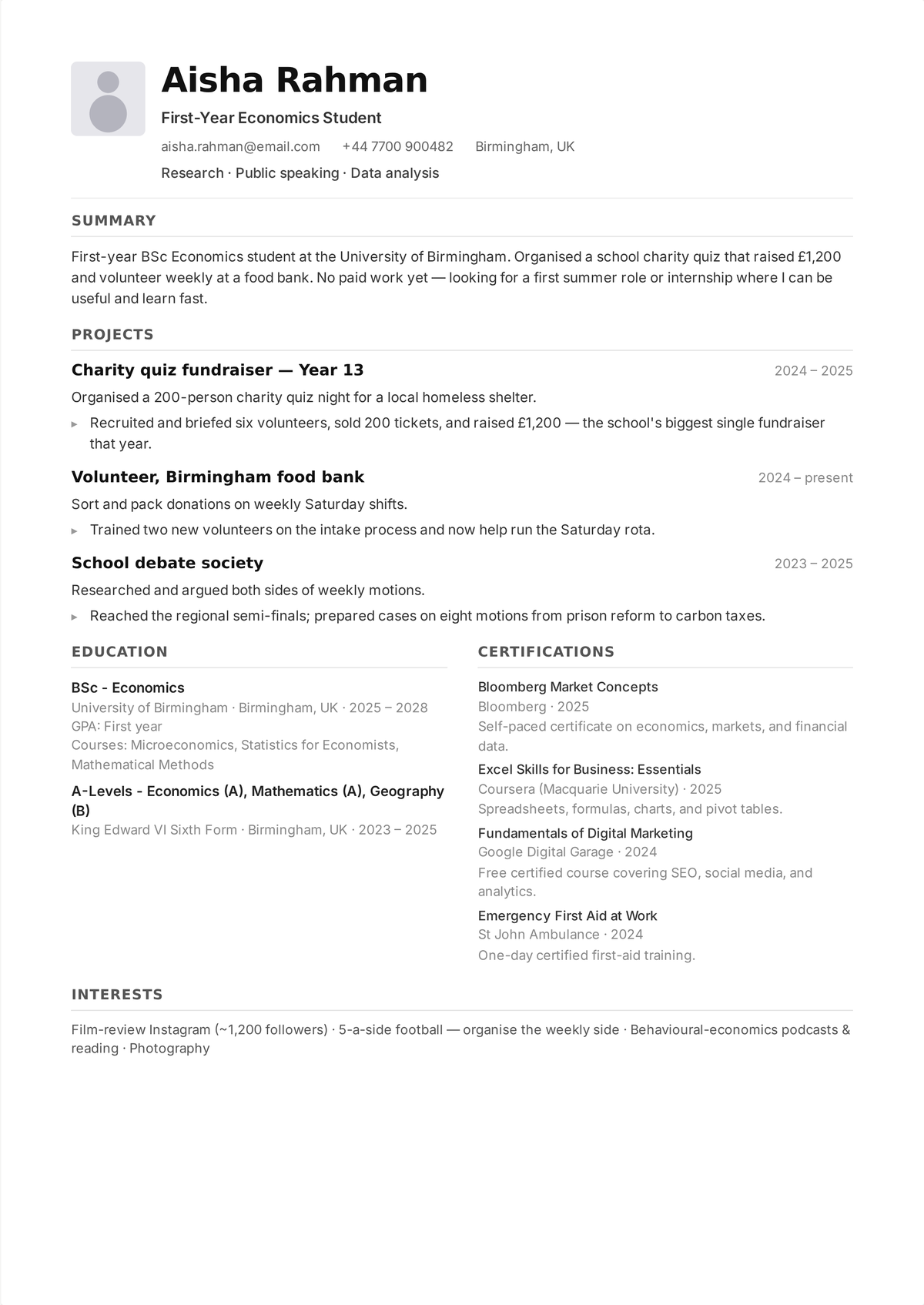
This is the one most people are looking for. Aisha is a first-year economics student who has never had a paid job. Her CV is built entirely from school, a fundraiser, and volunteering — and it still reads as full, because every line has a scale and a result.
Aisha Rahman
Birmingham, UK · aisha.rahman@email.com · +44 7700 900482 · linkedin.com/in/aisha-rahman
Summary
First-year BSc Economics student at the University of Birmingham. Organised a school charity quiz that raised £1,200 and volunteer weekly at a food bank. No paid work yet — looking for a first summer role or internship where I can be useful and learn fast.
Projects and activities
Charity quiz fundraiser — Year 13 (2024–2025)
- Recruited and briefed six volunteers, sold 200 tickets, and raised £1,200 — the school's biggest single fundraiser that year.
Volunteer, Birmingham food bank (2024–present)
- Trained two new volunteers on the intake process and now help run the Saturday rota.
School debate society (2023–2025)
- Reached the regional semi-finals; prepared cases on eight motions from prison reform to carbon taxes.
Education
BSc Economics, University of Birmingham — 2025–2028 (first year)
Relevant modules: Microeconomics, Statistics for Economists, Mathematical Methods
A-Levels — King Edward VI Sixth Form — Economics (A), Mathematics (A), Geography (B)
Certifications & courses
Bloomberg Market Concepts (2025) · Excel Skills for Business, Coursera (2025) · Fundamentals of Digital Marketing, Google Digital Garage (2024) · Emergency First Aid, St John Ambulance (2024)
Skills
Excel (charts, formulas) · Google Sheets · PowerPoint · Public speaking · Python (beginner)
Languages
English (native) · Urdu (conversational)
Interests
Film-review Instagram (~1,200 followers) · 5-a-side football · behavioural-economics podcasts · photography
What makes it work with no job history:
- Lead with a posture, not an apology. The summary is honest about the no-experience part and turns it into one — useful, fast learner — while still naming the degree and a number (£1,200).
- Write activities like jobs. The fundraiser carries how many volunteers, how many tickets, and how much money — a project with a budget and a team, which is exactly what early roles are.
- Volunteering counts. Say what you did, not just that you showed up: "now help run the Saturday rota" shows she was trusted.
- Fill the page with the sections others skip. Certifications and free online courses (Google's Digital Garage, Bloomberg Market Concepts), a couple of languages, and two or three specific interests do the work a job history normally would — and a free course you finished on your own proves exactly the initiative a first employer is screening for.
- Keep your latest grades. A-levels stay because she's a first-year — they're her most recent completed qualification. By second year, they come off.
Always put a LinkedIn URL in the header. It's the one link a recruiter actually clicks on a junior CV. A filled-in profile — a photo, the same history, a recommendation or two — turns a thin CV into a real person; a missing or empty one quietly raises the question of why. Keep the URL clean (set a custom one in your LinkedIn settings) and make sure the profile says the same thing the CV does.
No experience? List activities and projects as their own section — placing it above education is fine, but never leave a bare "work experience" heading with nothing under it. An empty experience section advertises the gap. A full projects section hides it.
Build yours as you read: start from a free, ATS-friendly template — every one is single-column and parser-tested — and drop your own projects and activities into the same structure.
Example 2 — Business student, marketing internship
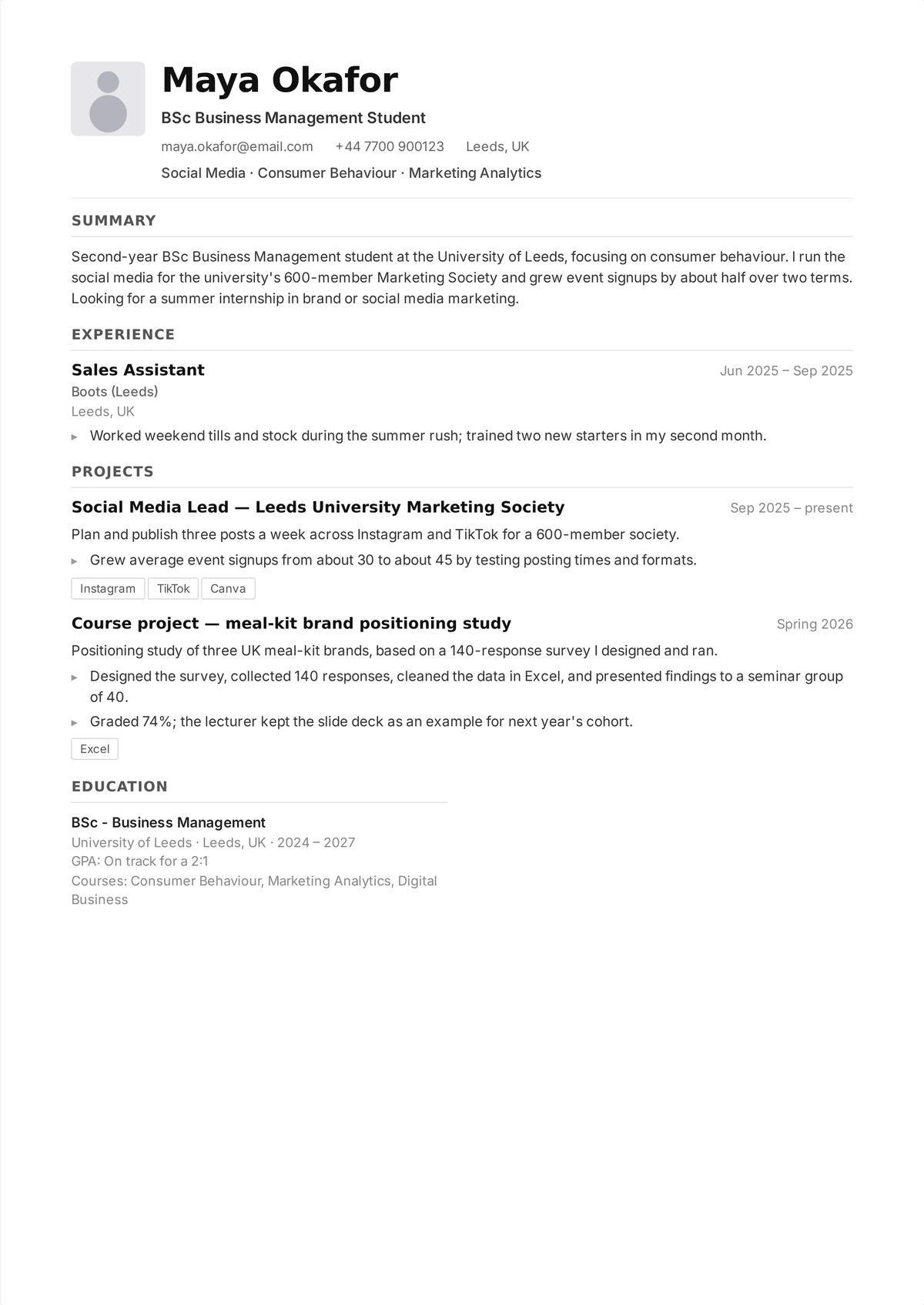
Maya is a second-year business student applying for a summer marketing internship. She has one retail job, but her society role and a course project do most of the work.
Maya Okafor
Leeds, UK · maya.okafor@email.com · linkedin.com/in/maya-okafor
Summary
Second-year BSc Business Management student at the University of Leeds, focusing on consumer behaviour. I run the social media for the university's 600-member Marketing Society and grew event signups by about half over two terms. Looking for a summer internship in brand or social media marketing.
Projects and activities
Social Media Lead, Leeds University Marketing Society — Sep 2025 to present
- Plan and publish three posts a week across Instagram and TikTok for a 600-member society.
- Grew average event signups from about 30 to about 45 by testing posting times and formats.
Course project: meal-kit brand positioning study — Spring 2026
- Designed a survey, collected 140 responses, cleaned the data in Excel, and presented to a seminar group of 40. Graded 74%.
Work experience
Sales Assistant, Boots (Leeds) — Jun to Sep 2025
- Worked weekend tills during the summer rush; trained two new starters in my second month.
Skills and languages
Excel (pivot tables, lookups) · Canva · Instagram and TikTok analytics · French (B1)
The moves worth copying:
- The summary names the degree, the year, one number, and the target role. A recruiter learns who Maya is in three lines.
- The society role is written like a job — a cadence (three posts a week) and a result (signups up by half). Committee roles earn that treatment when you describe what you did, not the title.
- The retail job gets one line and still earns its place. Training new starters says more about reliability than any adjective.
Example 3 — Computer science student, placement
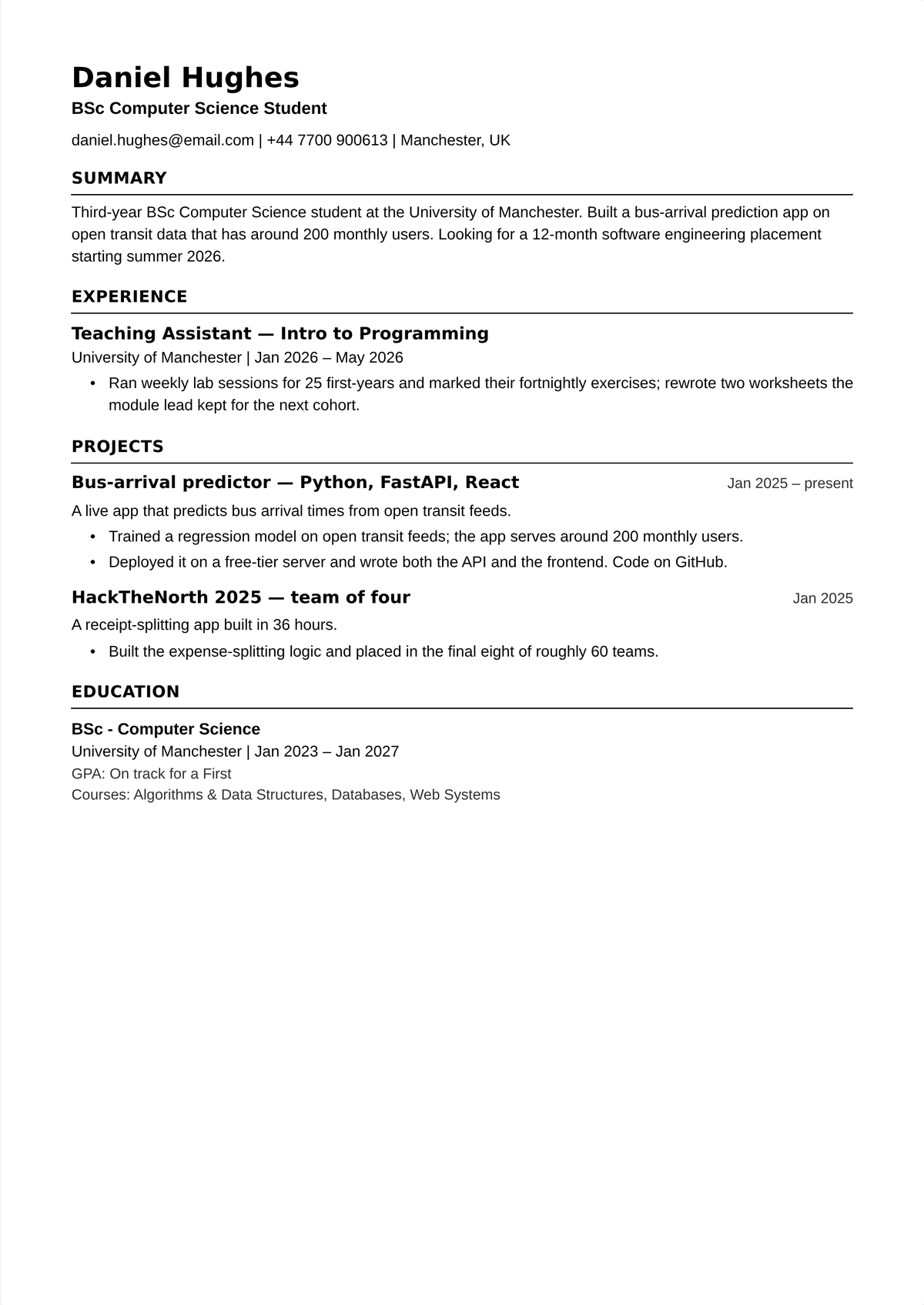
Technical CVs follow the same order, but the projects section does more of the work and every project gets a public link. Daniel is a third-year computer science student applying for a 12-month placement.
Daniel Hughes
Manchester, UK · daniel.hughes@email.com · github.com/danhughes · linkedin.com/in/danielhughes
Summary
Third-year BSc Computer Science student at the University of Manchester. Built a bus-arrival prediction app on open transit data that has around 200 monthly users. Looking for a 12-month software engineering placement starting summer 2026.
Projects
Bus-arrival predictor — Python, FastAPI, React (2025–present)
- Trained a regression model on open transit feeds; the app serves around 200 monthly users.
- Deployed it on a free-tier server and wrote both the API and the frontend. Code on GitHub.
HackTheNorth 2025 — team of four
- Built the receipt-splitting logic in 36 hours; placed in the final eight of roughly 60 teams.
Experience
Teaching Assistant, Intro to Programming — Jan to May 2026
- Ran weekly labs for 25 first-years and marked fortnightly exercises.
Education
BSc Computer Science, University of Manchester — 2023–2027, on track for a First
Skills
Python · FastAPI · React & TypeScript · Git · SQL/PostgreSQL · Docker (basics)
The details worth copying: the stack is named inside each project title, every project has a scale figure even when it's small (200 users), and anything that runs gets a public link. Two hundred users isn't a startup, but it proves the thing exists and that someone besides the marker has used it. For technical students a portfolio matters as much as the CV — a project is more convincing as a screenshot and a working link than as two bullets. Prezumi builds a resume and a matching portfolio from one profile, so the bullets and the proof stay in sync; there are more examples of how students use it on the blog.
For a developer, GitHub is the CV behind the CV. A recruiter for any software role *will* open your profile, so link it in the header, pin the two or three repos you're proudest of, and make sure the projects on your CV are the ones they'll find there — each with a short readme that says what it does and how to run it. An active, tidy GitHub does more for a junior developer than another bullet point; an empty or abandoned one undercuts the CV. The same logic applies to a portfolio link: a working demo beats a description every time.
What to put when you have no experience
The honest secret of a first CV: you have more to work with than you think. A few sections do most of the heavy lifting.
What counts as experience
You don't need a payslip for something to belong on a CV. All of these are real, and all of them go in the projects-and-activities section:
- Course projects and your thesis — anything with a brief, a deliverable, and a grade.
- Volunteering — a food bank, a charity shop, a community group; regular commitment reads as reliability.
- Society and committee roles — treasurer, social-media lead, event organiser.
- Tutoring, mentoring, coaching — paid or not, it shows you can explain things and turn up.
- Fundraisers and events — a quiz night or a bake sale is a project with a budget and a team.
- Sports teams and clubs — captaincy, attendance, a full season's commitment.
- Part-time and seasonal work — retail, hospitality, babysitting, a paper round.
- Personal projects — a blog, an app, a small online shop, a channel with real numbers.
Skills you can honestly list (and where they come from)
Skip the generic "hard-working, team player." Name skills you can point to, and the thing that proves each one:
- From group projects — teamwork, splitting work, hitting a deadline with other people.
- From part-time work — reliability, customer service, handling money, staying calm under pressure.
- From your degree — research, data analysis, writing, a named tool (Excel, Python, SPSS, CAD).
- From running a society or event — organisation, budgeting, getting people to show up.
- From tutoring or presentations — explaining clearly, public speaking.
- Languages and tools — list the real level (French B1, Excel pivot tables); never "fluent" if you're not.
The sections that fill a thin page
With no work history, these are the sections that turn half a page into a full one — and each answers a question an employer is asking about someone untested:
- Certifications and free online courses. A first-aid or food-hygiene certificate, or a free course you finished — Google Digital Garage, HubSpot Academy, freeCodeCamp, a Coursera audit, Bloomberg Market Concepts — proves you go and learn things without being told to. List the title, the issuer, and the year.
- Relevant coursework. Name the three or four modules that map to the job; it shows you've already touched the work.
- Languages. List every second language with an honest level (native, fluent, conversational, or the exam grade). For customer-facing and international roles it's a real differentiator and the easiest section to under-sell.
- Interests. Two or three *specific* ones that carry a signal — "captain of the rowing club", "run a 1,200-follower film account" — never "reading, music, socialising."
- A LinkedIn URL. Put it in the header. It's the link a recruiter actually clicks, and a filled-in profile makes you a real, checkable person rather than a name on a page.
How to write each section
The summary
Three sentences: who you are (degree, year, university), one piece of evidence, and what you're applying for. Skip objective-statement filler like "seeking to leverage my skills" and name the target role plainly. Two more, for other fields:
- "Final-year Mechanical Engineering student at TU Delft, writing a thesis on low-cost wind turbine blades. Comfortable in MATLAB and SolidWorks after three design-build modules. Looking for a graduate role in renewable energy."
- "Second-year Psychology student at the University of Glasgow. Tutored GCSE maths for two years and run the statistics study group for my course. Applying for a summer research assistant position in the developmental psychology lab."
Turning coursework and activities into bullets
The pattern is what you did, at what scale, with what outcome. Grades, response counts, audience sizes, and team sizes all count as outcomes:
Before: Studied Marketing Analytics. After: Analysed a year of sales data for a case-study retailer in Marketing Analytics; final report graded 75%.
Before: Group project on sustainability. After: Led a four-person project auditing a café's packaging costs; our model showed an 18% saving and the owner kept the spreadsheet.
Before: Member of the Finance Society. After: Organised the Finance Society's autumn careers panel; booked four speakers and filled 90 of 100 seats.
Before: Part-time restaurant work. After: Waited tables on 20-cover Friday shifts for 14 months; given closing keyholder responsibility after six.
If a bullet has no number, ask what you could count: people, responses, hours, weeks, a percentage, a grade. One of those is almost always available.
Mistakes that sink student CVs
- Going to two pages. Keep it to one. You have a few years of material at most, and a second page usually means the first wasn't edited.
- Listing every module. Pick the three or four relevant to this application and leave the rest to your transcript.
- Getting the grade decision wrong. Include your average when it helps — a 2:1 or first in the UK, roughly a 3.5+ GPA in the US. If it's lower, leave it off and let projects talk, but prepare an honest interview answer.
- Burying projects under an irrelevant job. If your strongest evidence is a course project, it goes above the supermarket job, even when the job is more recent.
- A decorative template machines can't read. More than 90% of employers surveyed in Harvard Business School's Hidden Workers study use such systems to filter applications, and graphics-heavy templates are what trips them. Start from a clean resume template — the ATS-friendly set is built for clean parsing — and run the finished PDF through a free ATS resume checker that does real text extraction before you send anything.
First-job roles this CV works for
The structure above — education and activities first, one page, a plain template — is exactly what's expected for a first paid role. It works as-is for a retail or sales assistant, waiter or barista, kitchen or warehouse work, a care or support assistant, a receptionist or admin assistant, data entry, a call-centre or customer-service role, a delivery or events helper, and most internships and apprenticeships. Tailor the summary line to the specific role, keep the rest, and the CV reads as ready rather than empty. Most of these applications also ask for a short letter, and the free cover letter generator drafts one from your CV and the job description.
If you're heading into a specific profession rather than a general first job, a targeted guide gets you closer. Education students moving into the classroom, for instance, can follow our teacher resume examples, which lead with certification and student teaching the way a first teaching job expects.
FAQ
What should a student CV include if I have no work experience?
Lead with education and projects: your degree and expected graduation date, three or four relevant modules, then course projects, your thesis topic, society and committee roles, fundraisers, hackathons, tutoring, and volunteering. Write each one with a concrete scale and outcome, the way you'd describe a job — see Example 1 above, which is built entirely without a paid job. Recruiters reading student CVs expect education to be the main section, so this looks normal rather than thin.
How do I write a CV as a first-year or high school student?
Same structure, with school doing more of the work. Keep your most recent completed qualification (A-levels, IB, or high school GPA) and add anything with a result attached: a prefect or club-leadership role, a sports team, a fundraiser, a personal project, volunteering. One page, no "references available on request," and a plain template a parser can read.
How long should a student CV be?
One page. A student rarely has more than a few years of relevant material, and recruiters spend roughly seven seconds on a first scan, so a second page mostly dilutes the first. If you're fighting for space, cut school-level achievements and long module lists before you cut project detail.
Should I put my grades on a student CV?
Include your grade average when it works in your favour: a 2:1 or first in the UK, or roughly a 3.5+ GPA in the US. If it's lower, leave it off the CV and put the weight on projects, but prepare a short honest answer for interviews. Individual module grades are worth listing only when one is unusually strong and directly relevant.
Is a student CV different from a student resume?
For students the difference is mostly vocabulary: "CV" in the UK and most of Europe, "resume" in the US and Canada, and the one-page student document is the same in both. The exception is the academic CV used for research and PhD applications, which runs longer and lists publications. For internships, placements, and part-time jobs, write the one-page version.
What skills should I put on a CV with no experience?
List skills you can point to evidence for, not generic adjectives. Pull them from what you've actually done: teamwork and deadline management from group projects; reliability and customer service from part-time work; research, writing, and a named tool (Excel, Python) from your degree; organisation and budgeting from running a society or event; public speaking from tutoring or presentations. Add languages and tools at their real level. The "what to put when you have no experience" section above breaks this down by source.
Should a student CV have a hobbies or interests section?
Only when an interest does real work — it shows a relevant skill, a genuine commitment, or something to talk about in an interview. "Captain of the university rowing club" or "run a 2,000-follower film-review account" earns its line; "reading, music, socialising" does not. If space is tight, cut it before you cut a project.
About the author
Zubair Baqai is an AI engineer and the founder of Prezumi. He started it after researching what gets candidates interviews at companies like Google, Meta, Microsoft and Amazon. He writes Prezumi's guides on resumes, ATS screening and CV formats. About Prezumi
Your job-search toolkit
Free tools for every step of a job application. No signup.
- Write a tailored cover letter — Upload your resume, paste the job description, pick a style, and get a cover letter matched to the role in under a minute.
- Turn your resume into a website — Convert your resume into a live personal website with a matching online resume and one shareable link for recruiters.
- Check if ATS can read your resume — Upload your PDF and get an instant score for text extraction, reading order, sections, contact info, and content strength.
- Write a resignation letter — Fill in your name, role, and last day, pick a tone, and get a clean, professional resignation letter to copy or download as a PDF.
- Convert to a Harvard resume — Reformat any resume into the Harvard career-services layout used by students and recent grads — preview instantly, download the PDF free.
- Translate your CV — Translate your resume between English, Spanish, German, French, Italian, Portuguese, Turkish, and Arabic — layout and dates kept intact.
- Fix weak resume wording — Find buzzwords, weak verbs, vague bullets, and missing metrics. Get a 0–100 wording score and stronger rewrites.
- Convert to a Europass CV — Turn any resume into the Europass-style format European employers expect — preview instantly, download the PDF free.
- Convert GPA & grades — Convert between US GPA, percentage, letter grades, UK honours, ECTS, and 10-point CGPA — and see if you graduated cum laude.