Nurse Resume Examples for Every Specialty and Level
Nurse resume examples from new-grad RN to nurse practitioner, across ICU, ER, pediatrics, and L&D, plus a copyable template, salary ranges, and skills to list.
A nurse resume has to clear two gates before anyone reads about your bedside manner: a current, unencumbered license for the state you're applying in, and the certifications the unit requires — BLS and ACLS at a minimum, plus specialty certs like PALS, NRP, CCRN, or TNCC depending on where you want to work. Hospital recruiters and the applicant tracking system in front of them screen for those first, so they belong at the top of the page. Below are nurse resume examples for every specialty and career stage, from a new-grad RN to a nurse practitioner, each linked to a live sample you can open, plus the skills, sections, and numbers that move a nursing resume past a parser and onto a nurse manager's shortlist.
The examples come first, then a text template you can copy, then the writing advice behind all of them — licensure, certifications, quantified patient-care results, a strong summary, and the keywords a hospital's hiring software looks for. The general rules that apply to any resume are collected in our resume writing guide; this page is the nursing-specific version.
How these examples were made. Each résumé below is a real Prezumi template rendered from a complete nursing profile — the same builder you'd use for your own — not a static mock-up. The names and numbers are illustrative. The licensure, certification, and salary guidance reflects how U.S. hospital hiring commonly works; requirements differ by state, facility, and country, so check your local board of nursing and the posting before you copy anything wholesale.
Nurse resume examples by specialty and level
Nursing is not one job. A new-grad on a med-surg floor and a nurse practitioner running their own clinic share a license and almost nothing else about their shift, and their resumes should look as different as their units do. Each example below is a real resume rendered in a clean, ATS-friendly Prezumi template — so you can see the exact format for your specialty and experience level and then build your own from the same structure. Click any example to enlarge it, or use it as your starter profile with one tap.
New-graduate registered nurse (entry level)
A new-grad RN resume has a specific problem: you have a license and almost no paid nursing experience yet, so the resume has to make your clinical rotations carry the weight. This one leads with the RN license and NCLEX-RN pass, then treats each clinical placement as a real experience entry — the unit, the hours, the patient population, and the skills you practiced under a preceptor. It names the day-one competencies a nurse manager looks for in a new grad: medication administration, charting in an EHR like Epic or Cerner, patient assessment, and safe patient handling. Your BSN or ADN, your GPA if it's strong, and any externship or nurse-tech work round it out.
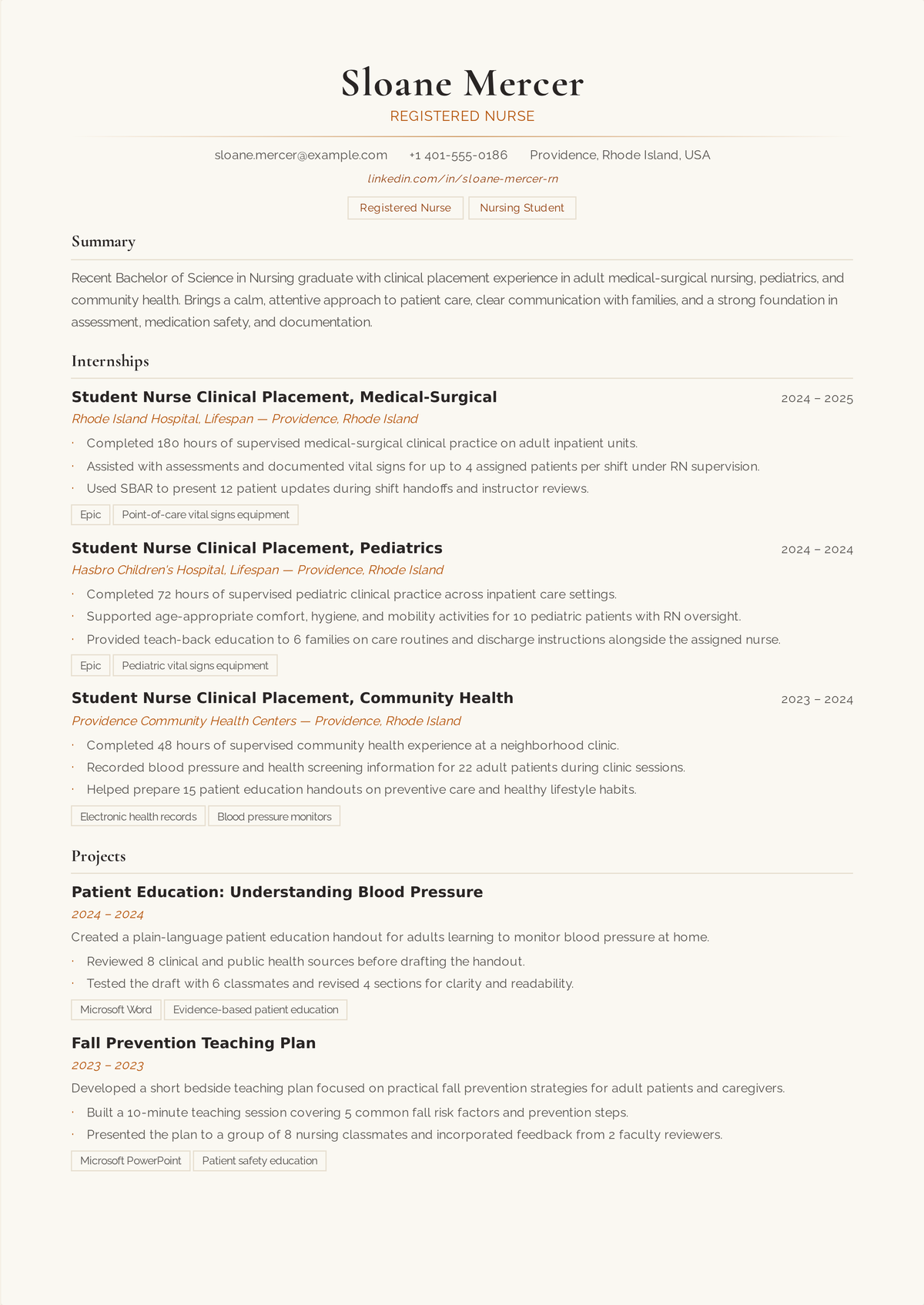
Why this resume works
- The active RN license, state, and NCLEX-RN pass sit in the first three lines, the hard gate every hospital posting checks first.
- Clinical rotations are written as experience — unit, hours, patient population, and skills practiced — not buried in an education footnote.
- It names the competencies a nurse manager expects on day one: medication administration, EHR charting, patient assessment, and infection control.
- An externship, nurse-tech role, and BLS certification stand in for a thin work history, which is exactly right for a first nursing job.
Medical-surgical / staff RN (new to mid-career)
Med-surg is where most nurses prove they can carry a full assignment, and this resume shows it. It foregrounds a typical patient load — four to six patients a shift on a busy floor — and the throughput that proves competence: admissions and discharges handled, interdisciplinary rounds, patient teaching before discharge, and the documentation that keeps a unit compliant. The numbers here are patient-satisfaction scores, fall and pressure-injury rates kept low, and readmissions avoided, because med-surg is measured on safe, high-volume care.
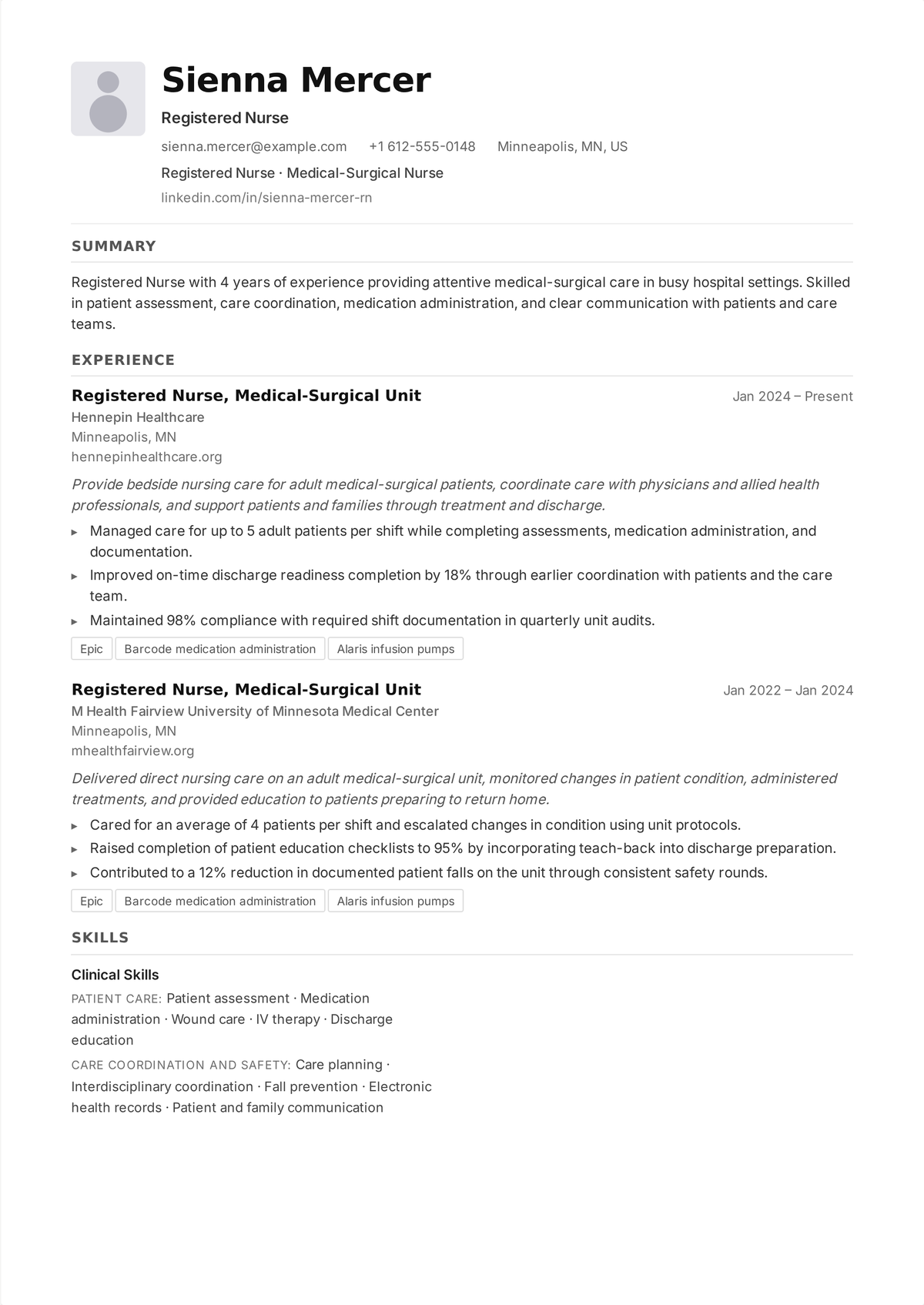
Why this resume works
- It states the patient ratio plainly — four to six patients a shift — so a nurse manager sees the load the nurse already carries.
- Duties become outcomes: fall rates, pressure-injury rates, and 30-day readmissions written as real numbers rather than "provided patient care."
- It shows the full cycle a med-surg nurse owns, from admission assessment through discharge teaching and follow-up.
- It stays ATS-clean, with standard headings and the unit's own terms — telemetry, PCA pumps, wound care, Epic — that a parser filters on.
ICU / critical-care nurse (mid-career)
An ICU resume has to signal that you can manage the sickest patients in the building, so it leads with critical-care certification (CCRN) and the technology the unit runs on: ventilators, continuous renal replacement, vasoactive drips titrated to hemodynamics, and arterial and central lines. This one shows a one-to-one or one-to-two ratio, rapid-response and code participation, and the judgment that critical care rewards — catching a deteriorating patient early. The numbers are ventilator days, CLABSI and CAUTI rates held at zero, and successful rapid-response interventions.
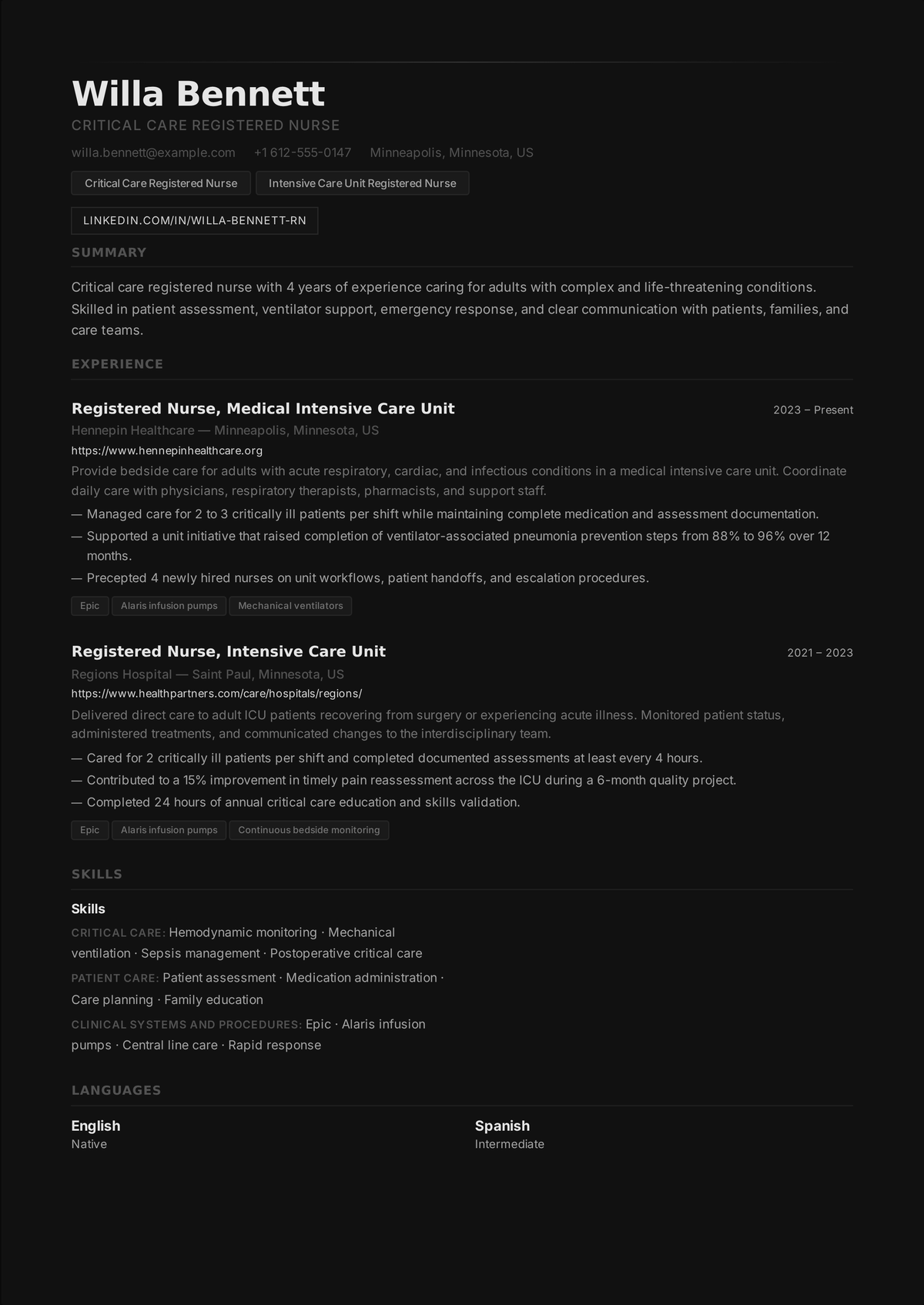
Why this resume works
- It leads with CCRN and the critical-care skill set — ventilators, CRRT, titrated vasoactive drips, invasive lines — that an ICU posting screens for first.
- It names the ratio (1:1 or 1:2) so the acuity of the assignment is obvious at a glance.
- Safety outcomes carry the page: zero CLABSI and CAUTI across a measured period, and successful rapid-response and code interventions.
- It shows the judgment the unit values — early recognition of deterioration — with a concrete example rather than a claim.
Emergency / ER nurse (mid-career)
An ER resume is about triage, speed, and range. This one leads with TNCC and ENPC or CEN certification, then shows the work: triaging to the Emergency Severity Index, running trauma and stroke and STEMI protocols, starting IVs and drawing labs fast, and moving patients through a department under constant pressure. The numbers that matter here are door-to-triage and door-to-provider times, throughput on a high-volume shift, and the breadth of acuity handled from a stubbed toe to a full code in the same hour.
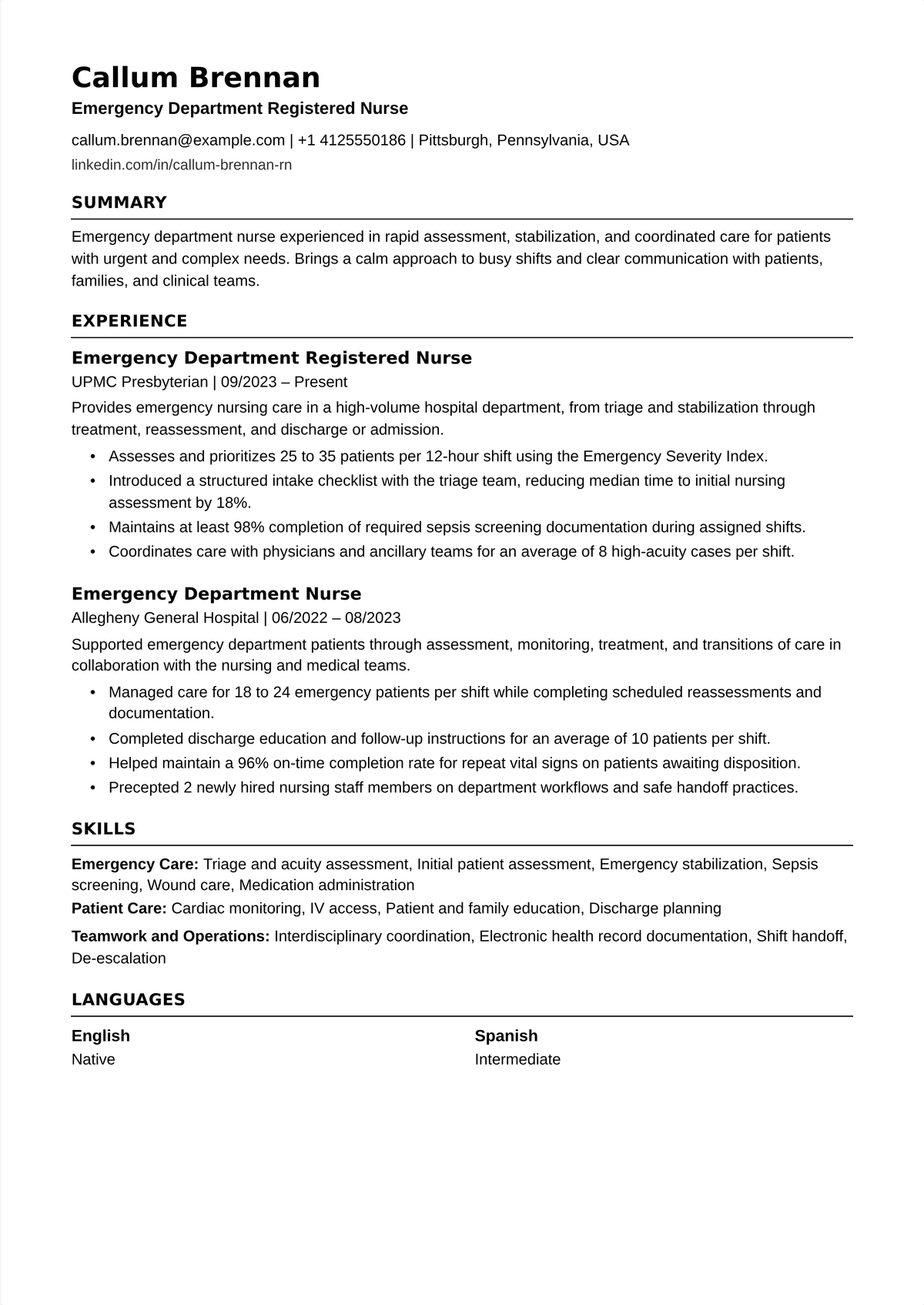
Why this resume works
- It foregrounds emergency certifications — TNCC, ENPC, CEN — and ESI triage, the competencies an ER posting checks for first.
- It names the protocols the role runs on: trauma activation, stroke and STEMI alerts, sepsis bundles, and rapid IV access.
- Throughput is quantified — door-to-triage and door-to-provider times, patients per shift — because the ER is measured on flow.
- It shows range across acuity, from fast-track complaints to resuscitation, which is the ER's defining skill.
Pediatric nurse (mid-career)
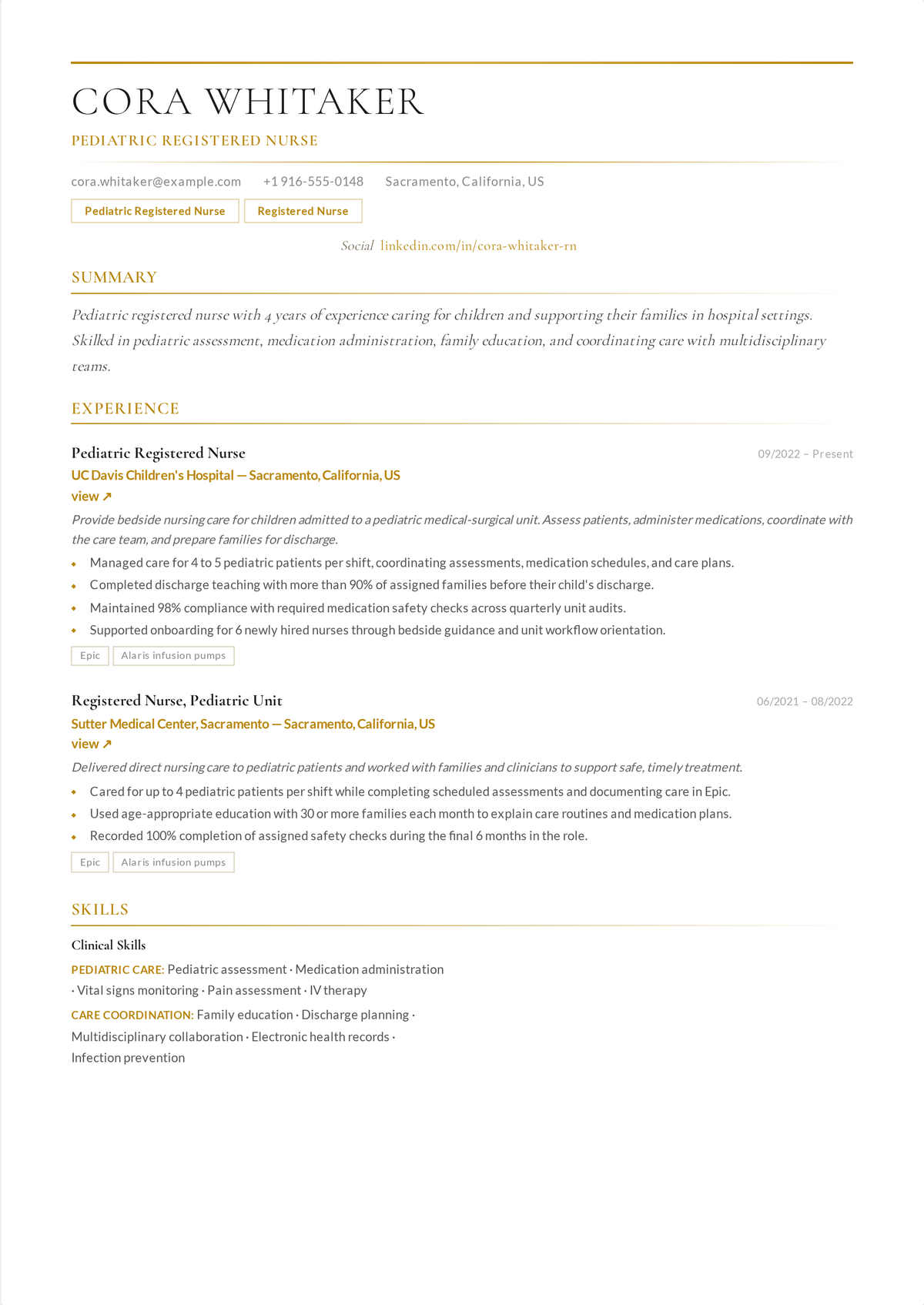
A pediatric resume shows that you can care for children and partner with their parents at the same time. This one leads with PALS certification and the weight-based, developmentally appropriate care peds demands: dosing by kilogram, age-specific assessment, atraumatic care techniques, and family-centered communication. The numbers here are immunization and screening rates, pain scores managed, and the parent-education and discharge-teaching that keep a child out of the hospital after they go home.
Why this resume works
- It leads with PALS and the peds-specific skill set — weight-based dosing, age-appropriate assessment, atraumatic care — that a children's unit screens for.
- It shows the family partnership the role runs on: parent education, discharge teaching, and communicating with a frightened child's caregivers.
- Outcomes are measured in pediatric terms: pain scores managed, immunization and screening rates, and readmissions avoided.
- It names the systems and tools a peds posting looks for, from pediatric early-warning scores to safe double-check medication protocols.
Labor & delivery nurse (mid-career)
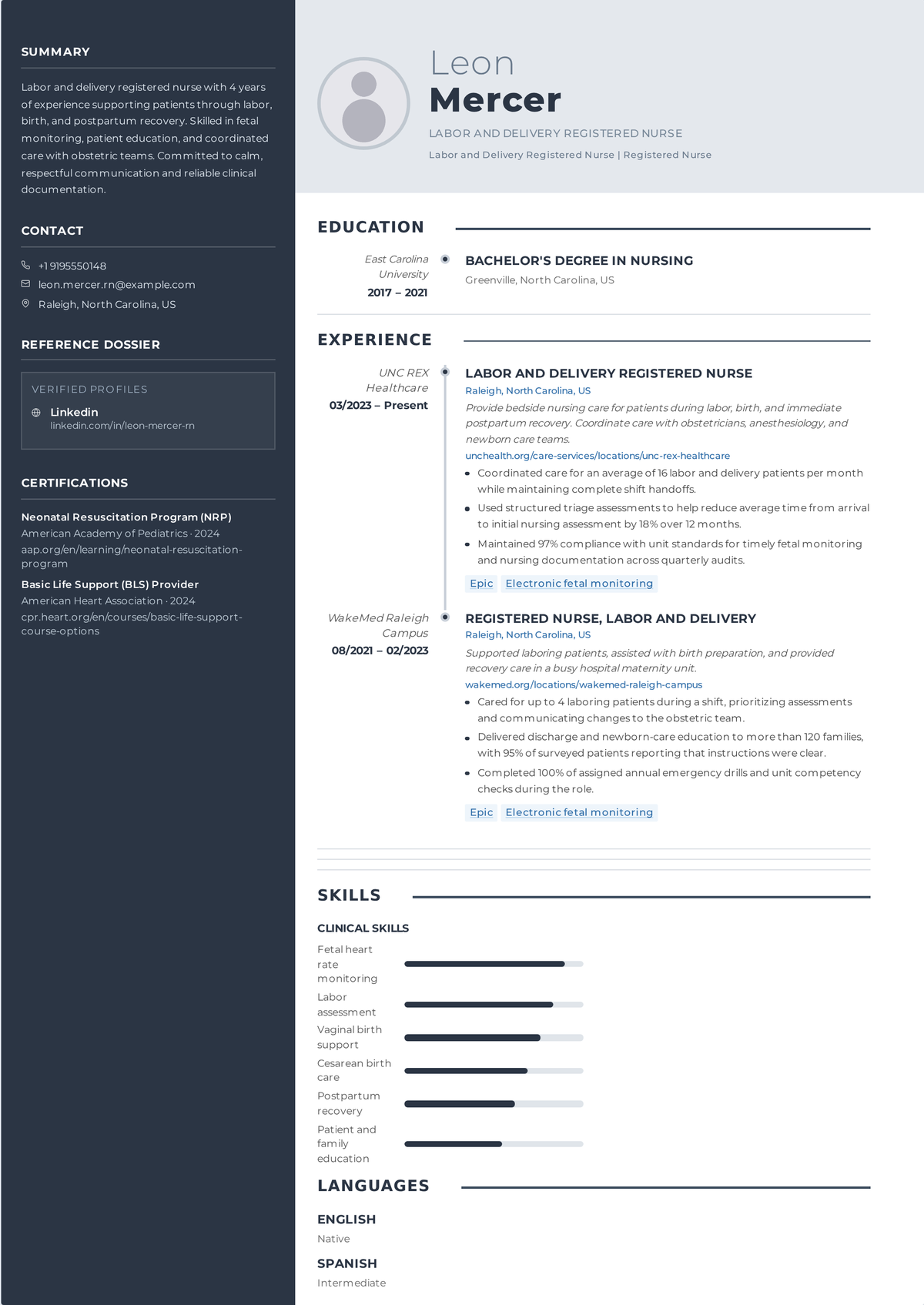
A labor-and-delivery resume covers two patients at once — mother and baby — and this one reads that way. It leads with electronic fetal monitoring competency and NRP certification, then shows the work: supporting patients through labor, assisting vaginal and cesarean deliveries, immediate newborn care and resuscitation, and recognizing obstetric emergencies like postpartum hemorrhage or shoulder dystocia early. The numbers are deliveries supported, newborn Apgar outcomes, and the breastfeeding and discharge teaching that set up the first week at home.
Why this resume works
- It leads with electronic fetal monitoring and NRP, the certifications an L&D posting screens for before anything else.
- It shows the dual-patient scope clearly: labor support, delivery assistance, and immediate newborn care and resuscitation.
- It names the emergencies the role trains for — postpartum hemorrhage, shoulder dystocia, fetal distress — and the early recognition that defines a strong L&D nurse.
- Outcomes are concrete: deliveries supported, newborn outcomes, and breastfeeding and discharge education that reduce readmission.
Nurse practitioner (senior)
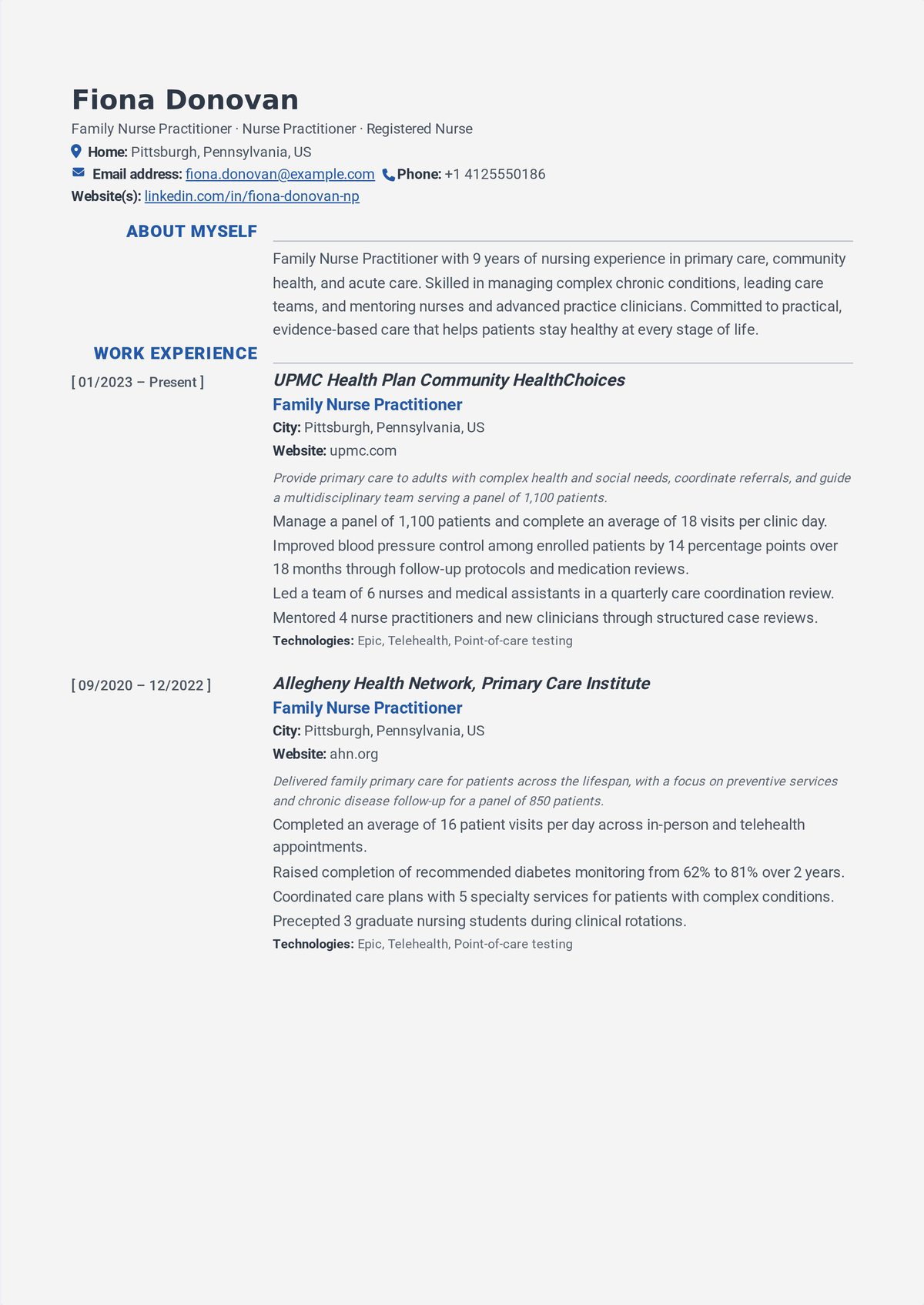
A nurse practitioner's resume crosses from bedside nursing into diagnosis and prescribing, so it reads more like a clinician's. It leads with the APRN license, national board certification (such as FNP-C or AGACNP-BC), DEA registration, and prescriptive authority, then shows a managed patient panel: diagnosing and treating, ordering and interpreting diagnostics, prescribing, and running chronic-disease management. The numbers here are panel size, quality measures like blood-pressure or A1c control, and the access improvements an NP brings to a practice. If you're building the long clinical version, our academic CV guide covers how to list scholarly and precepting work.
Why this resume works
- It leads with the APRN license, national board certification, DEA registration, and prescriptive authority — the credentials a practice verifies first.
- It frames the role at provider scale: a managed panel, diagnoses made, diagnostics ordered and interpreted, and prescriptions written.
- Quality is measured the way value-based practices measure it: blood-pressure and A1c control, screening rates, and improved access.
- It shows the autonomy that separates an NP from an RN — independent visits, chronic-disease management, and collaborative care with physicians.
Not every nursing resume is for an RN role. Two more positions round out the picture — the licensed and support roles that many nursing careers start from, and that facilities hire for constantly.
Licensed practical nurse (LPN / LVN)
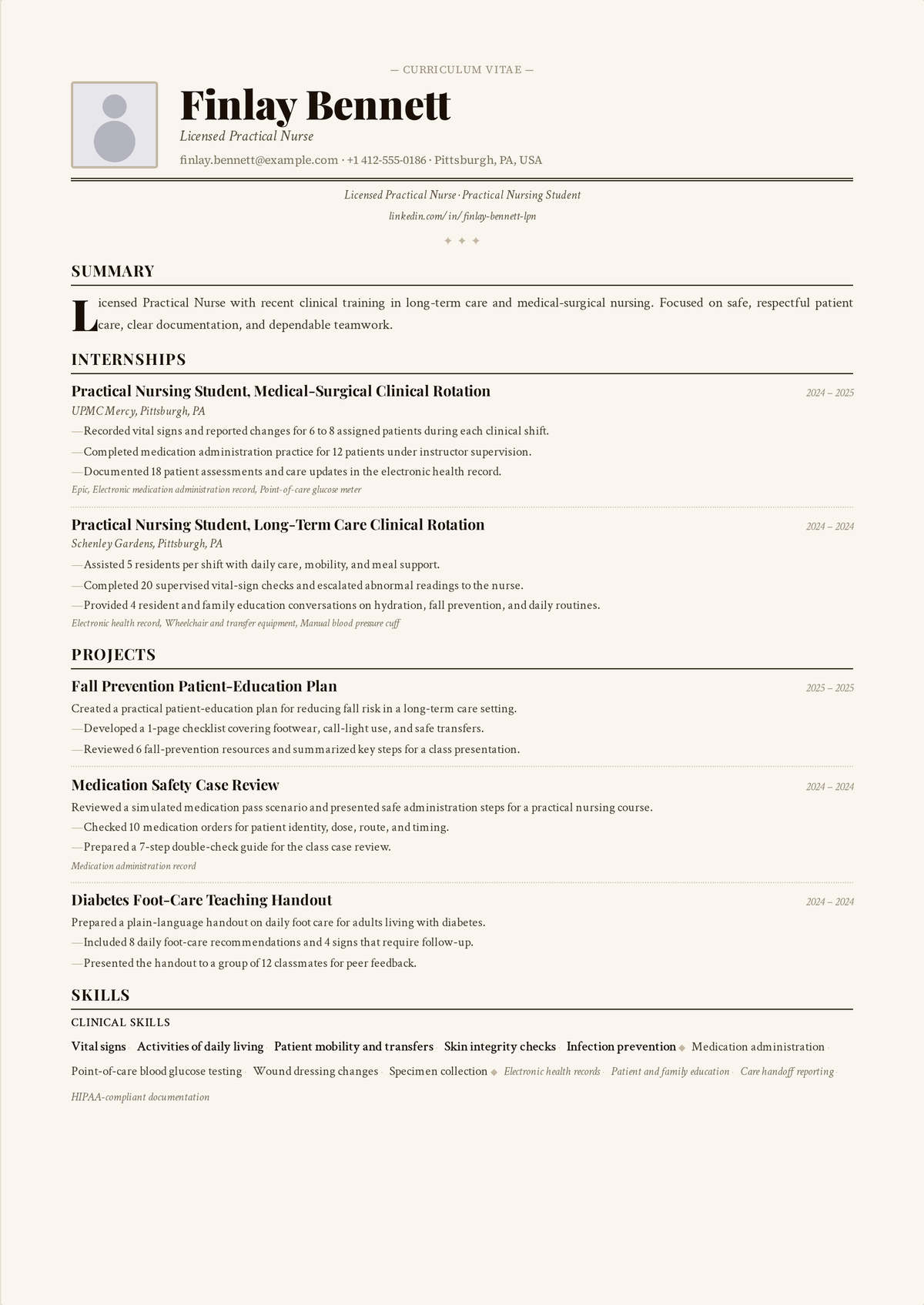
An LPN or LVN resume leads with the practical-nurse license and the scope that comes with it: medication administration, wound care, vital signs and routine assessments, and direct patient care under an RN or physician. It's a common role in long-term care, rehab, and clinics, so this one shows the patient population and the volume handled — residents cared for, treatments completed, and the documentation that keeps a facility compliant. Many LPNs are also working toward an RN, so the resume signals any bridge program in progress.
Why this resume works
- It leads with the LPN/LVN license and the clear scope of practice — medication administration, wound care, routine assessment — a facility screens for.
- It names the setting and volume: residents or patients cared for, treatments completed, and shifts covered in long-term care or clinic work.
- Duties become numbers — medication-pass accuracy, wound-healing outcomes, and documentation compliance — rather than a bare task list.
- It reads as a career in motion, signaling an LPN-to-RN bridge program in progress where one applies.
Certified nursing assistant (CNA) (entry level)
A CNA resume shows that you can deliver safe, compassionate direct care and free the nurses to nurse. This one leads with the CNA certification and the activities-of-daily-living work the role is built on: bathing, feeding, mobility and transfers, vital signs, and the careful observation that flags a change in a patient before it becomes a crisis. For many people it's the first step toward an LPN or RN, so the resume also signals the nursing coursework or program in progress.
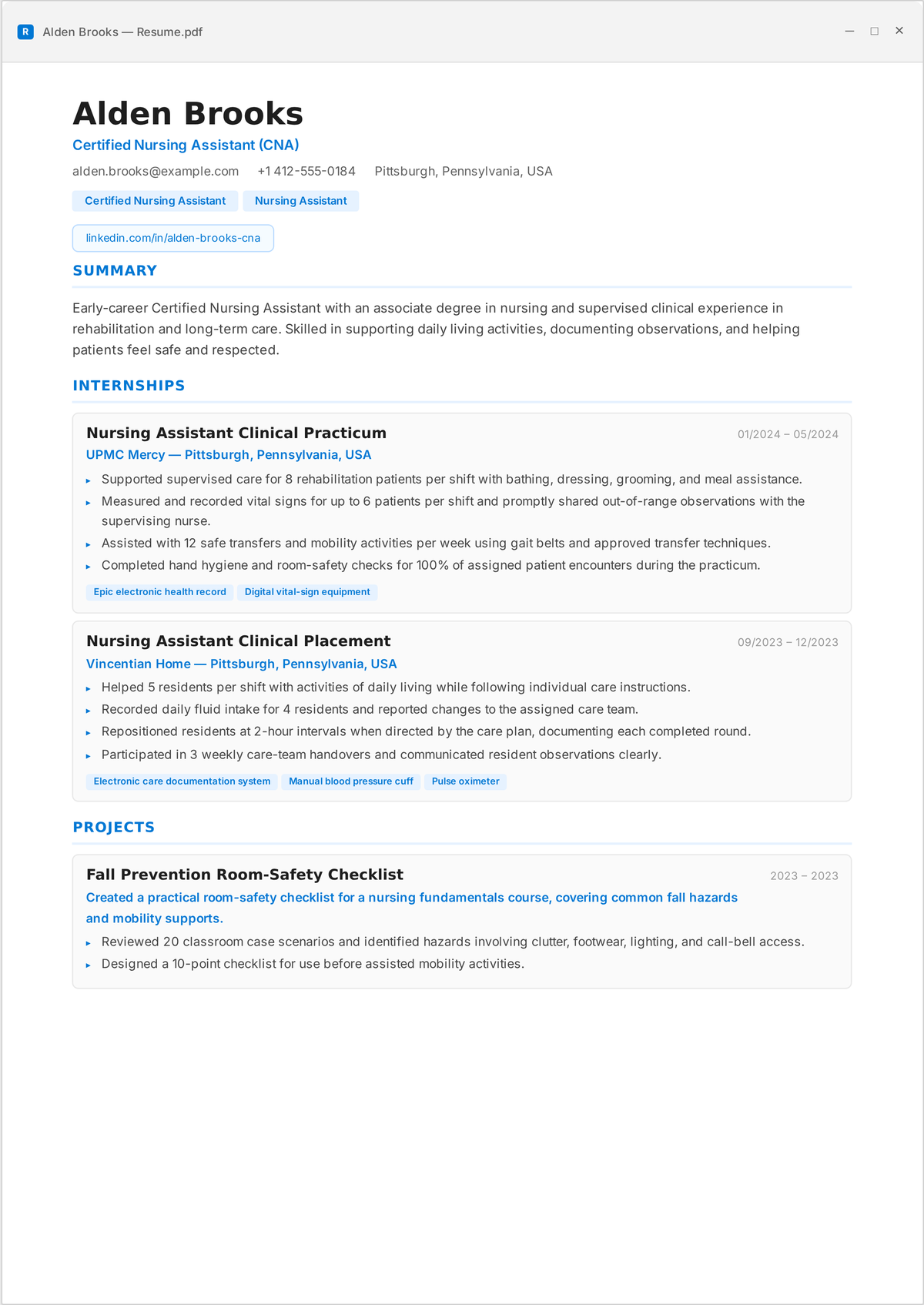
Why this resume works
- It names the CNA certification and state registry status up top, the gate a facility checks before scheduling a shift.
- It shows the core work concretely: activities of daily living, safe transfers and mobility, vital signs, and intake-and-output tracking.
- It backs the role with numbers — patients supported per shift, fall prevention, and observations escalated that caught a change early.
- It reads as a step on a path, signaling nursing coursework or an LPN/RN program in progress where it applies.
A nurse resume template you can copy
Here is a complete med-surg RN resume in plain text — single column, standard headings, real numbers. It's a template in the practical sense: swap in your own license, hospital, and results, and you have a resume a parser can read and a nurse manager can scan in seconds.
Marcus Reyes, RN, BSN
San Antonio, TX · marcus.reyes@email.com · (210) 555-0176 · linkedin.com/in/marcus-reyes-rn
Summary
Texas-licensed registered nurse (BSN) with four years on a 32-bed medical-surgical unit, carrying a 5-patient assignment on day shift. Kept the unit's patient-fall rate below the hospital benchmark for eight straight quarters and raised HCAHPS communication scores from the 60th to the 82nd percentile through structured bedside shift report. Seeking a med-surg or progressive-care role in a Magnet facility.
Licensure & certifications
Registered Nurse, Texas (Lic. #RN123456), active and unencumbered · BLS (AHA), current · ACLS (AHA), current · Med-Surg Certification (CMSRN) 2024
Experience
Registered Nurse, Medical-Surgical Unit — Methodist Hospital, San Antonio (2022–present)
- Carry a 5-patient assignment on a 32-bed unit; completed 600+ admissions and discharges a year with full assessment and discharge teaching.
- Held the unit fall rate below the hospital benchmark for 8 consecutive quarters by standardizing hourly rounding and bed-alarm checks.
- Precepted 6 new-graduate nurses through orientation, 5 of whom passed their 90-day review on the first attempt.
- Served on the unit practice council and rolled out a bedside shift-report change that lifted HCAHPS communication scores 22 points.
Registered Nurse, Telemetry — Baptist Medical Center, San Antonio (2021–2022)
- Monitored and managed up to 6 telemetry patients, recognizing and escalating 3 lethal arrhythmias that led to timely rapid-response activation.
Nurse Extern, Surgical Unit — University Health, San Antonio (Summer 2020)
- Supported RNs with assessments, vital signs, and post-op care for a 28-bed surgical floor under preceptor supervision.
Education
Bachelor of Science in Nursing (BSN), University of Texas Health San Antonio — 2017–2021
Skills
Medical-surgical nursing · Telemetry · IV therapy and venous access · Wound care · Patient and family education · Epic (EHR) · Bedside shift report · Fall and pressure-injury prevention
Languages
English (native) · Spanish (professional working proficiency)
What makes this one work: the license and certifications sit directly under the summary with their exact status, every experience bullet carries a number a manager could verify, and the two RN roles are stacked to show a clear progression. The layout is deliberately plain so an applicant tracking system extracts each field cleanly.
List the license in full: the exact title, state, and current status — "Registered Nurse, Texas, active and unencumbered." That's what tells a manager you're cleared to work. Add the license number only when an application specifically asks for it: it's a sensitive ID, and a resume gets uploaded to job boards and forwarded around, so there's no reason to publish it by default. Always confirm BLS and ACLS are current and dated — an expired card is the most common reason a qualified nurse's application stalls.
The skills to put on a nurse resume
Nursing skills fall into a handful of areas that hospitals screen for by name. List the ones the posting actually asks for, in its own words, and back the important ones with a bullet in your experience section rather than leaving them as a bare list. Mix clinical skills with the technology and soft skills a unit depends on.
| Skill area | What to put on the resume |
|---|---|
| Clinical / bedside | Patient assessment, medication administration, IV insertion, wound care, specimen collection |
| Specialty procedures | Ventilator and drip titration (ICU), fetal monitoring (L&D), triage and trauma protocols (ER) |
| Certifications | BLS, ACLS, PALS, NRP, TNCC, CCRN, CEN — list the ones your unit requires, with dates |
| EHR & technology | Epic, Cerner, Meditech, barcode medication administration, telemetry, infusion pumps |
| Patient safety & quality | Fall prevention, pressure-injury prevention, CLABSI/CAUTI reduction, medication reconciliation |
| Communication & teaching | Patient and family education, discharge teaching, interdisciplinary rounds, bedside shift report |
| Regulatory & compliance | HIPAA, infection control, Joint Commission standards, accurate and timely documentation |
Skip skill bars and star ratings. A screening tool reads "four stars in IV therapy" as nothing, and a nurse manager reads it as filler. A short, honest list of named skills plus one bullet that shows the skill in action does more than any graphic.
How to write each section of a nurse resume
Put licensure and certifications first
A nursing job has a hard gate: a current, unencumbered license for the state you're applying in, plus the certifications the unit requires. A recruiter, and the applicant tracking system in front of the recruiter, checks that before anything else, so give it a Licensure and Certifications section directly under your summary. List the license title, the state, and its status — "Registered Nurse, Ohio, active and unencumbered." Then list BLS, ACLS, and any specialty certifications with their issuing body and date: "ACLS (AHA), valid through 2027." If you hold a multistate (eNLC) license, say so — it tells an employer you can work across compact states. If your license is still pending, write "RN licensure expected June 2026 (NCLEX scheduled)" rather than leaving it off; a pending license is a very different thing from no license.
Turn patient care into numbers
"Provided care to patients" describes a shift. "Carried a 5-patient med-surg assignment and held the unit fall rate below benchmark for eight quarters" describes a nurse worth hiring. Nursing produces measurable results, and a resume that names them stands out in a stack that mostly doesn't. The numbers that carry weight: patient ratios and census, patient-satisfaction (HCAHPS) scores, infection and fall rates, readmissions avoided, and specialty metrics like ventilator days or door-to-provider times. Pull them from your unit's quality dashboards and your own shift data, write them as aggregates, and only claim what you can defend in an interview — "how did you track that?" is the obvious follow-up.
Before: Responsible for administering medications to patients. After: Administered medications to a 6-patient assignment with 100% barcode-scan compliance and zero reportable medication errors over two years.
Before: Helped reduce patient falls on the unit. After: Cut patient falls 40% on a 32-bed unit by standardizing hourly rounding and bed-alarm checks, holding the rate below benchmark for 8 quarters.
Write a summary that names your specialty and one result
Two or three sentences at the top: your license and specialty, your years of experience, and the single strongest result you can point to. "Texas-licensed RN (BSN) with four years in critical care; held zero CLABSI across a 16-bed ICU for two years" tells a manager more than a paragraph about your passion for helping people. Name the facility or unit you're applying to when you can — it signals you tailored the resume rather than sending the same file everywhere. Skip an objective statement about what you hope to gain; the summary describes what the unit gets.
Use the keywords the posting and the ATS scan for
Hospitals run applications through an applicant tracking system that parses your resume and matches it against the posting. Systems vary — some knock out a missing must-have certification, many just rank or flag candidates for a recruiter — but a parser-safe file written in the posting's own words gives you the best odds either way. Reuse the posting's exact language where it's honest: if it says "telemetry," "CCRN," "Epic," or "progressive care," use those terms rather than synonyms, and spell out an acronym once in full. Keep the layout parser-safe: single column, standard headings (Experience, Education, Licensure, Skills), a real-text PDF, no photo, no graphics boxing in your history. You can check what a parser actually pulls from your file with Prezumi's free ATS resume checker, and the ATS-friendly templates start you from a layout that already passes.
Nurse salary insights
Nursing pay is driven by specialty, setting, shift differential, and geography more than by negotiation, and it has risen sharply in high-acuity and hard-to-staff roles. The ranges below are illustrative U.S. figures meant to show how compensation shifts by role; your actual figure depends on state, facility, union contract, and years of service. For current national medians by role, the U.S. Bureau of Labor Statistics Occupational Outlook Handbook is the citable source.
| Nursing role | Typical U.S. salary range (illustrative) |
|---|---|
| Certified nursing assistant (CNA) | $32,000–$45,000 |
| Licensed practical nurse (LPN / LVN) | $48,000–$62,000 |
| New-graduate / staff RN | $65,000–$85,000 |
| ICU / ER / specialty RN | $78,000–$105,000 |
| Travel nurse (contract) | $90,000–$130,000+ |
| Nurse practitioner (APRN) | $110,000–$140,000+ |
Two things move these numbers within a facility: credentials and shift. A specialty certification like CCRN or CEN often earns a pay bump and makes you eligible for higher-acuity units, and night, weekend, and charge-nurse differentials add up fast. It's worth putting both on the resume — a specialty cert is a credential a manager recognizes on sight, and charge or preceptor experience shows you take on more than your own assignment.
Build your nurse resume in Prezumi
Prezumi holds your nursing history as one profile and renders it into any of 55+ templates, so you write the license, the certifications, and the results once. Import an existing resume to skip retyping, pick an ATS-friendly template that keeps a clean single column, and export a text-based PDF for free. When you apply to a specific unit, the AI editor rewords your real entries to match that posting (it can only reshape the details you entered, so it won't invent a patient-satisfaction score), and the ATS checker confirms the file parses before you send it. If you're a new graduate writing your first nursing resume, our first-job resume guide shows how to fill a resume with clinical rotations, externships, and coursework instead of years on the job, and the student CV examples use the same one-page approach. For the letter that goes with the application, the free cover letter generator works from your resume and the posting.
FAQ
Do I list my nursing license on a resume?
Yes, and near the top. A nursing job is gated on holding a current, unencumbered license for the state you're applying in, so a Licensure and Certifications section belongs directly under your summary. List the license title, the state, and its status — "Registered Nurse, Ohio, active and unencumbered" — then add BLS, ACLS, and any specialty certifications with their issuing body and expiration date. Add the license number only if the application asks for it; it's a sensitive ID that doesn't belong on a document you upload to job boards.
How do I write a new-grad nurse resume with no experience?
Treat your clinical rotations as your experience section, because that is exactly what they are. Give each placement a real entry with the unit, the hospital, the hours, the patient population, and the skills you practiced under your preceptor — medication administration, assessments, EHR charting, a procedure you assisted with. Add your NCLEX pass and license (or expected date), relevant coursework, and any externship, nurse-tech, or CNA work. Our first-job resume guide walks through filling a resume when you don't have years of paid work yet.
Which certifications should go on a nurse resume?
The ones your unit requires, dated and with the issuing body. BLS is universal; ACLS is expected for most hospital RN roles; then add the specialty certs the posting names — PALS and NRP for peds and L&D, TNCC and CEN for the ER, CCRN for critical care, and CMSRN for med-surg. List them in a dedicated Certifications section near the top, and make sure none have expired, since an expired card is the most common reason a qualified nurse's application stalls.
How long should a nurse resume be?
One page for new graduates and nurses with up to roughly ten years of experience; two pages are justified when a decade or more of directly relevant clinical work, certifications, and leadership genuinely fills them. Nurse practitioners and nurses with a research or academic record use a longer CV that lists scholarly work, precepting, and presentations in full. Keep it to real content — a nurse manager would rather see one dense, specific page than two padded ones.
Should a nurse resume include a photo?
No, for jobs in the US, UK, Canada, and most of Europe. Hospitals don't need a photo, many prefer applications without one to avoid bias, and a photo can trip up an applicant tracking system. A few countries do expect a photo on any CV; follow local convention if you're applying somewhere that clearly asks for one, but leave it off by default.
How do I show patient-care results with numbers?
Pull aggregate results from your unit's quality dashboards and your own shift data, and put them in your experience bullets. The numbers that carry weight are patient ratios and census, HCAHPS patient-satisfaction scores, fall and pressure-injury rates, infection rates like CLABSI and CAUTI, readmissions avoided, and specialty metrics like ventilator days or door-to-provider times. Never name an individual patient or include anything that could identify one — that breaks HIPAA and reads as a red flag. Only claim figures you can explain in an interview.
What skills should I put on a nurse resume?
The ones the posting names, in its own words. The core set most units screen for is patient assessment, medication administration, IV therapy, and wound care, plus the EHR you use (Epic, Cerner, Meditech), patient-safety practices like fall and infection prevention, and patient and family education. Specialty roles add their own — fetal monitoring for L&D, ventilator and drip management for the ICU, triage and trauma protocols for the ER. Back the important skills with a bullet that shows them in action rather than leaving them as a bare list, and skip skill bars.
How is an ICU nurse resume different from a med-surg one?
An ICU resume signals you can manage the sickest patients at a 1:1 or 1:2 ratio, so it leads with CCRN and critical-care technology — ventilators, titrated drips, invasive lines — and safety outcomes like zero CLABSI. A med-surg resume shows you can carry a full assignment of four to six patients safely and move them through admission, treatment, and discharge, so it foregrounds throughput, fall and readmission rates, and discharge teaching. The certifications differ too: CCRN for the ICU, CMSRN for med-surg.
Do I put my BSN or ADN, and my GPA, on a nurse resume?
List your nursing degree with the school and graduation year. Include your GPA only as a new graduate and only if it's strong (roughly 3.5 or above); after your first nursing job, your clinical experience carries the resume and the GPA comes off. If you're an ADN-prepared RN enrolled in an RN-to-BSN program, say so — many Magnet hospitals require or strongly prefer a BSN, and a program in progress signals you're on track.
How do I make my nurse resume ATS-friendly?
Use a single-column layout, standard section headings (Experience, Education, Licensure, Skills), and a PDF that contains real extractable text rather than an image. Reuse the exact keywords from the job posting where they honestly apply, spell out acronyms like CCRN or TNCC once in full, and leave out photos, columns, and graphics that scramble parsing. Prezumi's free ATS resume checker runs real text extraction on your file and shows you what a parser pulls out, so you can confirm it reads cleanly before you send it.
How do I list a compact (multistate) or out-of-state nursing license?
State exactly where the license is valid and its status. If you hold a multistate license through the Nurse Licensure Compact (eNLC), say so — it tells an employer you can practice across compact states without a new application. For a single-state license when you're applying elsewhere, list it as-is and add "[state] licensure application in progress" if you've started the endorsement process. For an internationally educated nurse, name the country of your original license, your NCLEX status, and any credential evaluation (such as CGFNS) you've completed.
Should I put a professional nursing organization or LinkedIn on the resume?
A LinkedIn link is optional but low-cost; include it if the profile is current and matches the resume. Membership in a specialty organization (AACN, ENA, AWHONN) is worth one line in a short Professional Affiliations or Certifications area, especially if it comes with a certification. Don't pad the resume with every membership and CE course — keep it to one or two clean pages and let the license, certifications, and measured results carry the weight.
About the author
Zubair Baqai is an AI engineer and the founder of Prezumi. He started it after researching what gets candidates interviews at companies like Google, Meta, Microsoft and Amazon. He writes Prezumi's guides on resumes, ATS screening and CV formats. About Prezumi
Your job-search toolkit
Free tools for every step of a job application. No signup.
- Write a tailored cover letter — Upload your resume, paste the job description, pick a style, and get a cover letter matched to the role in under a minute.
- Turn your resume into a website — Convert your resume into a live personal website with a matching online resume and one shareable link for recruiters.
- Check if ATS can read your resume — Upload your PDF and get an instant score for text extraction, reading order, sections, contact info, and content strength.
- Write a resignation letter — Fill in your name, role, and last day, pick a tone, and get a clean, professional resignation letter to copy or download as a PDF.
- Convert to a Harvard resume — Reformat any resume into the Harvard career-services layout used by students and recent grads — preview instantly, download the PDF free.
- Translate your CV — Translate your resume between English, Spanish, German, French, Italian, Portuguese, Turkish, and Arabic — layout and dates kept intact.
- Fix weak resume wording — Find buzzwords, weak verbs, vague bullets, and missing metrics. Get a 0–100 wording score and stronger rewrites.
- Convert to a Europass CV — Turn any resume into the Europass-style format European employers expect — preview instantly, download the PDF free.
- Convert GPA & grades — Convert between US GPA, percentage, letter grades, UK honours, ECTS, and 10-point CGPA — and see if you graduated cum laude.
