Project Manager Resume Examples and Templates
Project manager resume examples for IT, agile, construction, operations, and program management, plus a copyable template and the PMP and skills to list.
A project manager's resume has to answer one question in the first six seconds: can you deliver — on scope, on time, on budget — and can you prove it with numbers? Project management is a results job, so hiring managers scan past the soft-skill adjectives and look for projects you ran, their size and budget, and whether they landed. A relevant certification (PMP, CSM, PRINCE2) is a strong signal, but delivery is the real currency. Below are project manager resume examples for every field and level, from an entry-level coordinator to a senior program manager, each linked to a live sample you can open, plus the skills, sections, and numbers that get a resume past an applicant tracking system and in front of a hiring team.
The examples come first, then a text template you can copy, then the writing advice behind all of them — a delivery-focused summary, projects written as outcomes, the methodologies and tools you've run, and the keywords a company's hiring software scans for. The general rules that apply to any resume are collected in our resume writing guide; this page is the project-management-specific version.
How these examples were made. Each résumé below is a real Prezumi template rendered from a complete project-management profile — the same builder you'd use for your own — not a static mock-up. The names, companies, and numbers are illustrative. The certifications, methodologies, and salary guidance reflect how project-management hiring commonly works; conventions differ by field and country, so read the posting before you copy anything wholesale.
Project manager resume examples by field and level
"Project manager" spans fields that share a discipline and little else. A scrum master running two-week sprints and a construction PM sequencing subcontractors across an 18-month build share a goal and almost nothing else about their day, and their resumes should look as different as their job sites do. Each example below is a real resume rendered in a clean, ATS-friendly Prezumi template — so you can see the exact format for your field and level and then build your own from the same structure. Click any example to enlarge it, or use it as your starter profile with one tap.
Project coordinator (entry level)
An entry-level project coordinator resume has to show you can keep a project organized and moving even before you've run one solo. This one leads with the coordination work: maintaining schedules and trackers, running status updates, coordinating stakeholders, managing documentation, and supporting a senior PM through a delivery. It names the tools (a project-tracking tool, spreadsheets, a collaboration suite) and any certification in progress, like the CAPM or a CSM. The strongest entry-level bullets carry a number: projects supported, meetings coordinated, or a tracker that kept a team on schedule.
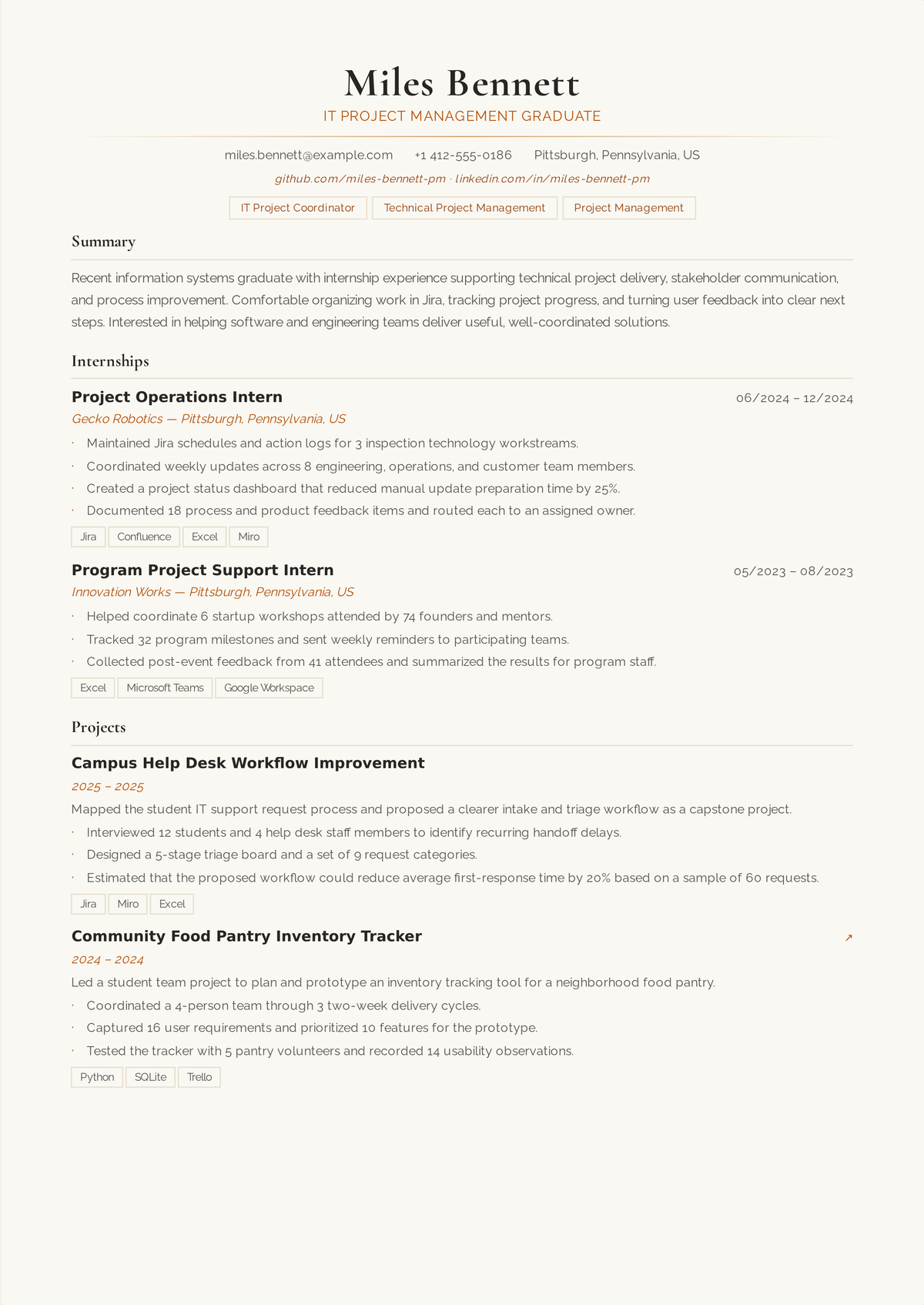
Why this resume works
- It shows the coordination work a PM track is built on: schedules, trackers, status updates, stakeholder coordination, and documentation.
- It names the tools (Jira, Asana, MS Project, a collaboration suite) and any certification in progress, like the CAPM or CSM.
- Even entry-level bullets carry numbers: projects supported, meetings coordinated, and a tracker that kept a team on schedule.
- It reads as someone a senior PM can delegate to and trust, which is exactly what a coordinator hire wants.
IT / technical project manager (mid-career)
An IT project manager delivers software and infrastructure projects, so this resume leads with the delivery record and the technical domain, then shows the work: planning and tracking against scope and budget, managing cross-functional engineering and vendor teams, controlling risk and change, and shipping on schedule. The numbers are projects delivered on time and on budget, the size of the budget and team managed, and the business outcome — a system launched, a migration completed, a cost saved. It also shows fluency with how technical teams actually work, whether that's agile, waterfall, or a hybrid.
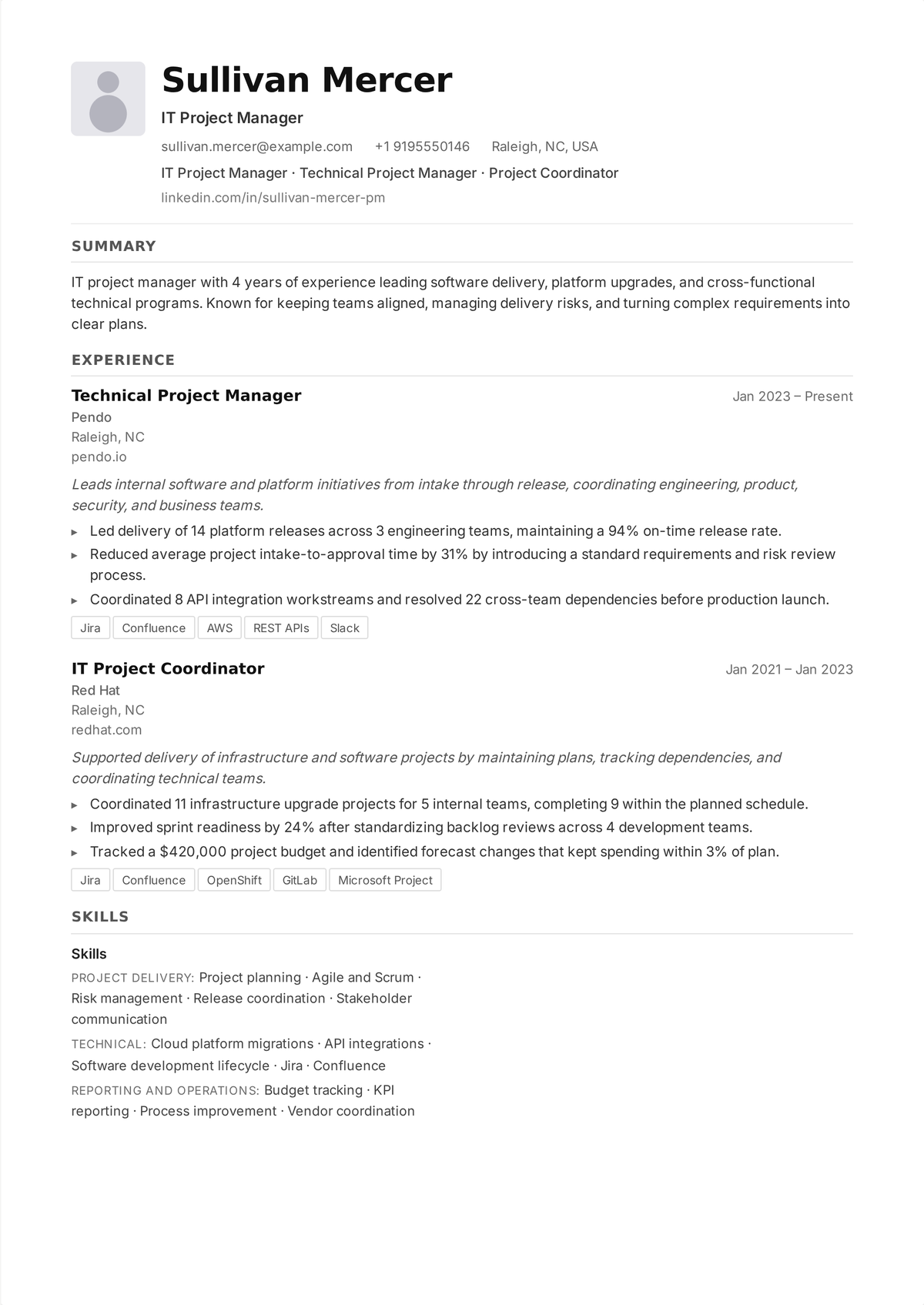
Why this resume works
- It leads with a delivery record and the technical domain, so a hiring manager sees both the track record and the fit.
- It shows the PM core: planning to scope and budget, managing cross-functional engineering and vendor teams, and controlling risk and change.
- Every project carries numbers — delivered on time and on budget, team and budget size, and the business outcome it produced.
- It names the methodology (agile, waterfall, hybrid) and tools (Jira, Confluence) that an IT PM posting screens for.
Scrum master / agile project manager (mid-career)
A scrum master's resume is about enabling a team to deliver, not commanding it, so this one reads differently. It leads with the agile certification (CSM, PSM) and the teams and cadence run, then shows the work: facilitating sprints, standups, reviews, and retrospectives, removing blockers, coaching the team on agile practices, and protecting focus. The numbers are velocity and predictability improved, cycle time reduced, on-time sprint and release delivery, and team-health signals. It shows the servant-leadership the role is built on with concrete facilitation, not a claim about being collaborative.
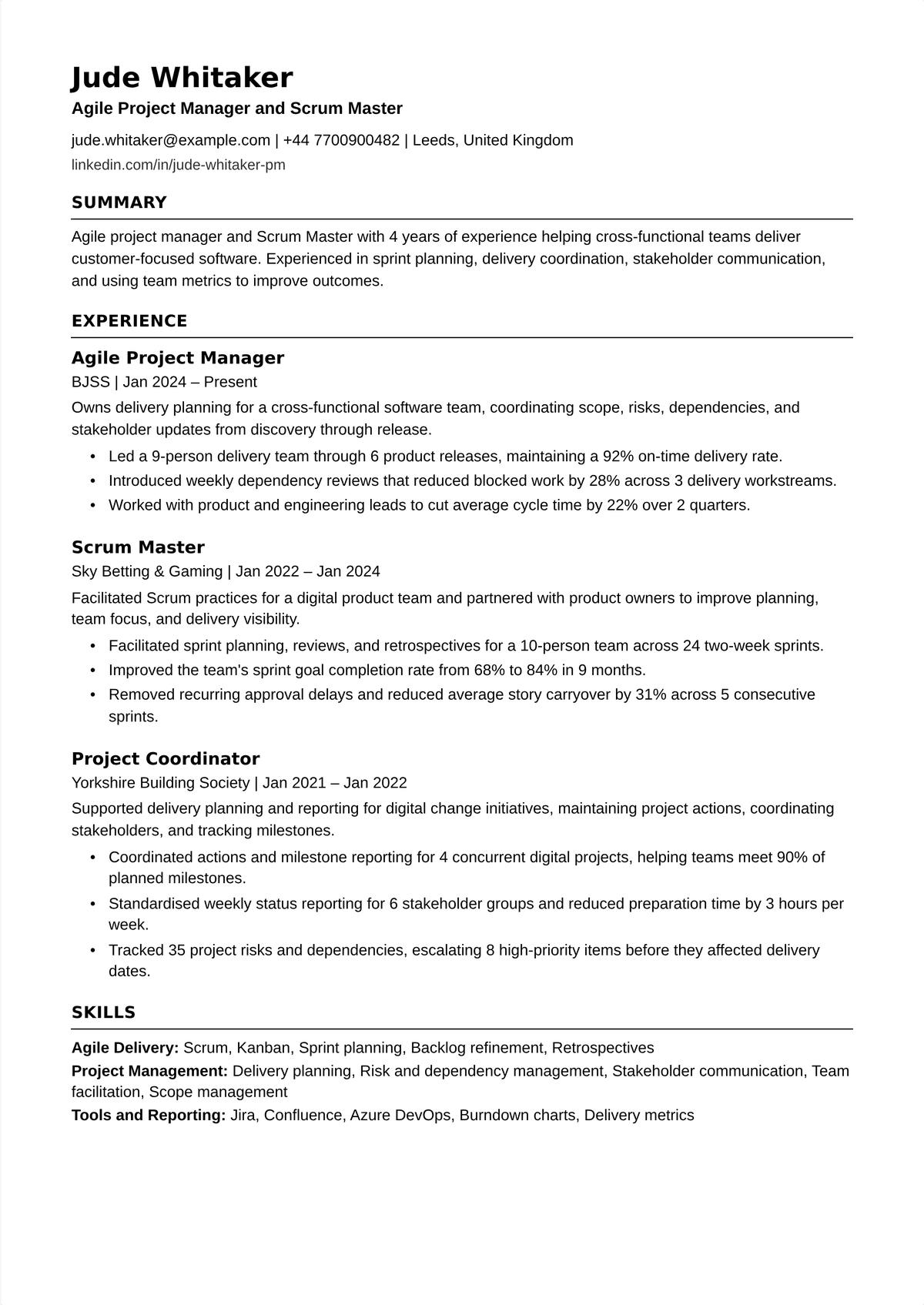
Why this resume works
- It leads with the agile certification (CSM, PSM) and the teams and cadence run, which an agile posting screens for first.
- It shows the facilitation that defines the role: sprints, standups, reviews, retrospectives, and blockers removed.
- Outcomes are measured in agile terms: velocity and predictability, cycle time, on-time sprint and release delivery, and team health.
- It demonstrates servant-leadership through concrete coaching and blocker-removal rather than an adjective about being collaborative.
Operations project manager (mid-career)
An operations PM drives process and efficiency projects across a business, so this resume leads with the improvement record, then shows the work: mapping and redesigning processes, running cross-departmental initiatives, implementing systems, and managing change through an organization. The numbers are efficiency gained, cost reduced, cycle time cut, and the scale of the rollout — sites, teams, or people affected. It often shows a continuous-improvement toolkit (Lean, Six Sigma) and the stakeholder management that process change always requires, because the hardest part is getting people to adopt the new way.
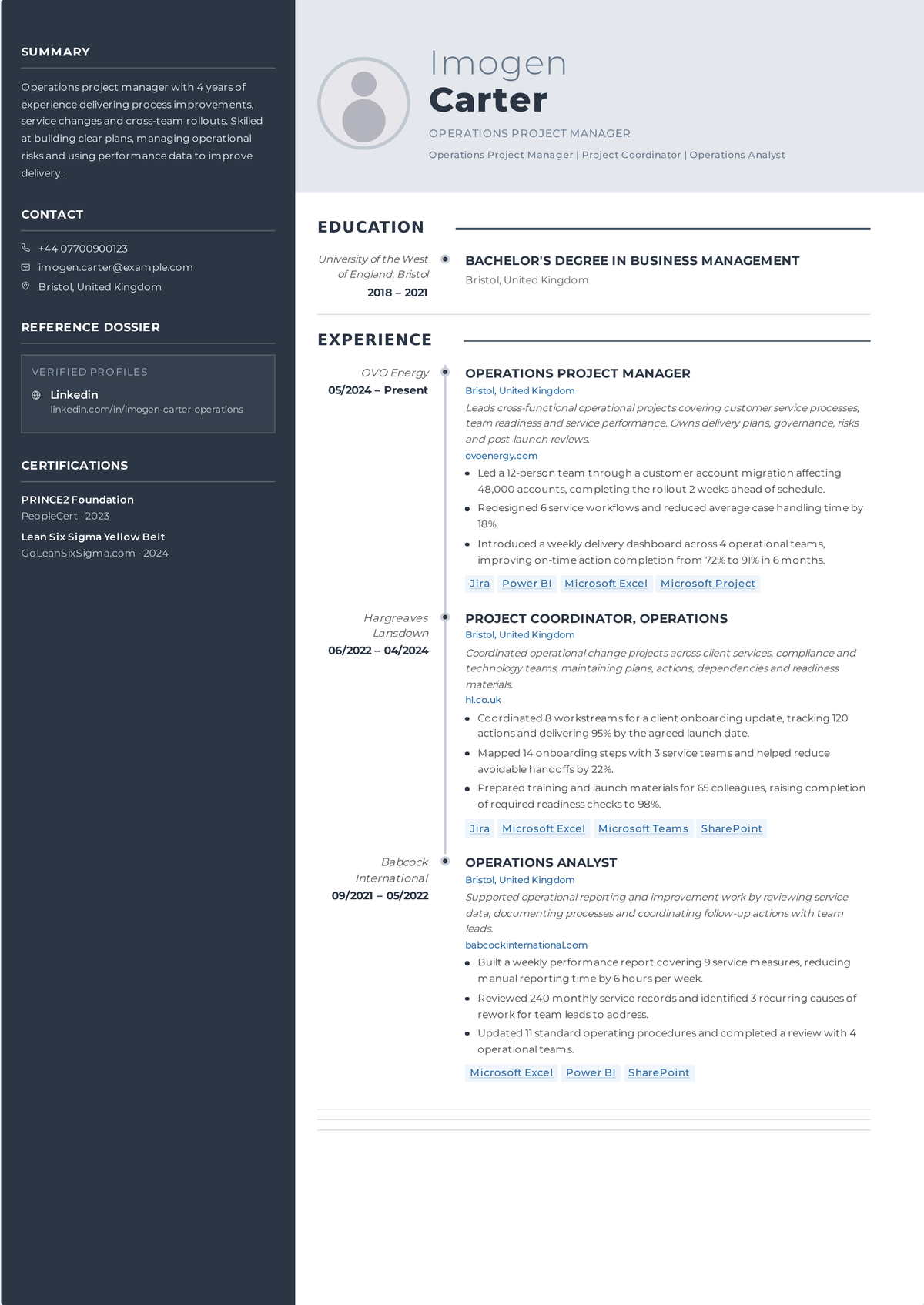
Why this resume works
- It leads with an improvement record and frames the role around process and efficiency, not just task delivery.
- It shows the operations toolkit: process mapping and redesign, cross-departmental initiatives, and system implementation.
- Outcomes are concrete: efficiency gained, cost reduced, cycle time cut, and the scale of the rollout in sites, teams, or people.
- It names the methodology (Lean, Six Sigma) and the change management that makes a process improvement actually stick.
Construction project manager (senior)
A construction PM delivers physical projects where the stakes are budget, schedule, and safety, so this senior resume leads with the projects built — their type, value, and square footage — then shows the work: managing budgets and schedules, coordinating subcontractors and trades, handling permits and inspections, and keeping a job site safe and compliant. The numbers are project value delivered, on-budget and on-schedule completion, safety record, and change-order control. At this level it also shows the scale managed — multiple concurrent projects or a large single build — and leadership of site teams.
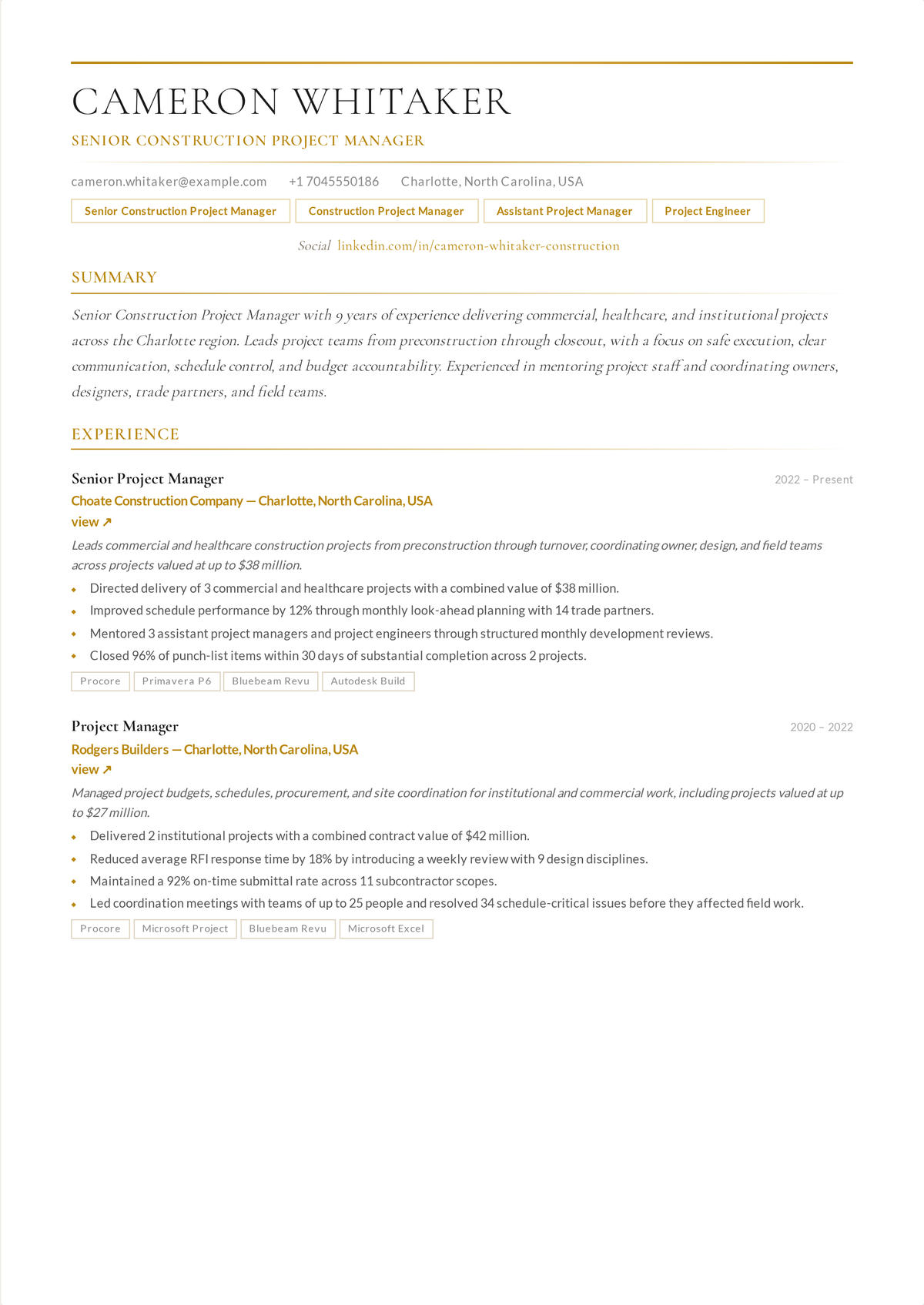
Why this resume works
- It leads with the projects built — type, dollar value, and square footage — so the scale is obvious in one line.
- It shows the construction PM core: budget and schedule management, subcontractor coordination, permits, inspections, and site safety.
- Outcomes are concrete: project value delivered, on-budget and on-schedule completion, safety record, and change orders controlled.
- At a senior level it shows scale — concurrent projects or a large build — and leadership of site teams and trades.
Program manager (senior)
A program manager runs a portfolio of related projects toward a strategic outcome, so this senior resume looks up a level from any single project. It leads with the program's scope — the projects, teams, and budget rolled up — then shows the work: aligning projects to a business goal, managing cross-project dependencies and risk, reporting to executives, and steering a large stakeholder group. The numbers are the program's budget and headcount, the strategic outcome delivered, and the dependencies and risks managed across projects. It reads as someone trusted with ambiguity and executive visibility, not just a delivery plan.
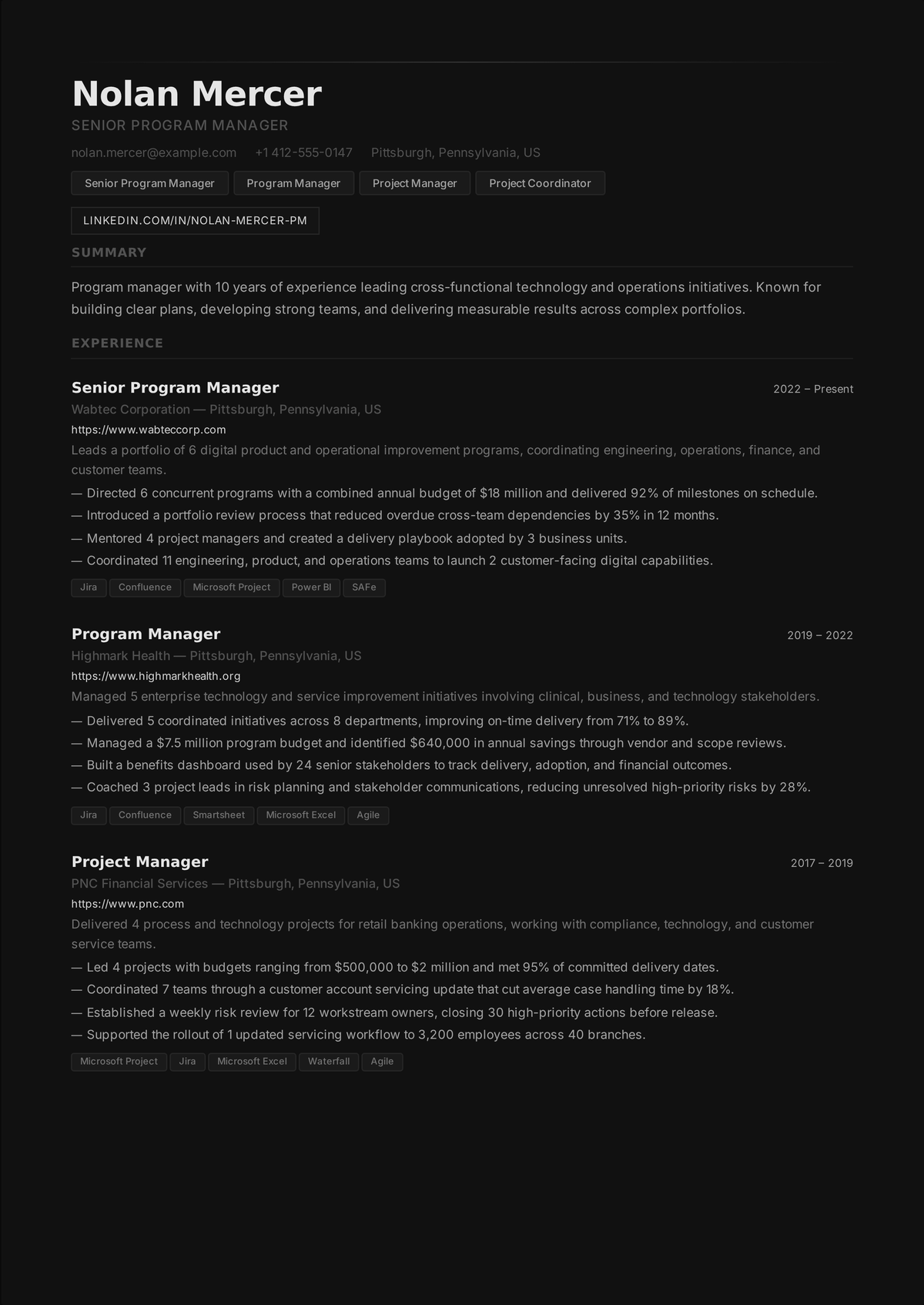
Why this resume works
- It leads with the program's scope — projects, teams, and budget rolled up — so the level above single-project PM is clear.
- It shows the program work: aligning projects to a strategic goal, managing cross-project dependencies and risk, and reporting to executives.
- Outcomes are strategic: the business goal the program delivered and the risks and dependencies steered across projects.
- It demonstrates comfort with ambiguity and executive visibility, the signals that separate a program manager from a project manager.
A project manager resume template you can copy
Here is a complete mid-career IT project-manager resume in plain text — single column, standard headings, real numbers. It's a template in the practical sense: swap in your own projects, certifications, and results, and you have a resume a parser can read and a hiring manager can scan in seconds.
Sara Lindqvist, PMP
Boston, MA · sara.lindqvist@email.com · (617) 555-0138 · linkedin.com/in/sara-lindqvist
Summary
PMP-certified IT project manager with six years delivering software and infrastructure projects for financial-services clients. Delivered 20+ projects totaling $9M on time and within budget, including a core-banking migration completed two weeks early and $300k under budget. Looking for a senior PM or program manager role.
Skills & certifications
PMP (PMI) · Certified ScrumMaster (CSM) · Agile, Scrum, Waterfall, hybrid · Budget and risk management · Stakeholder management · Jira · Confluence · MS Project · Smartsheet · Vendor management
Experience
Senior Project Manager — Charles River Financial Systems, Boston (2022–present)
- Delivered a 14-month core-banking migration ($4.2M, team of 22) two weeks early and $300k under budget, with zero critical post-launch incidents.
- Run a portfolio of 4–6 concurrent projects, holding an on-time delivery rate of 92% across two years against a prior baseline of 70%.
- Rebuilt the risk and change-control process, cutting scope-creep overruns from a recurring problem to under 5% of budget on average.
- Lead cross-functional teams of engineers, QA, and vendors, and present monthly status to the client steering committee.
Project Manager — Beacon Digital, Boston (2019–2022)
- Managed 12 web and mobile delivery projects ($50k–$600k) for enterprise clients, 11 delivered on time and within budget.
- Introduced two-week sprints and a shared Jira board that cut average project cycle time 20%.
Project Coordinator — Beacon Digital, Boston (2018–2019)
- Maintained schedules, trackers, and documentation for a 3-PM team and coordinated 30+ stakeholder meetings a quarter.
Education
BS in Business Administration, Boston University — 2014–2018
Certifications
Project Management Professional (PMP), 2021 · Certified ScrumMaster (CSM), 2020
What makes this one work: the PMP sits in the name line and again in the skills section, the summary names a flagship delivery (on time, two weeks early, $300k under) in its second sentence, and every experience bullet carries a number a hiring manager could verify. The layout is deliberately plain so an applicant tracking system extracts each field cleanly, and the progression from coordinator to senior PM is visible at a glance.
Lead every project bullet with the delivery, then the detail. "Managed a software project" is a responsibility; "delivered a $4.2M migration two weeks early and $300k under budget" is a result. Project management is a results discipline, so put the on-time, on-budget, on-scope outcome and the project's size up front, then add the team, the methodology, and the how. A resume full of "responsible for" with no numbers reads as someone who attended projects rather than delivered them.
The skills to put on a project manager resume
Project management skills split into the delivery discipline, the methodologies and tools, and the people skills that make a project actually land. List the ones the posting names, in its own words, name the exact tools and methods, and back the important ones with a bullet that shows a project delivered because of them.
| Skill area | What to put on the resume |
|---|---|
| Delivery discipline | Scope, schedule, and budget management; planning; risk and issue management; change control |
| Methodologies | Agile, Scrum, Kanban, Waterfall, hybrid — name the ones you've actually run, and SAFe for scaled orgs |
| Tools | Jira, Confluence, Asana, MS Project, Smartsheet, Monday — plus any field-specific tool (Procore for construction) |
| Stakeholder & team | Stakeholder management, cross-functional leadership, vendor management, executive reporting |
| Financial & analytical | Budgeting, cost control, resource planning, status and earned-value reporting, KPIs |
| Certifications | PMP, CAPM, CSM, PSM, PRINCE2, SAFe, Lean Six Sigma — list what you hold or are pursuing |
Skip skill bars and star ratings, and go easy on bare soft-skill adjectives. "Excellent communicator" and "four stars in leadership" mean nothing to a parser and read as filler to a hiring manager. A named methodology and tool set, plus a bullet that shows a project delivered because you managed the risk or aligned the stakeholders, does far more than any graphic.
How to write each section of a project manager resume
Write a summary that names your field, certification, and one delivery
Two or three sentences at the top: your field and years, your certification, and the single strongest project you delivered. "PMP-certified IT project manager with six years in financial services; delivered a $4.2M migration two weeks early and under budget" tells a hiring manager more than a paragraph about your leadership philosophy. Name the field (IT, construction, operations) and the methodology you run, because they define the role. Skip an objective statement about what you hope to grow into; the summary describes what the company gets.
Write projects as outcomes, not responsibilities
"Responsible for managing projects" describes a seat. "Delivered 20+ projects totaling $9M on time and within budget, including a migration completed two weeks early" describes a project manager worth hiring. Delivery is the whole job, so a resume that names outcomes stands out in a stack of responsibility lists. The numbers that carry weight: on-time and on-budget delivery rate, project and portfolio budget, team size led, scope delivered, and the business result — revenue, cost, efficiency, or risk. Use the shape "delivered X ($, timeline, team), producing Y," and only claim what you can walk an interviewer through.
Before: Responsible for managing software development projects. After: Delivered a $4.2M core-banking migration (team of 22) two weeks early and $300k under budget, with zero critical post-launch incidents.
Before: Helped improve the team's delivery process. After: Rebuilt risk and change control across a 6-project portfolio, lifting on-time delivery from 70% to 92% and holding scope-creep under 5% of budget.
Name the methodologies and tools you've actually run
Project roles are specific about how work gets done, and a posting usually names the methodology and tools the team uses. List the methods you've genuinely run — Agile, Scrum, Kanban, Waterfall, hybrid, SAFe — and the exact tools — Jira, Confluence, Asana, MS Project, Smartsheet, Procore — rather than a vague "project management software," because a parser and a hiring manager both scan for the real names. If the posting is an agile role and you've run sprints, make Scrum and the tooling prominent; if it's a waterfall-heavy construction or government role, foreground schedule, budget, and the relevant software.
Use the keywords the posting and the ATS scan for
Companies run applications through an applicant tracking system that parses your resume and matches it against the posting. Systems vary — some screen out a missing must-have like the PMP, many just rank candidates for a recruiter — but a parser-safe file written in the posting's own words gives you the best odds either way. Reuse the posting's exact language where it's honest: if it says "PMP," "Agile," "stakeholder management," or "Jira," use those terms rather than synonyms. Keep the layout parser-safe: single column, standard headings (Summary, Experience, Skills, Certifications, Education), a real-text PDF, no photo, no graphics boxing in your history. You can check what a parser actually pulls from your file with Prezumi's free ATS resume checker, and the ATS-friendly templates start you from a layout that already passes.
Project manager salary insights
Project-management pay rises with scope, field, and certification. The ranges below are illustrative U.S. figures meant to show how compensation shifts by role; your actual figure depends on industry, location, and the size of the budgets and teams you run — IT and specialized technical PMs typically sit above generalists. The PMP is a well-known lever that often correlates with higher pay. For current national medians, the U.S. Bureau of Labor Statistics Occupational Outlook Handbook is the citable source.
| Project-management role | Typical U.S. salary range (illustrative) |
|---|---|
| Project coordinator | $50,000–$68,000 |
| Project manager (mid) | $80,000–$110,000 |
| IT / technical project manager | $95,000–$135,000 |
| Scrum master / agile PM | $90,000–$130,000 |
| Senior / construction project manager | $105,000–$150,000 |
| Program manager | $125,000–$175,000+ |
Two things move these numbers most: the field and the scope you own. The same title pays well above average in IT, finance, and specialized construction, and the step from running one project to owning a portfolio or program is the biggest single jump. On the resume, that means foregrounding the budgets and teams you've managed and the strategic outcomes you've delivered, and naming your field and certification, because they set the pay band as much as the job title does.
Build your project manager resume in Prezumi
Prezumi holds your delivery history as one profile and renders it into any of 55+ templates, so you write the projects, the certifications, and the outcomes once. Import an existing resume to skip retyping, pick an ATS-friendly template that keeps a clean single column, and export a text-based PDF for free. When you apply to a specific role, the AI editor rewords your real entries to match that posting (it can only reshape the details you entered, so it won't invent a budget figure), and the ATS checker confirms the file parses before you send it. If you're moving into project management from another field, our first-job resume guide and student CV examples show how to surface the coordination, planning, and delivery you've already done elsewhere. For the letter that goes with the application, the free cover letter generator works from your resume and the posting.
FAQ
Should I put the PMP on a project manager resume?
Yes, prominently — add "PMP" after your name and list it in a skills or certifications section. The PMP is the most recognized project-management credential and many postings screen for it, so if you hold it, make it impossible to miss. If you're pursuing it, say where you are ("PMP candidate, exam scheduled Q2"). Agile roles value the CSM or PSM the same way, and construction and government roles may look for PRINCE2 or a PE. Name the credential, its status, and the issuing body.
How do I quantify project management on a resume?
Lead every project with its outcome and size. The numbers that carry weight are on-time and on-budget delivery rate, the project and portfolio budget, the team size you led, the scope delivered, and the business result — revenue, cost, efficiency, or risk reduced. Use the shape "delivered X ($, timeline, team), producing Y" — for example, "delivered a $4.2M migration two weeks early and $300k under budget." Only claim what you can walk an interviewer through, because they will ask how the project actually landed.
How do I write a project manager resume with no direct PM experience?
Surface the project work you've already done under another title. Most people moving into project management have coordinated schedules, led a cross-functional effort, managed a budget, or delivered an initiative in a previous role — write those as project outcomes with numbers. Add a certification in progress (CAPM, CSM), name the methodologies and tools you've used, and lead with a summary that frames you as a deliverer. Our first-job resume guide shows how to build a resume around transferable delivery experience.
What's the difference between an IT PM, a scrum master, and a program manager resume?
An IT project manager resume leads with software and infrastructure projects delivered on scope, time, and budget, and names the technical domain and methodology. A scrum master resume is built around enabling a team — sprint facilitation, blockers removed, velocity and cycle-time improvements — and leads with an agile certification. A program manager resume looks up a level, leading with a portfolio of projects aligned to a strategic goal, cross-project dependency and risk management, and executive reporting. Lead with the one the posting is hiring for.
What skills should I put on a project manager resume?
The delivery discipline (scope, schedule, budget, risk, and change management), the methodologies you've run (Agile, Scrum, Waterfall, hybrid), the exact tools (Jira, Confluence, MS Project, Smartsheet, and field-specific ones like Procore), and the people skills that make projects land (stakeholder management, cross-functional leadership, vendor management). List the certifications you hold or are pursuing. Back the important skills with a bullet showing a project delivered because of them, and go easy on bare soft-skill adjectives.
How long should a project manager resume be?
One page for coordinators and PMs with up to roughly ten years of experience; two pages are justified when a decade or more of directly relevant delivery, with real budgets and leadership, genuinely fills them — a senior program manager with a long portfolio. Keep it dense and specific; a hiring manager scanning a stack would rather see one page of delivered projects with numbers than two pages of responsibilities. Trim old or irrelevant roles to a line.
Should a project manager resume include a photo?
No, for jobs in the US, UK, Canada, and most of Europe. Companies don't need a photo, many prefer applications without one to avoid bias, and a photo can trip up an applicant tracking system. A few countries do expect a photo on any CV; follow local convention if you're applying somewhere that clearly asks for one, but leave it off by default.
Should I list the project management tools I've used?
Yes, by exact name. Project teams run on specific tools, and a posting usually names the ones the team uses, so list the real products you've worked in — Jira, Confluence, Asana, MS Project, Smartsheet, Monday, or field-specific ones like Procore — rather than a vague "project management software." Both the applicant tracking system and the hiring manager scan for the specific names. If the posting names a tool you know, make sure it appears in your skills section and ideally in a bullet.
How do I make my project manager resume ATS-friendly?
Use a single-column layout, standard section headings (Summary, Experience, Skills, Certifications, Education), and a PDF that contains real extractable text rather than an image. Reuse the exact keywords from the posting where they honestly apply — "PMP," "Agile," "stakeholder management," the tool names — and leave out photos, columns, and graphics that scramble parsing. Prezumi's free ATS resume checker runs real text extraction on your file and shows you what a parser pulls out, so you can confirm it reads cleanly before you send it.
Do certifications or delivered projects matter more on a PM resume?
Delivered projects matter more, but a certification gets you past the first screen. A PMP, CSM, or PRINCE2 signals you know the framework and helps with applicant tracking systems that filter for it, but hiring managers decide on your delivery record — the budgets you ran, the teams you led, and whether projects landed on time and on scope. Lead with the certification in a skills line, then spend the resume proving delivery with numbers. The strongest resumes have both.
About the author
Zubair Baqai is an AI engineer and the founder of Prezumi. He started it after researching what gets candidates interviews at companies like Google, Meta, Microsoft and Amazon. He writes Prezumi's guides on resumes, ATS screening and CV formats. About Prezumi
Your job-search toolkit
Free tools for every step of a job application. No signup.
- Write a tailored cover letter — Upload your resume, paste the job description, pick a style, and get a cover letter matched to the role in under a minute.
- Turn your resume into a website — Convert your resume into a live personal website with a matching online resume and one shareable link for recruiters.
- Check if ATS can read your resume — Upload your PDF and get an instant score for text extraction, reading order, sections, contact info, and content strength.
- Write a resignation letter — Fill in your name, role, and last day, pick a tone, and get a clean, professional resignation letter to copy or download as a PDF.
- Convert to a Harvard resume — Reformat any resume into the Harvard career-services layout used by students and recent grads — preview instantly, download the PDF free.
- Translate your CV — Translate your resume between English, Spanish, German, French, Italian, Portuguese, Turkish, and Arabic — layout and dates kept intact.
- Fix weak resume wording — Find buzzwords, weak verbs, vague bullets, and missing metrics. Get a 0–100 wording score and stronger rewrites.
- Convert to a Europass CV — Turn any resume into the Europass-style format European employers expect — preview instantly, download the PDF free.
- Convert GPA & grades — Convert between US GPA, percentage, letter grades, UK honours, ECTS, and 10-point CGPA — and see if you graduated cum laude.
