Doctor Resume Examples by Specialty and Career Level
Physician resume examples by career stage and specialty, from resident to attending surgeon, plus a copyable template, salary ranges, and sections to include.
Canonical: https://www.prezumi.com/blog/doctor-resume-examples
A physician resume has to clear a specific gate before anyone reads your bullet points: it must show that you are trained, licensed, and board-certified (or on track to be) for the exact role you're applying to. A residency program director, a hospital credentialing office, and a group-practice recruiter all scan for the same things first — your medical degree, your training, your USMLE or COMLEX progress, your state license, and your board status — because none of the rest matters until those check out. Below are physician resume examples by specialty and career stage, from a first-year resident to an attending surgeon, each shown as a real Prezumi template you can open and reuse, plus the sections, skills, and numbers that get a medical resume past a recruiter's screen and into a shortlist.
One thing to settle first: in U.S. medicine the words "resume" and "CV" get used loosely, and the right document depends on where you are in your career. Residency and fellowship applications run through ERAS, which is a structured CV in everything but name. Academic and hospital-employed physicians keep a full curriculum vitae that lists every publication, presentation, and grant and runs to several pages. A shorter one-to-two-page resume is what you send for many non-academic jobs: locums, telehealth, industry, administrative, and utilization-review roles. The examples here span both formats, and each one names which it is. The rules that apply to any resume, medical or not, live in our resume writing guide; this page is the physician-specific version.
How these examples were made. Each résumé below is a real Prezumi template rendered from a complete physician profile — the same builder you'd use for your own — not a static mock-up. Names and numbers are illustrative. The licensing, board-certification, and salary guidance reflects how U.S. physician hiring commonly works and was checked against primary sources (USMLE, ECFMG, ABMS, NRMP, BLS); rules and figures change and vary by state and specialty, so confirm the specifics with the relevant board before you rely on them. Last reviewed: August 2026.
Physician resume examples by specialty and level
Medicine is not one job, and a resident's document and an attending surgeon's read nothing alike. Each example below is a real resume rendered in a clean, ATS-friendly Prezumi template, so you can see the exact format for your specialty and stage and then build your own from the same structure. Click any example to enlarge it, or use it as your starter profile with one tap.
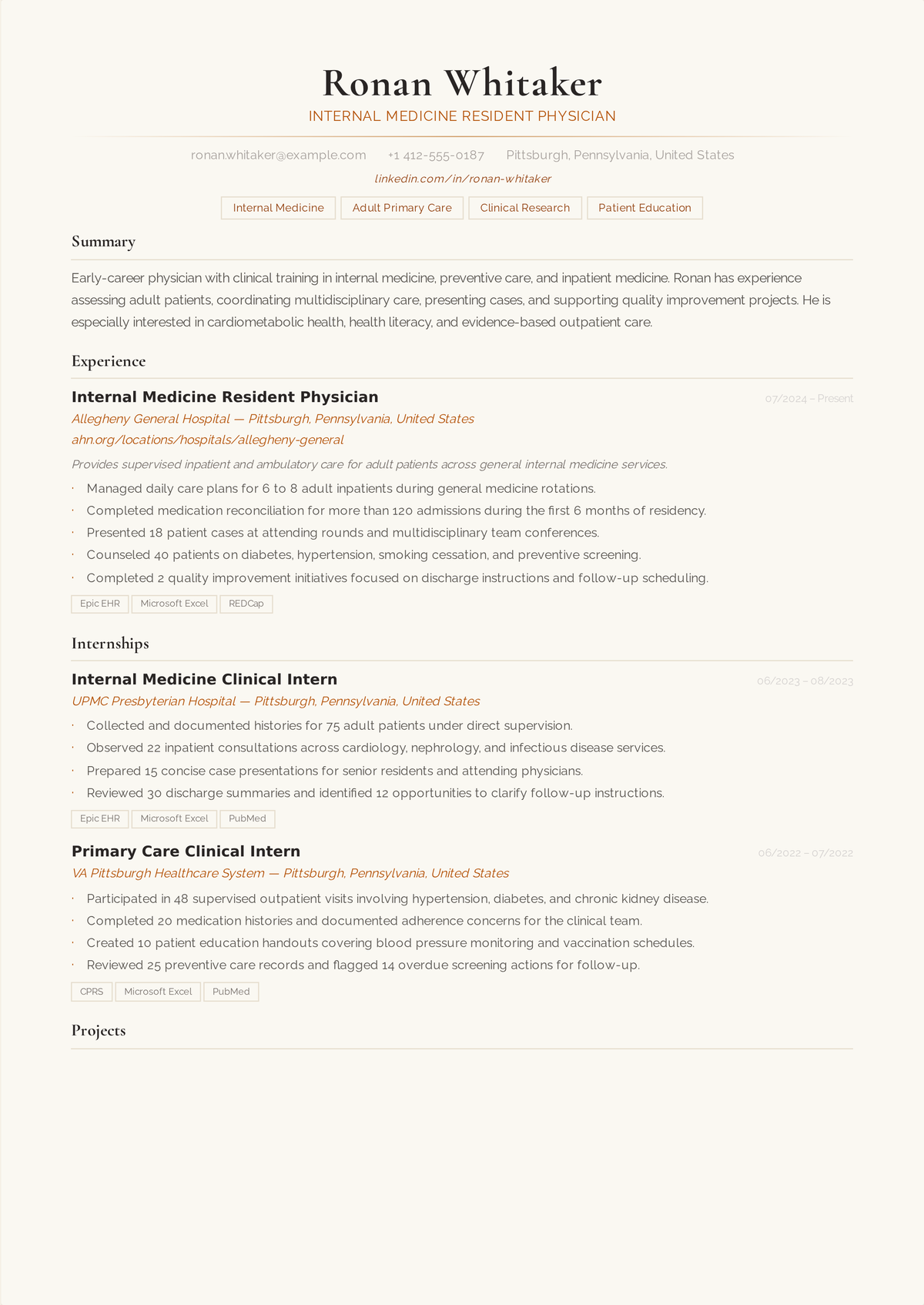
Medical resident / intern (entry level)
A first- or second-year resident is early enough that training, not job history, carries the page. This one leads with the MD or DO degree and the residency program, then the USMLE Steps passed, the state training license, and DEA registration status. Below that come the rotations and procedures logged, since a resident's real experience is measured in rotations completed and cases seen rather than years employed. Research, posters, and any first-author work go near the top too, because programs and early employers read them as evidence you can carry a project through.
Why this resume works
- The MD/DO degree, residency program, and USMLE Step 1 and Step 2 CK results sit in the first block, the credentials a program or early employer checks before anything else.
- It lists the training-license status and DEA registration plainly, so a credentialing office sees the paperwork is in order.
- Experience is told in rotations and procedures logged, which is exactly how a resident's clinical time is measured this early.
- A first-author poster and a QI project stand in for a thin work history and show the academic side programs look for.
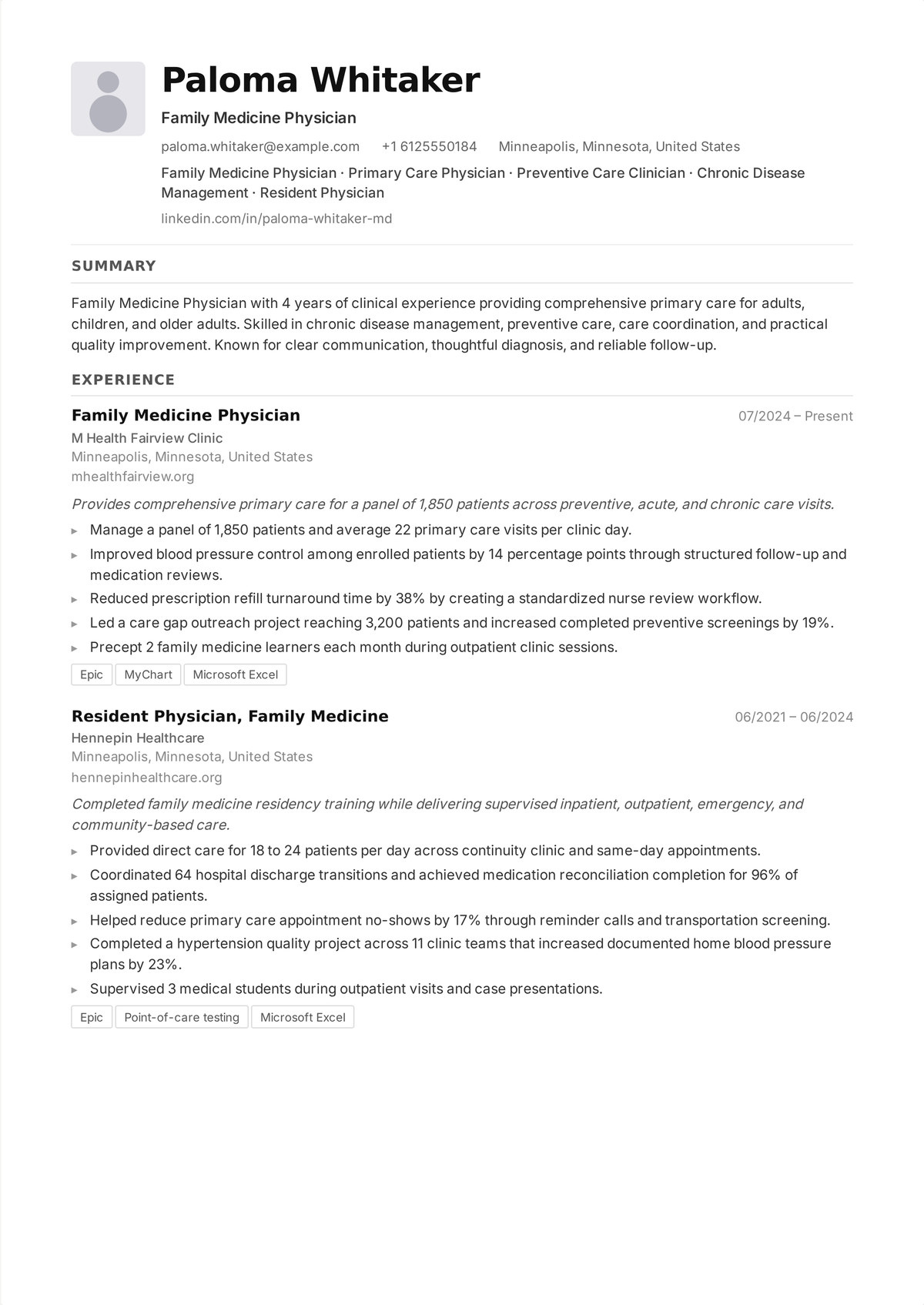
Family medicine physician / GP
A family physician sees the widest range of patients of any specialty, and the resume should show that breadth. This one leads with the medical degree, the completed family-medicine residency, board certification from the American Board of Family Medicine, and an active unrestricted state license and DEA. The clinical section then shows the mix: preventive care and chronic-disease management, pediatric-to-geriatric range, procedures done in clinic, and panel size. Outcomes belong here too, framed as the metrics a group practice actually tracks, like the share of diabetic patients at goal A1c.
Why this resume works
- Board certification, an active unrestricted state license, and DEA registration lead the page, the hard gate every credentialing office checks.
- It shows the breadth that defines family medicine: preventive care, chronic-disease management, and a patient panel that runs from pediatrics to geriatrics.
- Clinical impact is quantified in terms a practice tracks — panel size, A1c and blood-pressure control rates, and same-day access — instead of vague duties.
- It names the in-clinic procedures the physician is credentialed for, so a recruiter sees the scope without reading between the lines.
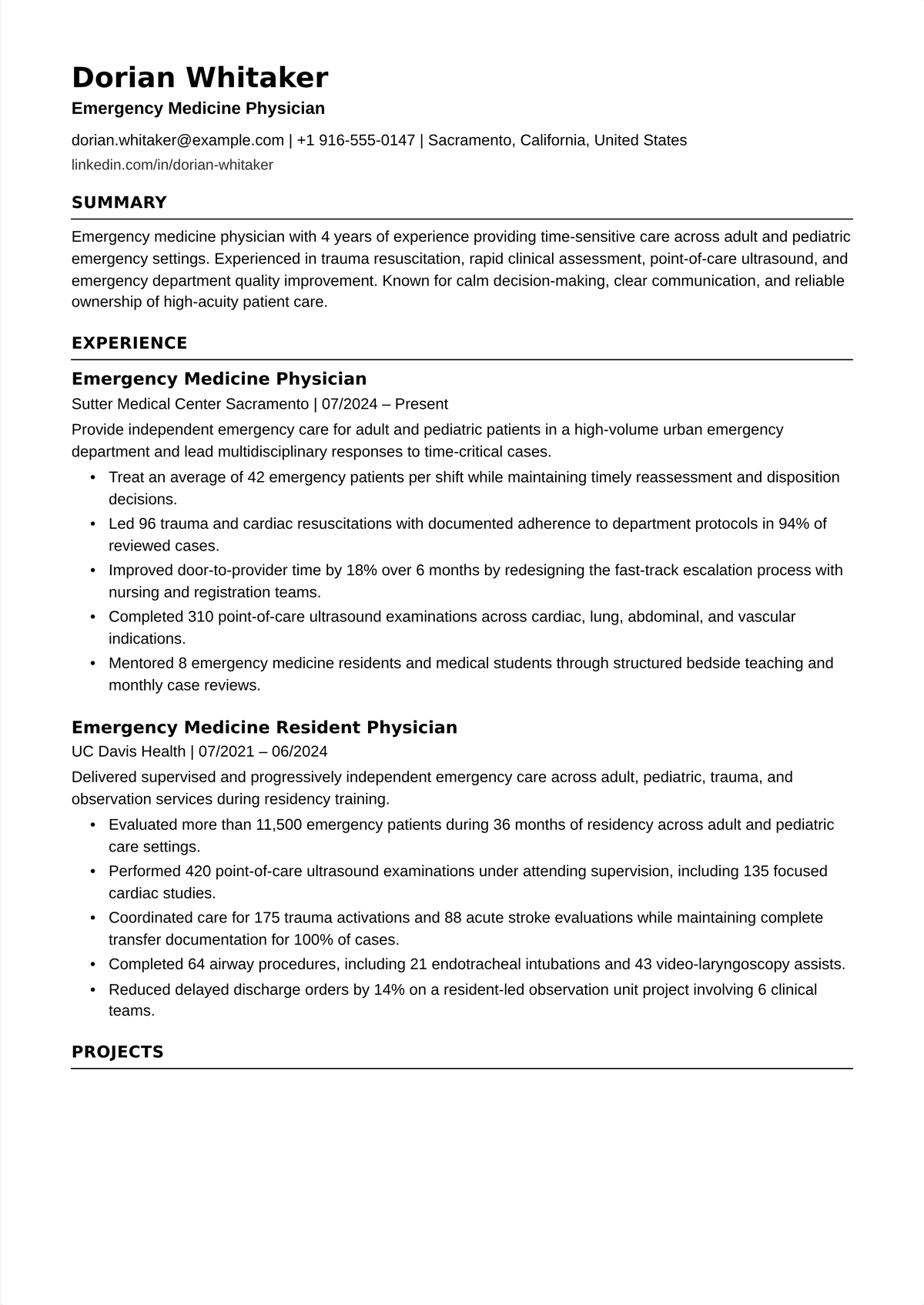
Emergency medicine physician
Emergency medicine is high-acuity and high-volume, and the resume has to prove you can run a busy department without missing the sick patient. This one leads with the EM residency and American Board of Emergency Medicine certification, then the procedural range that matters in the ED: intubation, central lines, procedural sedation, ultrasound, and trauma and resuscitation experience. Volume metrics carry weight here, like patients per hour and the acuity mix of the departments worked, alongside any role in throughput, sepsis protocols, or department quality work.
Why this resume works
- The EM residency and board certification lead, followed by ACLS, ATLS, and PALS, the certifications an ED group screens for by name.
- It foregrounds the procedures that define the role — intubation, central and arterial lines, procedural sedation, and point-of-care ultrasound — with real counts.
- Volume and acuity are stated as numbers: patients per hour, annual department census, and Level I versus community trauma exposure.
- It shows the systems work that separates a senior EM candidate: sepsis-protocol adherence, door-to-provider times, and throughput improvements.
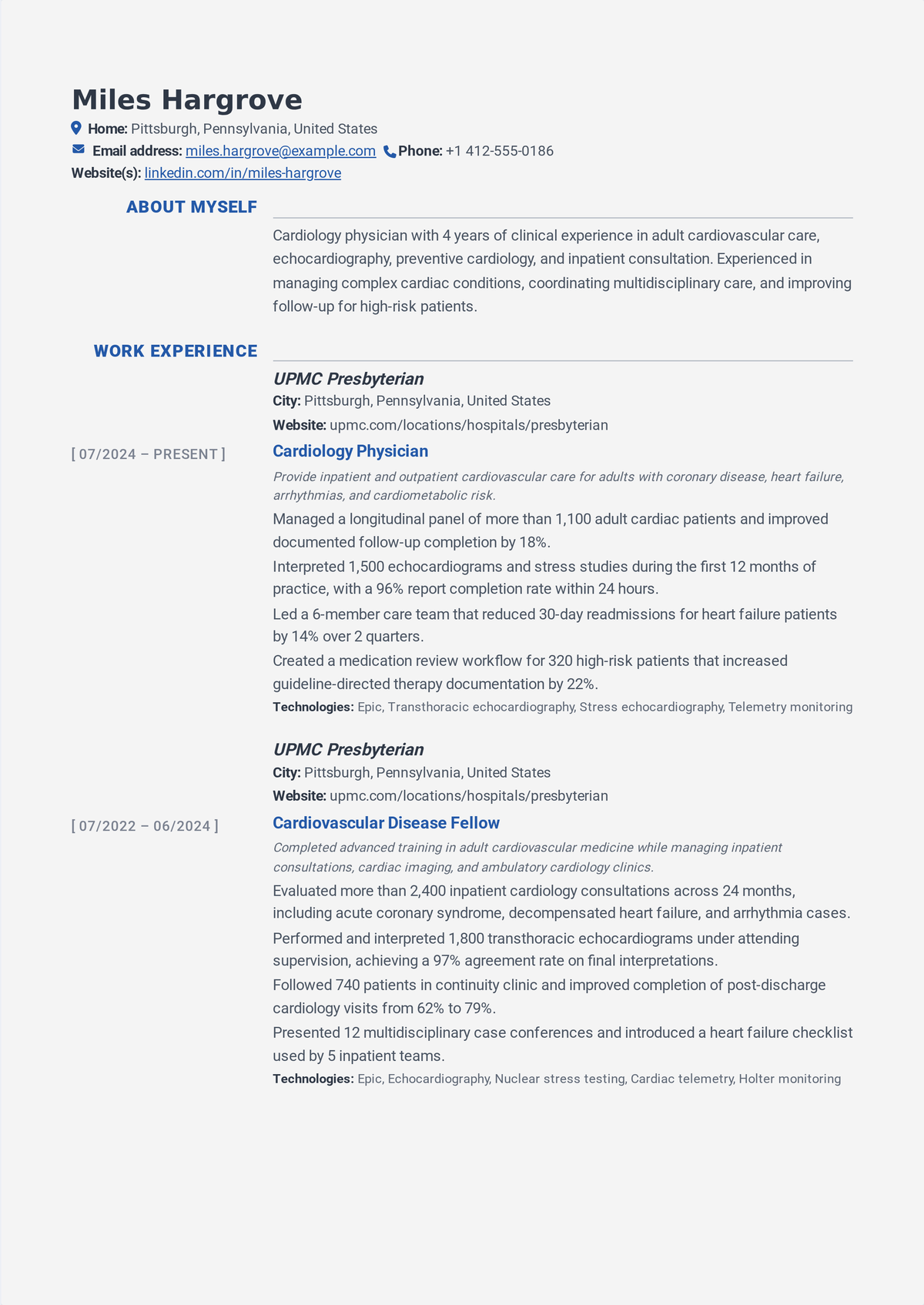
Cardiology fellow (subspecialty training)
A cardiology fellow has finished internal-medicine residency and is training in a subspecialty, so the document sits between a resident's and an attending's. This one leads with internal-medicine board certification and the cardiology fellowship in progress, then the procedural log that a cardiology program cares about: echocardiograms interpreted, stress tests, right and left heart catheterizations assisted or performed, and device exposure. Research is prominent, because fellowship is where an academic cardiology career is built — first-author papers, abstracts, and any grant or society involvement earn their space.
Why this resume works
- It states the completed internal-medicine board certification and the cardiology fellowship in progress up top, so the training stage is unambiguous.
- The procedural log is specific to the subspecialty: echos read, stress tests supervised, and catheterizations performed, each with a count.
- Research sits high on the page, with first-author publications and abstracts named, because fellowship is where the academic record is judged.
- It reads as a CV rather than a one-page resume, which is the correct format for fellowship and academic applications.
Pediatrician
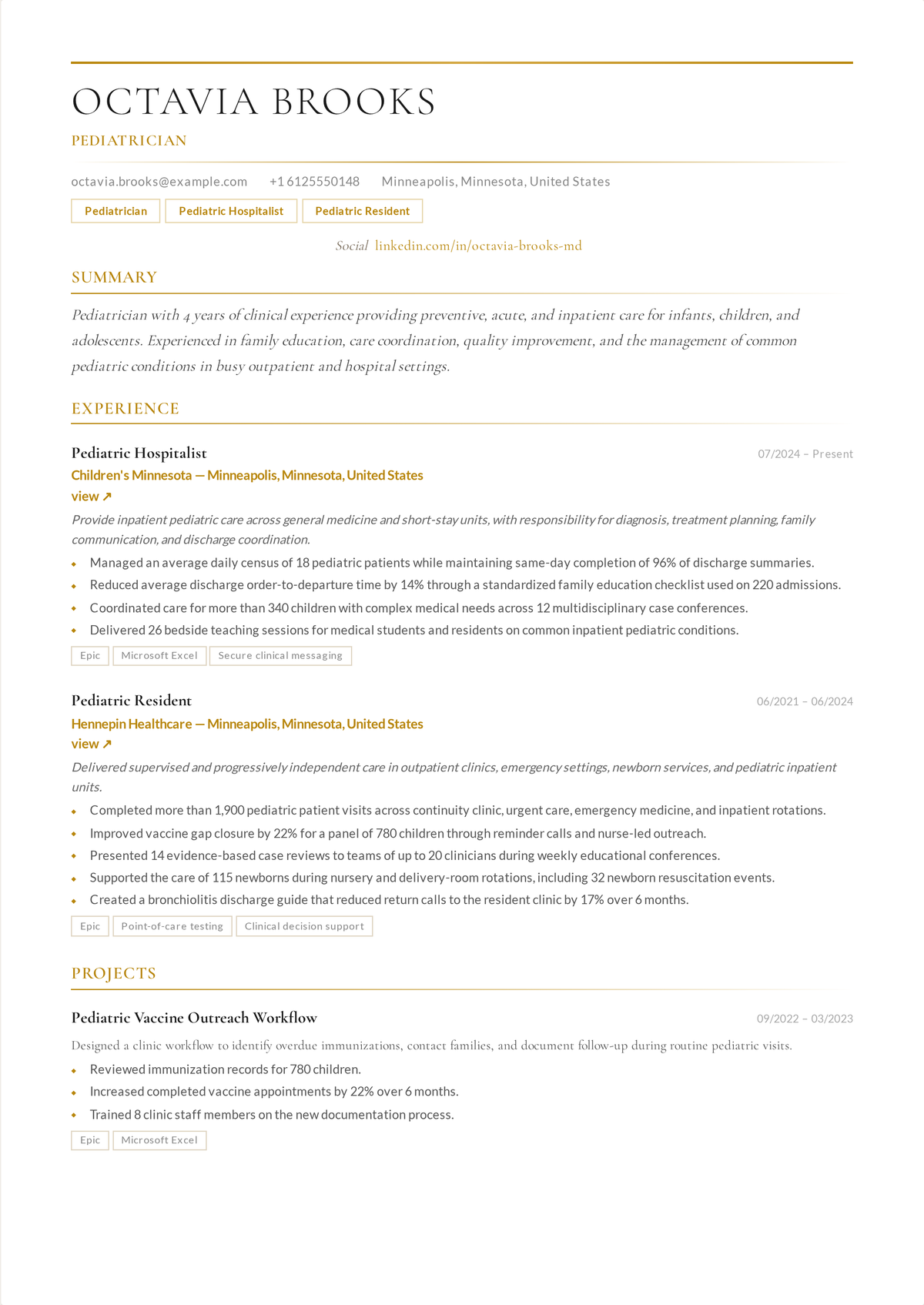
A pediatrician's resume shows a different kind of range: care from newborn to adolescent, plus the family communication and developmental-screening work that general pediatrics runs on. This one leads with the pediatrics residency and American Board of Pediatrics certification, then the clinical mix: well-child visits and immunization schedules, acute and chronic care, developmental and behavioral screening, and coordination with schools and specialists. The numbers that carry weight are panel size, immunization and well-visit completion rates, and any role in a practice's quality measures.
Why this resume works
- Board certification from the American Board of Pediatrics, an active license, and PALS/NRP lead the page, the credentials a pediatric group checks first.
- It shows the full age range general pediatrics covers, from newborn nursery to adolescent care, so the scope is clear at a glance.
- Preventive care is quantified where it counts: immunization completion, well-visit rates, and developmental-screening coverage.
- It names the collaboration the role runs on — coordinating with families, schools, and subspecialists — rather than leaving it implied.
Attending surgeon (senior)
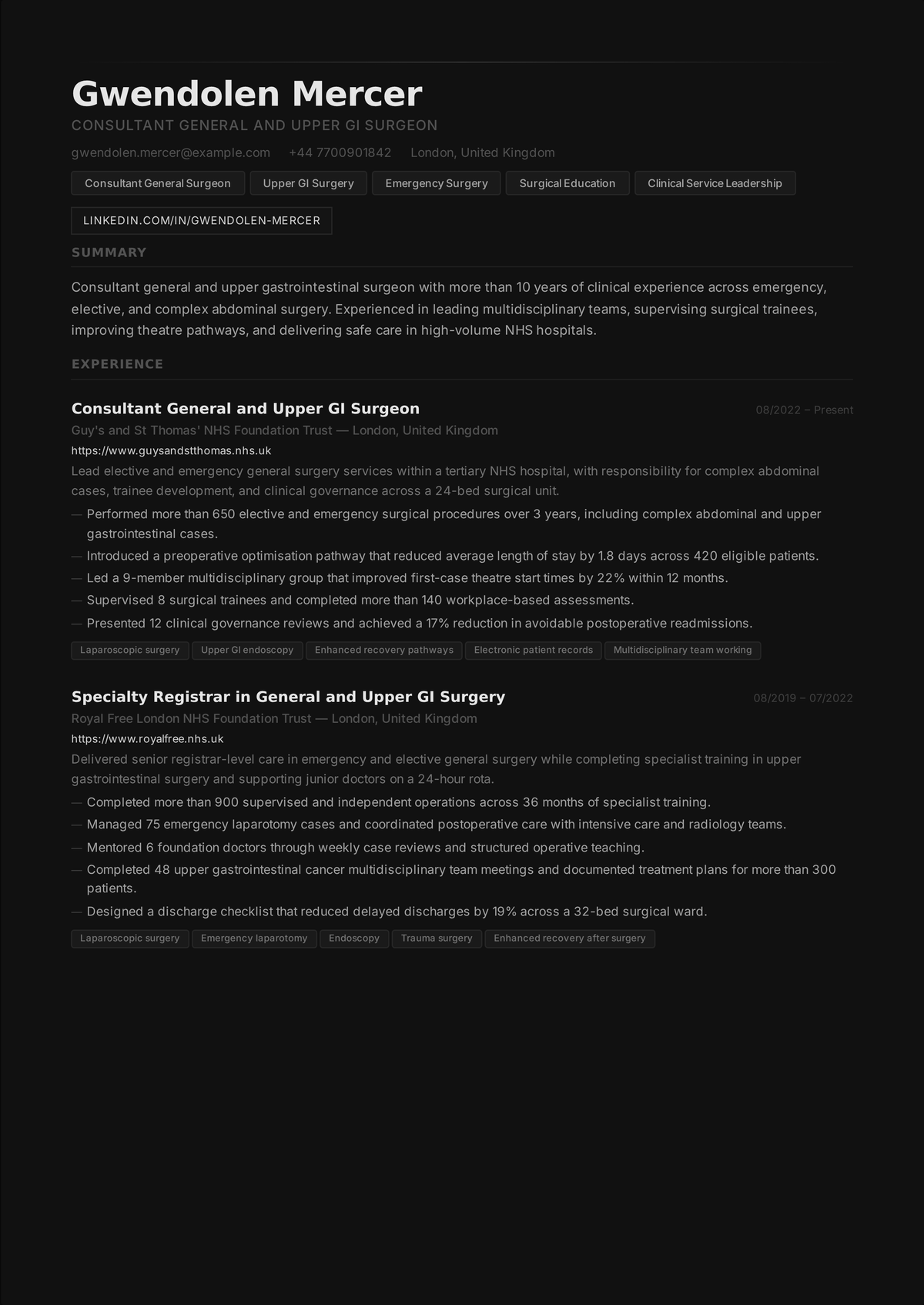
A senior surgeon's document is a full CV, and it leads with operative volume and outcomes because that is how surgical skill is judged. This one opens with the general-surgery residency, any fellowship, board certification from the American Board of Surgery, and hospital privileges, then the case log: total cases, the mix of procedures, and outcome and complication rates benchmarked where possible. Leadership belongs high on the page at this level — service-line or division leadership, resident teaching, and morbidity-and-mortality or quality-committee roles — alongside publications and any device or technique the surgeon is known for.
Why this resume works
- It leads with board certification, current hospital privileges, and a summary of operative volume, the three things a surgical hiring committee weighs first.
- The case log is specific: total cases, procedure mix, and complication rates benchmarked against a national standard where the data allows.
- Leadership reads as senior — division or service-line roles, M&M leadership, and resident teaching — not just a longer list of the same surgeries.
- Publications and any signature technique or device sit alongside the operative record, which is what a full surgical CV is expected to show.
Psychiatrist (senior)
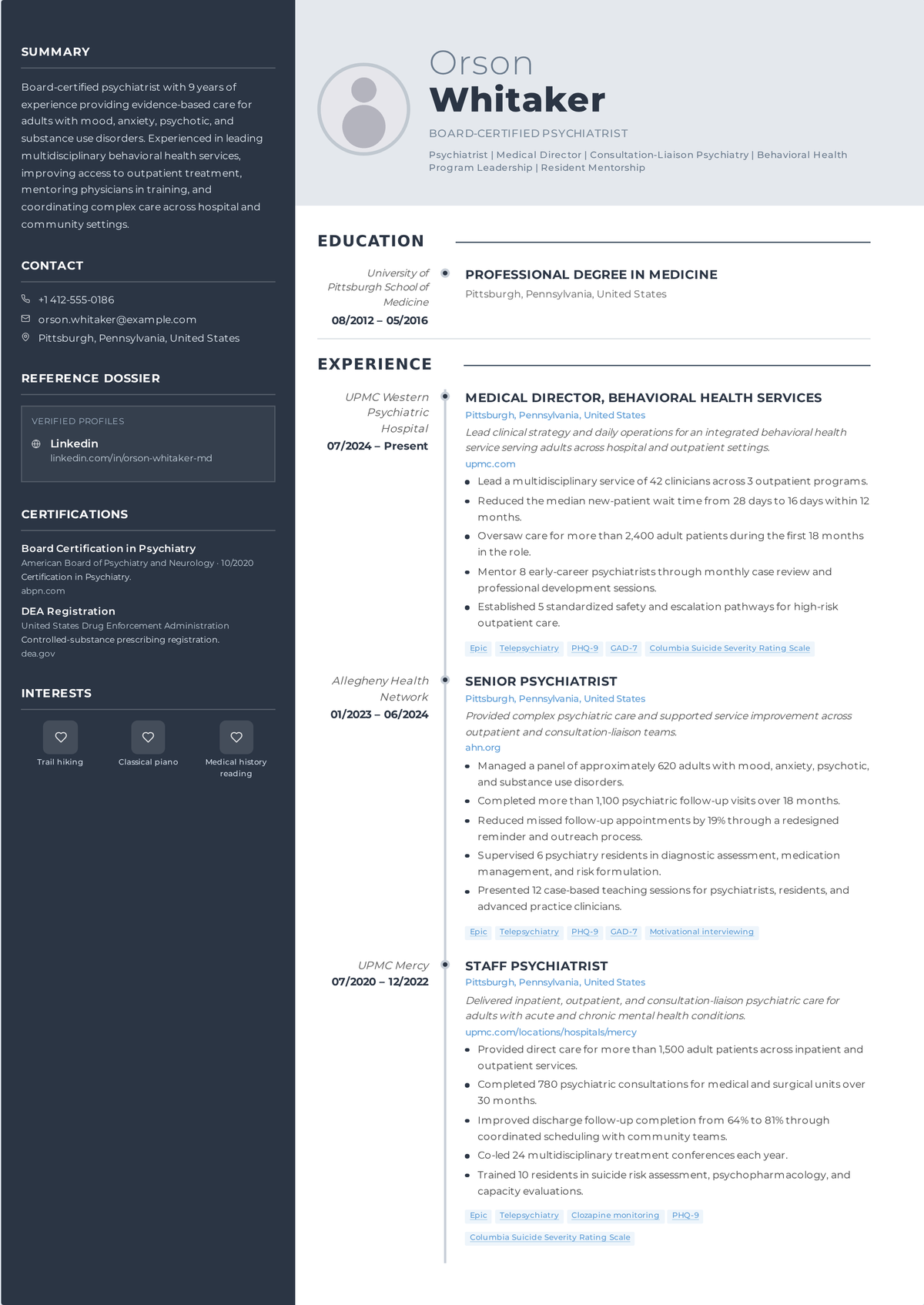
A senior psychiatrist's resume balances clinical range with the settings the work happens in, since inpatient, outpatient, consult-liaison, and telepsychiatry are different jobs. This one leads with the psychiatry residency, American Board of Psychiatry and Neurology certification, any subspecialty (addiction, child and adolescent, forensic), and DEA with any needed state controlled-substance registration. The clinical section then shows the mix: diagnostic evaluation, medication management, psychotherapy modalities, and any program or medical-director role. Metrics here are caseload, settings covered, and program-level outcomes rather than procedure counts.
Why this resume works
- ABPN board certification, any subspecialty, an active license, and DEA with state controlled-substance registration lead the page.
- It names the settings the psychiatrist covers — inpatient, outpatient, consult-liaison, and telepsychiatry — because each is a distinct competency an employer screens for.
- Clinical work is shown as range plus depth: diagnostic evaluation, medication management, and the specific psychotherapy modalities practiced.
- Seniority shows through a medical-director or program role and measured outcomes, not just years on the job.
Hospitalist / senior internist
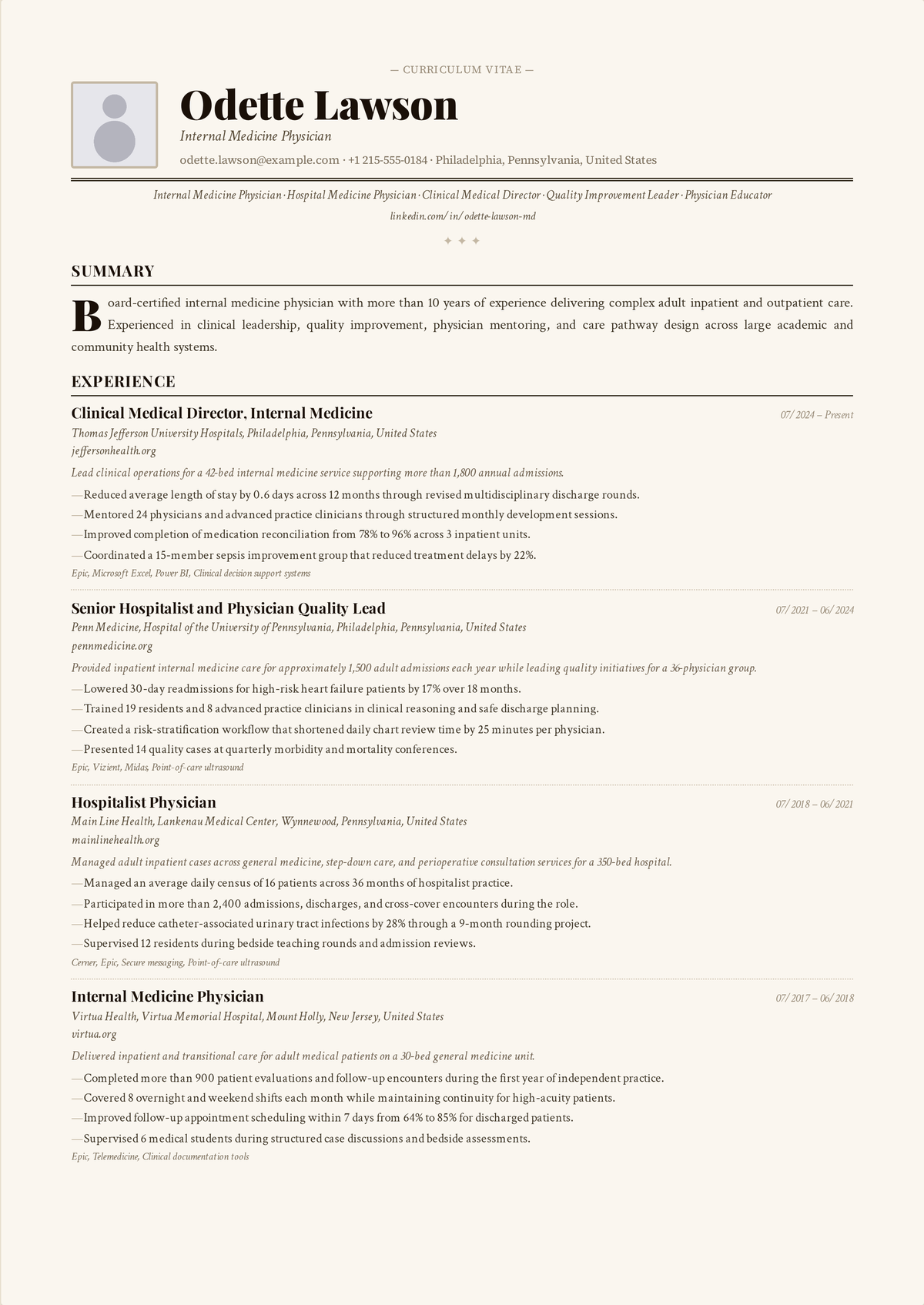
A hospitalist runs inpatient medicine, and the resume should read as someone who moves a busy service safely. This one leads with internal-medicine residency, American Board of Internal Medicine certification, and an active license, then the inpatient work: admissions and discharges managed, average census and length-of-stay handling, code and rapid-response leadership, and comfort with the sickest general-medicine patients short of the ICU. Systems work is a senior signal here — reducing readmissions, improving discharge timing, and leading care-transition or quality projects — and it belongs alongside the clinical volume.
Why this resume works
- ABIM board certification and an active license lead, followed by a clear statement of the inpatient scope the hospitalist covers.
- Volume is concrete: admissions and discharges per shift, average census, and comfort managing the sickest ward patients short of the ICU.
- It shows the systems impact hospitals hire senior hospitalists for — readmission reduction, length-of-stay and discharge-timing gains, and care-transition work.
- Code and rapid-response leadership and any quality-committee role signal seniority beyond raw clinical volume.
What goes in each section of a physician resume
Lead with education, training, and credentials
A physician resume front-loads the credentials because credentialing is literally the first hurdle a hospital or group runs you through. Put your medical degree (MD or DO), the school, and graduation year first, then residency and any fellowship with program names and dates. Follow with licensure and certification: your active state medical license (and any others), USMLE or COMLEX Steps passed, board-certification status with the certifying board named, and DEA registration. State your board status precisely — "board-certified, American Board of Internal Medicine" or "board-eligible, exam scheduled 2027" — because those mean very different things to a credentialer.
Show clinical experience as scope and volume
A physician's experience is measured in the patients seen and procedures done, so translate each role into scope and volume. Name the setting and acuity (community ED, academic ICU, outpatient clinic), the patient population, panel or census size, and the procedures you're credentialed and competent to perform, with counts where you have them. "Managed a 16-patient inpatient service" or "performed 200+ colonoscopies with a documented adenoma-detection rate above benchmark" tells a recruiter more than a paragraph of duties. Keep patient data aggregate and de-identified; never put anything on a resume that could identify a patient.
List licensure, board certification, and DEA carefully
Licensure and board certification each get named in full, because they are separate credentials that a credentialing office verifies independently. A state medical license lets you practice; board certification from an ABMS member board is a voluntary credential that most employers and payers now expect. List each active license by state and status, your board certification with the exact board and the certification date, and your DEA registration status. Do not print your full DEA number, NPI, or license number on a resume — those are sensitive identifiers, and a resume gets uploaded to job boards and forwarded widely; give the numbers on the credentialing application, where they belong.
Include publications, procedures, and CME where they fit the role
How much of this you list depends on the job. For residency, fellowship, and academic roles, a full CV lists every publication, poster, presentation, and grant, plus a detailed procedure log and teaching. For a community or industry job, a two-page resume names your strongest publications, your core procedural competencies, and current CME and certifications (ACLS, ATLS, PALS, ATN as the specialty requires) without the exhaustive list. Match the document to the reader: a fellowship program wants the long research record, a locums recruiter wants your license, board status, and what you can safely do on shift.
A physician resume template you can copy
Here is a complete family-medicine physician resume in plain text — single column, standard headings, credentials first, real numbers in the experience section. Swap in your own training, license, and outcomes and you have a document a parser can read cleanly and a recruiter can scan in seconds.
Daniel Okafor, MD
Columbus, OH · daniel.okafor@email.com · (614) 555-0132 · Board-certified, Family Medicine
Summary
Board-certified family physician with four years in a community group practice, managing a panel of 1,800 patients from pediatrics to geriatrics. Raised the share of diabetic patients at goal A1c from 58% to 74% over two years through a nurse-led chronic-care program. Seeking an outpatient family-medicine role with a value-based practice.
Licensure & certification
Board-certified, American Board of Family Medicine (2021) · Active unrestricted medical license, State of Ohio · DEA registration active · BLS/ACLS current
Education & training
Residency, Family Medicine — Riverside Methodist Hospital, Columbus, OH (2018–2021)
Doctor of Medicine (MD) — Ohio State University College of Medicine (2014–2018)
USMLE Step 1, Step 2 CK, and Step 3 passed
Experience
Family Physician — Central Ohio Primary Care (2021–present)
- Manage a 1,800-patient panel across the age range, from newborn well-child visits to geriatric chronic-disease care.
- Raised diabetic A1c-at-goal from 58% to 74% over two years by launching a nurse-led chronic-care outreach program.
- Perform in-clinic procedures including skin biopsies, joint injections, IUD placement, and endometrial biopsy.
- Precept family-medicine residents on outpatient rotations and lead the clinic's quality-measure review.
Skills & competencies
Chronic-disease management · Preventive care · In-clinic procedures · EHR (Epic) · Value-based care metrics · Spanish (conversational)
Selected activities
Member, American Academy of Family Physicians · Volunteer physician, Columbus free clinic (monthly)
Name your board status and license precisely, and keep the numbers off the page. "Board-certified, American Board of Family Medicine (2021)" and "active unrestricted Ohio license" tell a credentialer exactly what they need. Your full DEA number, NPI, and license number are sensitive identifiers — provide them on the credentialing application, not on a resume that gets uploaded to job boards and forwarded around.
Physician salary by career stage
Physician pay rises steeply from training to attending, then varies widely by specialty, setting, and region. The ranges below are illustrative U.S. figures meant to show how compensation shifts by stage and specialty; your actual figure depends on specialty, geography, employment model, and call burden. Resident and fellow stipends are set by training institutions and cluster in a narrow band; attending compensation is far wider. For citable national data, use the U.S. Bureau of Labor Statistics Occupational Outlook Handbook for physicians and surgeons and the annual Medscape Physician Compensation Report, and confirm resident stipends against the AAMC Survey of Resident/Fellow Stipends.
| Career stage / specialty | Typical U.S. compensation (illustrative) |
|---|---|
| Resident / intern (PGY-1 to PGY-3) | $60,000–$75,000 |
| Subspecialty fellow | $70,000–$95,000 |
| Pediatrician (attending) | $210,000–$280,000 |
| Family medicine physician (attending) | $230,000–$300,000 |
| Hospitalist / internist (attending) | $260,000–$340,000 |
| Psychiatrist (attending) | $250,000–$340,000 |
| Emergency medicine physician (attending) | $300,000–$400,000 |
| General / subspecialty surgeon (attending) | $350,000–$550,000+ |
Two things move an attending's number most: specialty and employment model. Procedural specialties pay more than cognitive ones, and a physician-owned or private-equity-backed group with productivity pay (RVUs) can pay very differently from a salaried academic post that trades income for research time and teaching. Board certification is effectively required to reach these ranges at all, since many payers and hospitals now condition privileges and network status on it.
Build your physician resume in Prezumi
Prezumi holds your training, licensure, and clinical record as one profile and renders it into any of 55+ templates, so you enter the credentials, procedures, and outcomes once. Import an existing CV to skip retyping, pick an ATS-friendly template that keeps a clean single column, and export a text-based PDF for free. When you apply to a specific program or group, the AI editor rewords your real entries to match that posting — it can only reshape the details you entered, so it won't invent a case count or a publication. If you also want a personal site to point program directors and recruiters to, our resume-to-website tool turns the same profile into a clean physician homepage. Planning your path rather than your next application? Our guide on how to become a doctor in the USA walks the full route including the international-medical-graduate track, and if you trained or want to train in Europe, studying medicine in Germany covers that option. If you qualified abroad and want to practise in another country, our medical licensing comparison for foreign doctors maps the exams, recognition bodies, and language tests across the US, UK, Germany, France, Italy, Australia, and Canada.
FAQ
Do doctors use a resume or a CV?
Both, depending on the role. Residency and fellowship applications run through ERAS, which is a structured CV. Academic and hospital-employed physicians keep a full curriculum vitae that lists every publication, presentation, and grant and can run several pages. A shorter one-to-two-page resume is used for many non-academic jobs, including locums, telehealth, industry, and administrative roles. Match the document to the reader: an academic program wants the long CV, a community or industry recruiter usually wants the shorter resume.
What should a physician put at the top of a resume?
Credentials, because credentialing is the first hurdle a hospital or group runs you through. Lead with your medical degree (MD or DO) and school, then residency and any fellowship, then licensure and board status: your active state license, USMLE or COMLEX Steps passed, board certification with the certifying board named, and DEA registration. A recruiter and a credentialing office both check those before they read a single clinical bullet, so they belong in the first block, not at the bottom.
Should I put my DEA number, NPI, or license number on my resume?
No. State that your license and DEA registration are active, and name the state and board, but leave the actual numbers off. Your DEA number, NPI, and license number are sensitive identifiers, and a resume gets uploaded to job boards and forwarded widely. Provide the numbers on the credentialing application, where they are required and handled securely. Publishing them on a resume creates a needless fraud and identity risk with no upside.
How do I list board certification if I'm board-eligible but not yet certified?
State it precisely, because "board-certified" and "board-eligible" mean different things to a credentialer. Write "board-eligible, American Board of Internal Medicine, exam scheduled [date]" rather than leaving it vague or implying certification you don't hold. Board certification is a voluntary credential from an ABMS member board that most employers and payers now expect, so a clear, honest status — certified, eligible with a date, or in the recertification cycle — reads far better than an ambiguous one.
How long should a doctor's resume or CV be?
It depends on the format. A non-academic physician resume for a community, locums, or industry job should be one to two pages and name your license, board status, core procedural competencies, and strongest publications. An academic or fellowship CV is expected to be longer and lists every publication, presentation, grant, and a full procedure and teaching record, so it commonly runs several pages by design. Use the short resume when a recruiter wants a quick read and the full CV when a program is evaluating your academic record.