Customer Service Resume Examples and Templates
Customer service resume examples for reps, call-center, technical support, customer success, and team leads, plus a copyable template and the skills to list.
A customer service resume is itself a customer service interaction: a hiring manager scanning a stack wants to see, fast, that you can resolve a problem, keep a customer calm, and hit the numbers the team is measured on. There's rarely a license to gate on, so the resume lives or dies on evidence — tickets closed, satisfaction scores, resolution times, and retention. Below are customer service resume examples for every role and level, from an entry-level representative to a support team lead, each linked to a live sample you can open, plus the skills, sections, and metrics that move a resume past an applicant tracking system and onto a shortlist.
The examples come first, then a text template you can copy, then the writing advice behind all of them — quantified results, a sharp summary, the tools you've used, and the keywords a company's hiring software scans for. The general rules that apply to any resume are collected in our resume writing guide; this page is the customer-service-specific version.
How these examples were made. Each résumé below is a real Prezumi template rendered from a complete customer service profile — the same builder you'd use for your own — not a static mock-up. The names and numbers are illustrative. The metrics and tools reflect how support and success teams commonly hire; conventions differ by company and country, so check the posting before you copy anything wholesale.
Customer service resume examples by role and level
"Customer service" covers a lot of jobs. A call-center agent working a phone queue and a customer success manager owning a book of enterprise accounts share a goal and almost nothing else about their day, and their resumes should look as different as their work does. Each example below is a real resume rendered in a clean, ATS-friendly Prezumi template — so you can see the exact format for your role and level and then build your own from the same structure. Click any example to enlarge it, or use it as your starter profile with one tap.
Customer service representative (entry level)
An entry-level representative's resume has to prove you can handle customers well even without years of support experience behind you. This one leads with a results-focused summary and the transferable skills every support team needs — clear communication, patience, problem-solving, and comfort with a ticketing system — then backs them with whatever real contact work you have: retail, hospitality, a part-time phone role, or a volunteer help desk. The strongest entry-level bullets still carry a number: customers served a day, a satisfaction score, or an upsell rate.
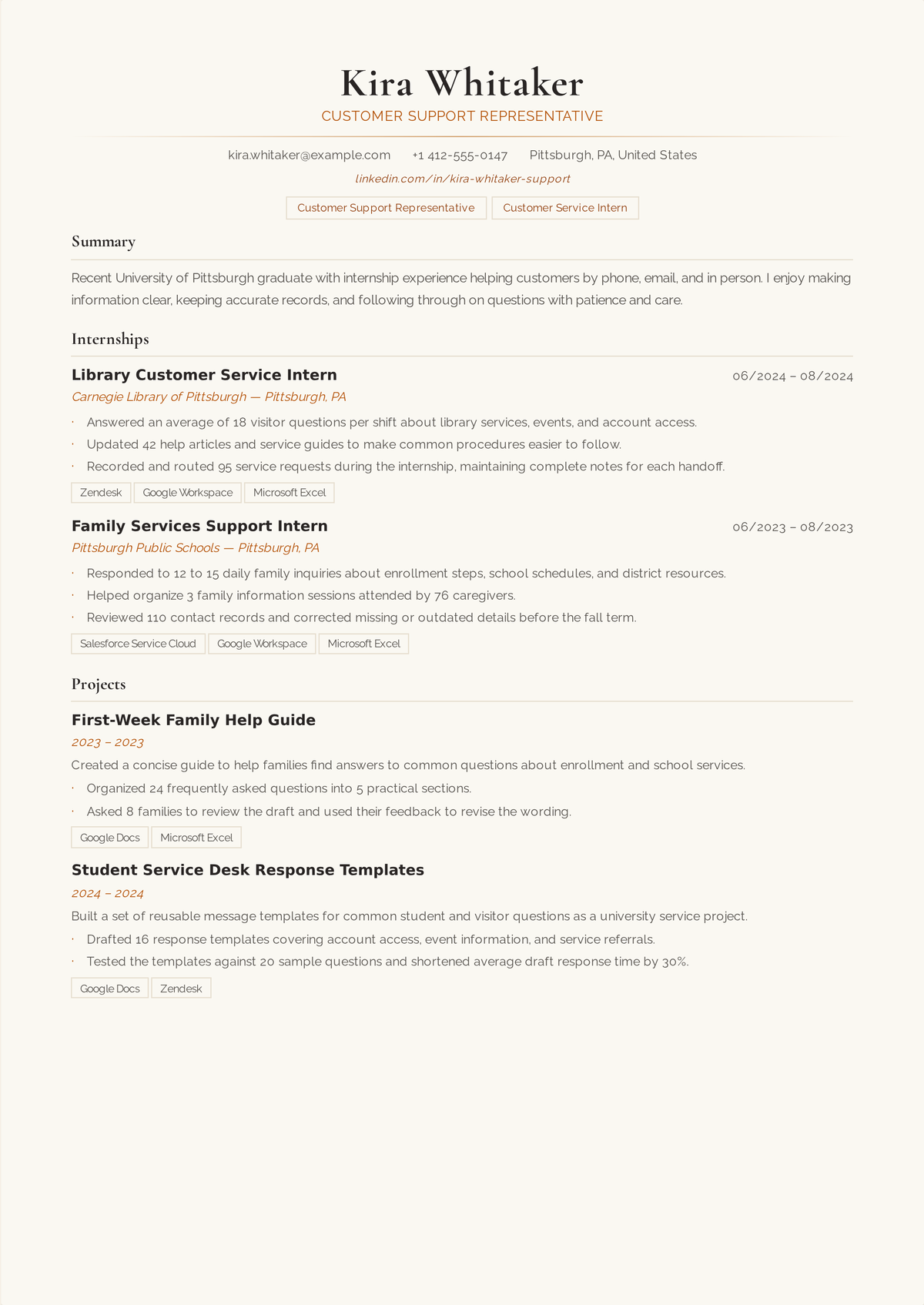
Why this resume works
- A tight summary names the strongest result up front, so a manager sees the fit before scrolling.
- It reframes retail, hospitality, and volunteer work as customer service — the skills transfer, and the resume says so plainly.
- Even entry-level bullets carry numbers: customers served per shift, a satisfaction score, or a complaint turned around.
- It names the basics a support team screens for — ticketing tools, clear written and phone communication, and conflict de-escalation.
Call-center agent (entry level)
A call-center resume is read against hard metrics, so this one puts them front and center: calls handled a day, average handle time, first-call resolution, adherence to schedule, and quality-assurance scores. It shows the work of a high-volume phone queue — following scripts and knowledge bases, documenting every call, de-escalating upset customers, and meeting a team's service-level agreement. The role rewards consistency, so the resume proves it with trend numbers rather than a single good month.
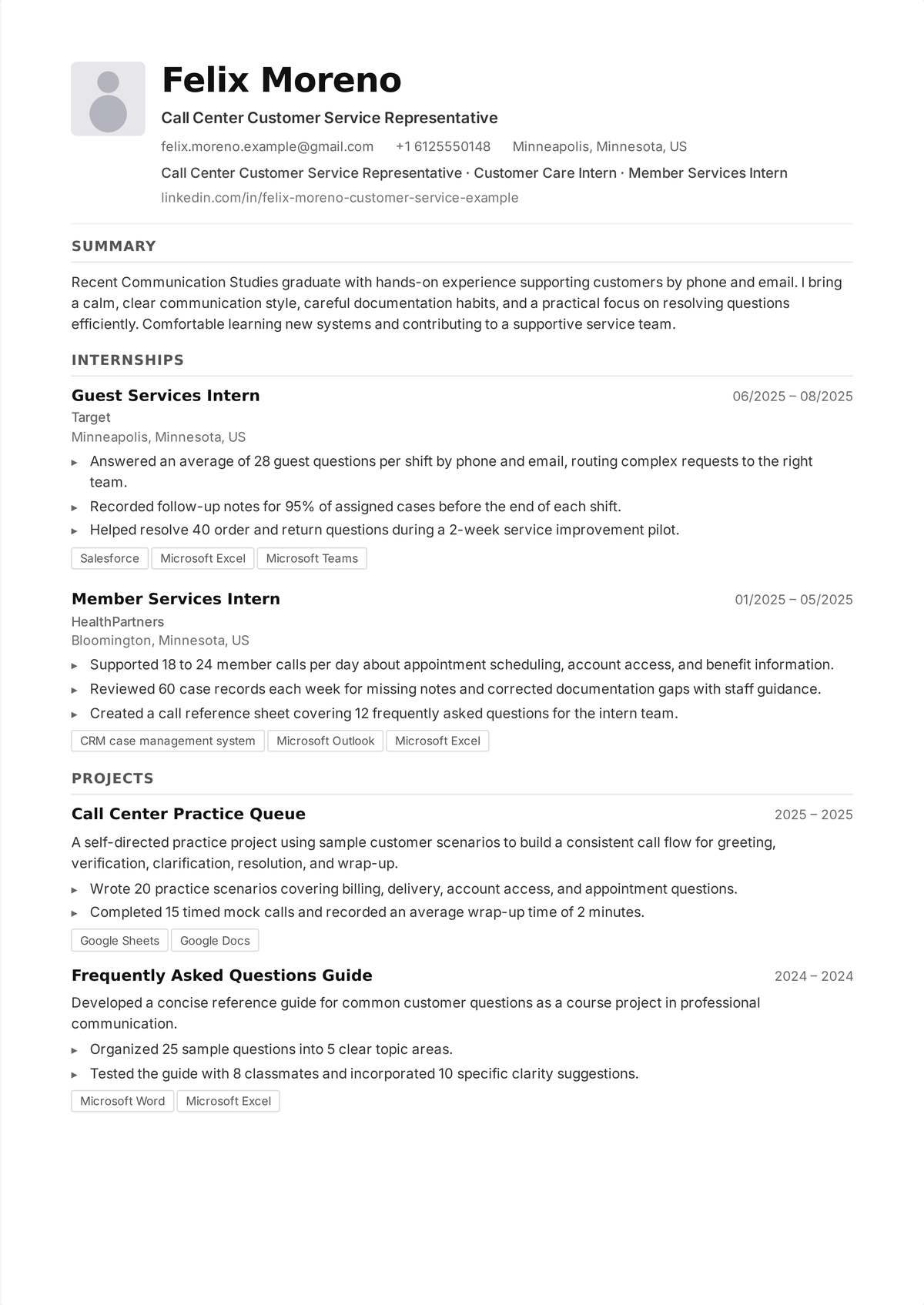
Why this resume works
- It leads with the metrics a call center lives on: calls per day, average handle time, first-call resolution, and QA score.
- It shows consistency over time, not a single good month, because that's what a workforce manager is screening for.
- It names the tools and processes of a phone queue: CRM and ticketing, knowledge bases, call documentation, and SLA adherence.
- It foregrounds de-escalation and empathy, the skills that keep QA scores high when the queue is long.
Technical support specialist (mid-career)
A technical support resume has to show both troubleshooting depth and customer care, so this one pairs the two. It names the product area and the tiers you cover, the systems you support, and the diagnostics you run, then shows the customer side: translating a technical fix into plain language, documenting solutions into the knowledge base, and escalating cleanly to engineering with a reproducible bug report. The numbers are tickets resolved, escalation rate, resolution time, and CSAT on technical issues — which is harder to earn than on a simple request.
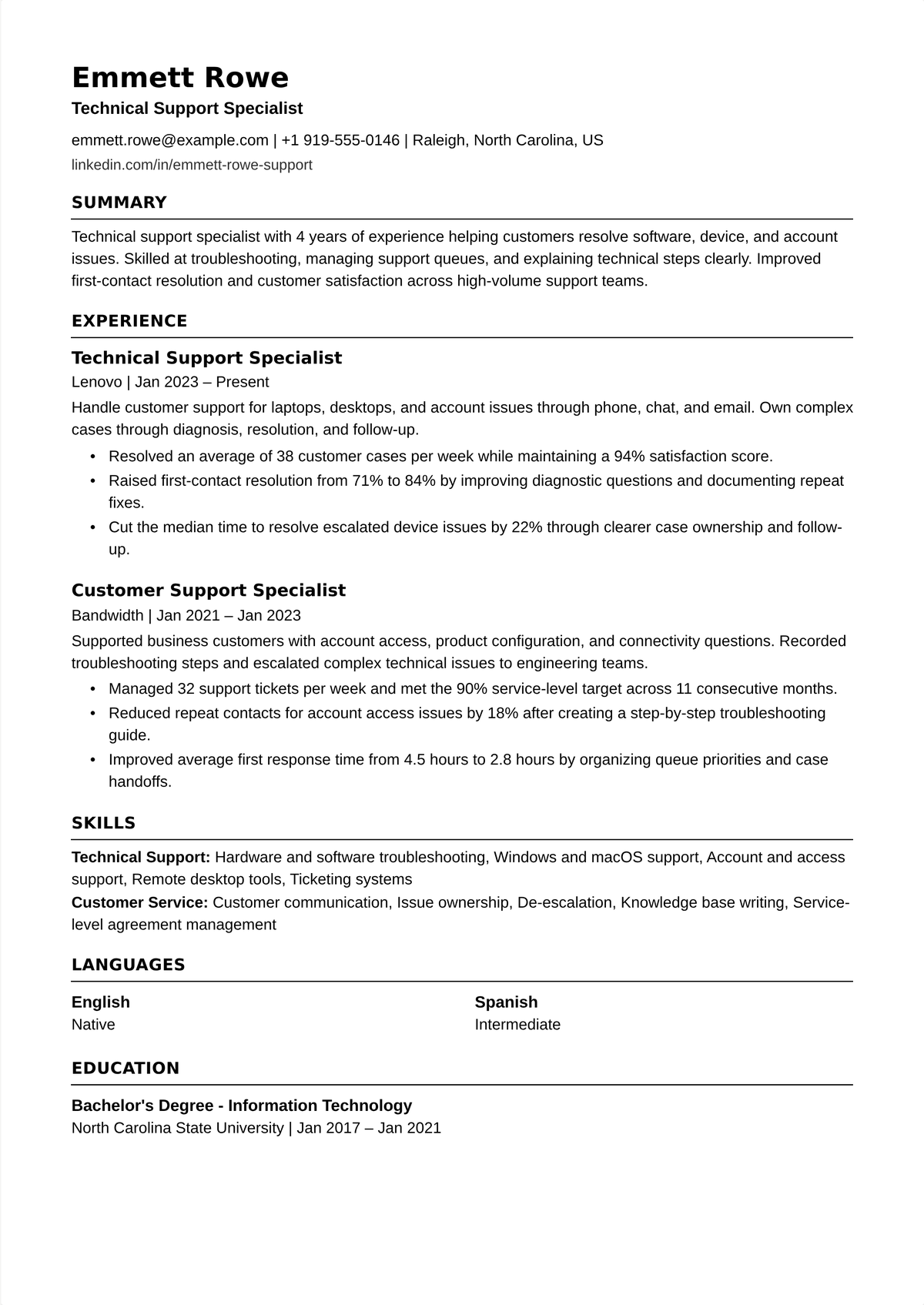
Why this resume works
- It shows the technical depth a support role needs — systems supported, diagnostics run, and the tiers covered — without drowning the customer side.
- It proves the rare combination: resolving a hard problem and explaining the fix in plain language a non-technical customer understands.
- It names the force-multiplier work — knowledge-base articles written and clean, reproducible escalations to engineering — that a lead values.
- Outcomes are measured where they're hard to earn: resolution time, escalation rate, and CSAT on technical tickets specifically.
Customer success manager (mid-career)
Customer success is a step beyond support: you own a portfolio of accounts and you're measured on whether they renew and grow, not just whether their tickets get closed. This resume leads with the book of business — number of accounts and total revenue managed — then shows the work that protects it: onboarding, quarterly business reviews, driving product adoption, spotting churn risk early, and partnering with sales on renewals and expansion. The numbers are net revenue retention, gross retention, churn reduced, and expansion revenue — the metrics a success leader hires on.
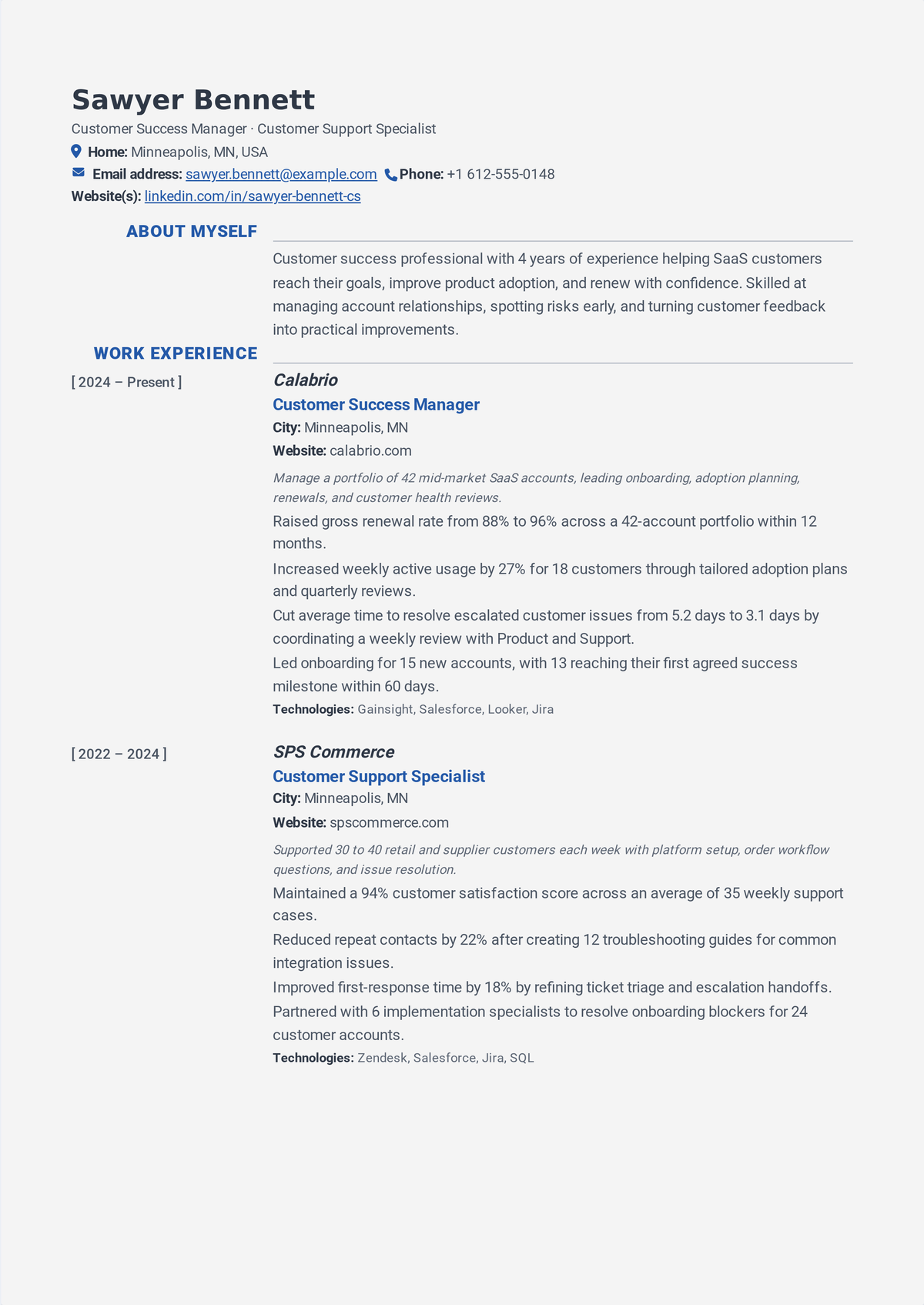
Why this resume works
- It leads with the book of business — accounts and revenue managed — so the scope of the role is clear in one line.
- It frames the job around renewal and growth, naming net revenue retention, gross retention, and expansion rather than ticket counts.
- It shows the proactive work success runs on: structured onboarding, quarterly business reviews, adoption plays, and early churn-risk flags.
- It names the cross-functional partnership — with sales on renewals and with product on feedback — that separates success from support.
Client relations / account manager (senior)
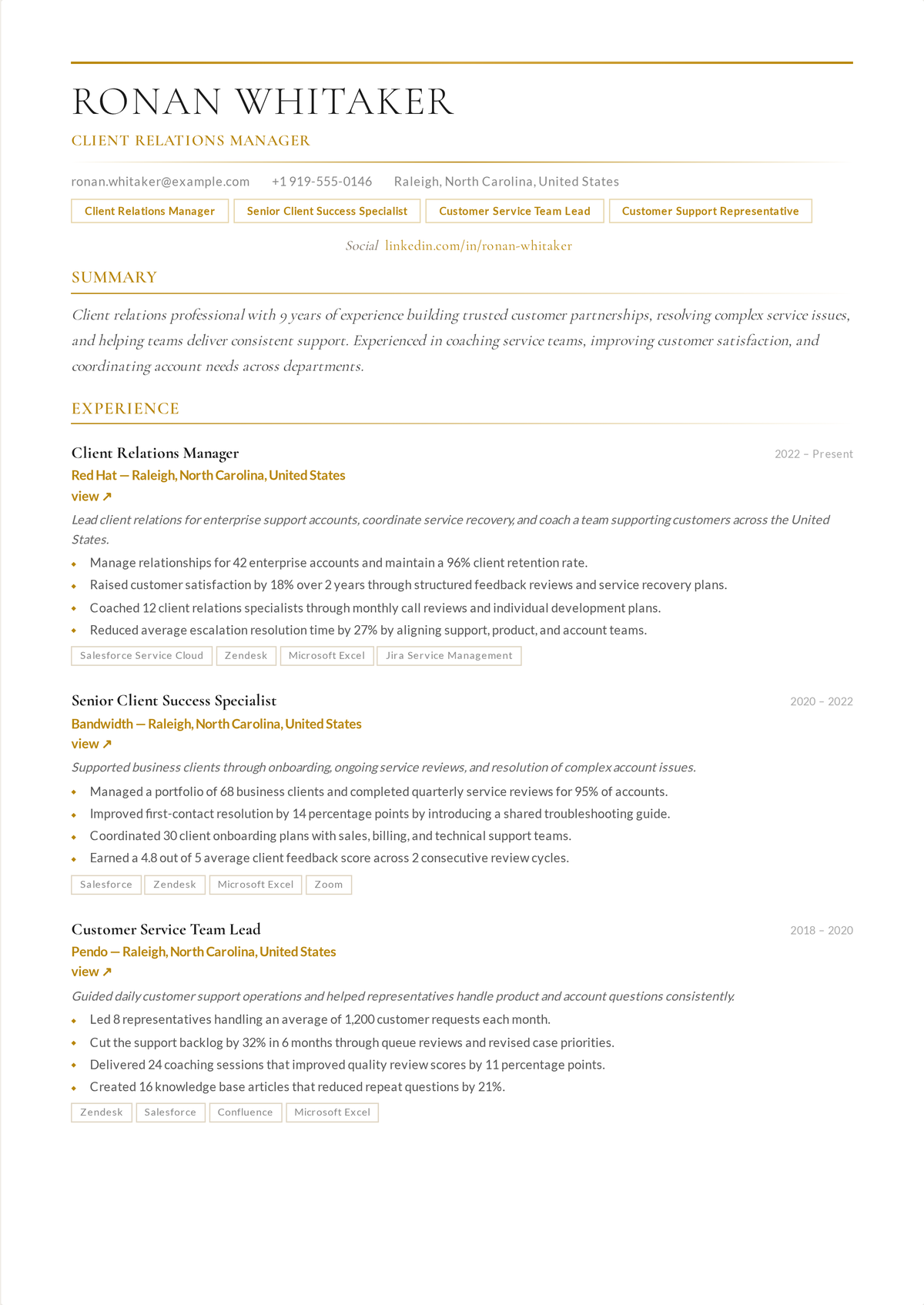
A senior client-relations resume is about trust and retention at scale. This one leads with the size and value of the relationships owned — key accounts, contract values, and tenure — then shows the work of keeping strategic clients happy: being the escalation point when things go wrong, running executive relationships, negotiating renewals, and turning a satisfied client into a reference or case study. The numbers are retention and renewal rates on the top accounts, satisfaction and NPS, and revenue protected or recovered when a major relationship was at risk.
Why this resume works
- It leads with the weight of the relationships owned — named key accounts, contract values, and years of tenure.
- It shows the senior work: executive-level relationships, escalation ownership, and renewal and contract negotiation.
- Outcomes are revenue-level: retention and renewal rates on top accounts, and revenue recovered when a major relationship was at risk.
- It demonstrates influence beyond the account — references, case studies, and client advocacy that feed marketing and sales.
Customer service team lead / supervisor (senior)
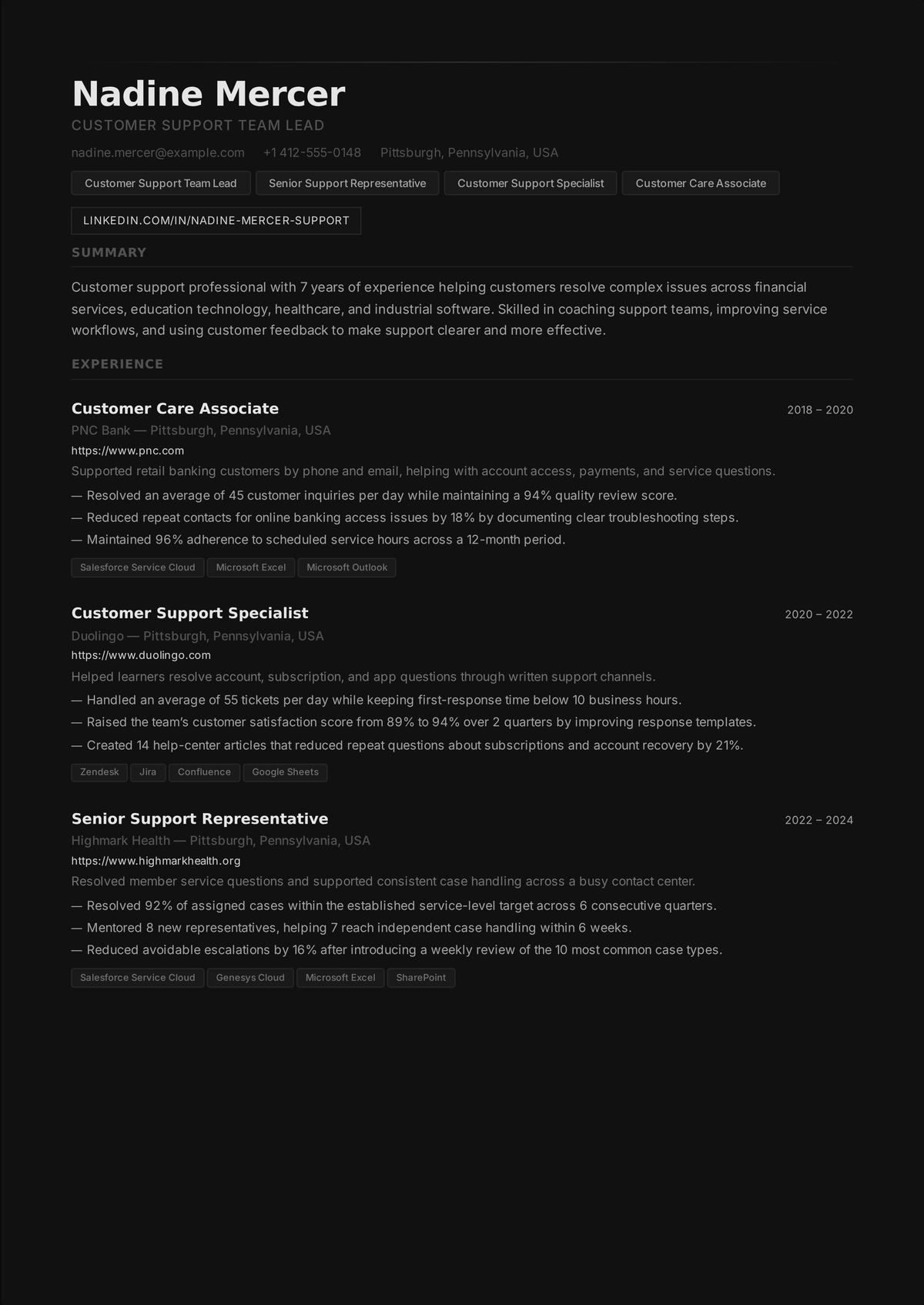
A team-lead resume shifts from "handles customers well" to "makes a team handle customers well." This one leads with the team size and scope managed, then shows the leadership work: coaching agents on quality, running the schedule and queue to hit service levels, handling the escalations the team can't, and improving a process or metric across the whole team. The numbers move up a level too — team CSAT and SLA attainment, agent retention and ramp time, and a measurable improvement you drove, like cutting average handle time or lifting first-contact resolution team-wide.
Why this resume works
- It states the team size and scope managed up top, so the level of responsibility is clear immediately.
- It shows leadership work concretely: coaching to quality scorecards, scheduling to service levels, and owning hard escalations.
- The metrics scale to the team: CSAT and SLA attainment, agent retention and ramp time, not one person's ticket count.
- It names a process improvement the lead drove across the team, which is the signal that separates a supervisor from a senior agent.
A customer service resume template you can copy
Here is a complete mid-career support resume in plain text — single column, standard headings, real numbers. It's a template in the practical sense: swap in your own role, company, and metrics, and you have a resume a parser can read and a hiring manager can scan in seconds.
Priya Sharma
Denver, CO · priya.sharma@email.com · (303) 555-0192 · linkedin.com/in/priya-sharma
Summary
Customer support specialist with five years handling high-volume email, chat, and phone support for a B2B SaaS product. Holds a 96% CSAT across 1,200+ monthly tickets and cut average first-response time from 6 hours to 90 minutes by rebuilding the team's macro and knowledge-base library. Seeking a senior support or customer success role on a product-led team.
Skills
Zendesk · Intercom · Salesforce Service Cloud · Jira · Live chat and email support · Troubleshooting · De-escalation · Knowledge-base writing · SLA management · CSAT/NPS
Experience
Senior Support Specialist — Brightloop Software, Denver (2022–present)
- Resolve 1,200+ email, chat, and phone tickets a month at a 96% CSAT, consistently above the 90% team target.
- Cut average first-response time from 6 hours to 90 minutes by rebuilding 40+ macros and 25 knowledge-base articles.
- Serve as tier-2 escalation point for the team and file reproducible bug reports that cut back-and-forth with engineering by a third.
- Onboarded and mentored 4 new agents, each reaching full productivity two weeks ahead of the standard ramp.
Customer Support Representative — Nimbus Retail, Denver (2020–2022)
- Handled 60–80 contacts a day across phone and chat for an e-commerce brand, maintaining a 94% satisfaction score.
- Processed returns, refunds, and order issues in the CRM with 99% documentation accuracy.
Retail Sales Associate — Summit Outfitters, Boulder (2018–2020)
- Served 100+ customers a day in a high-traffic store and resolved complaints on the spot, earning a store-best mystery-shopper score.
Education
BA in Communication, University of Colorado Boulder — 2014–2018
Certifications
Zendesk Support Administrator (2023) · HDI Customer Service Representative (2021)
What makes this one work: the summary names a hard metric (96% CSAT) and a real improvement in the first two lines, the skills section lists the exact tools a support posting scans for, and every experience bullet carries a number a manager could verify. The layout is deliberately plain so an applicant tracking system extracts each field cleanly.
Put your best metric in the first sentence of the summary. Customer service is one of the most measured jobs there is, so a hiring manager is looking for a number before anything else — a CSAT score, a resolution time, a retention rate. Lead with the strongest one you can honestly claim and can explain in an interview. A summary that opens with "96% CSAT across 1,200 monthly tickets" does more than a paragraph about being passionate about helping people.
The skills to put on a customer service resume
Customer service skills split into the soft skills that make you good with people and the tools and processes that make you employable on a specific team. List the ones the posting actually asks for, in its own words, name the exact platforms you've used, and back the important soft skills with a bullet that shows them in action.
| Skill area | What to put on the resume |
|---|---|
| Communication | Clear written and verbal communication, active listening, plain-language explanation, tone control |
| Problem-solving | Troubleshooting, root-cause analysis, de-escalation, handling an upset customer to resolution |
| Help-desk tools | Zendesk, Intercom, Freshdesk, Salesforce Service Cloud, Gorgias — name the ones you've used |
| CRM & ticketing | Logging and documenting contacts, managing a queue, SLA tracking, tagging and routing |
| Metrics & quality | CSAT, NPS, first-contact resolution, average handle time, QA scorecards, SLA attainment |
| Product & technical | Product knowledge, basic troubleshooting, knowledge-base writing, clean escalation to engineering |
| Languages | Any second language you can support customers in — a genuine differentiator on most teams |
Skip skill bars and star ratings. A screening tool reads "four stars in communication" as nothing, and a hiring manager reads it as filler. A short, honest list of named skills plus one bullet that shows the skill in action — a de-escalation that saved an account, a knowledge base that cut response time — does more than any graphic.
How to write each section of a customer service resume
Lead with a metric-driven summary
Two or three sentences at the top: your role and years in support, the tools and channels you work across, and the single strongest metric you can point to. "Support specialist with five years in B2B SaaS; 96% CSAT across 1,200 monthly tickets" tells a manager more than a paragraph about your people skills. Name the channels (phone, chat, email, social) and whether the environment is B2B or B2C, because they're different jobs. Skip an objective statement about what you hope to gain; the summary describes what the team gets.
Turn support work into numbers
"Answered customer inquiries" describes a seat. "Resolved 1,200 tickets a month at 96% CSAT and cut first-response time from 6 hours to 90 minutes" describes someone worth hiring. Customer service is unusually easy to quantify, so a resume that names its numbers stands out immediately. The metrics that carry weight: CSAT and NPS, first-contact and first-call resolution, average handle and response time, tickets or calls handled, retention and renewal rates, and QA scores. Pull them from your help-desk and CRM reports, and only claim what you can defend in an interview — "how did you measure that?" is the obvious follow-up.
Before: Responsible for answering customer emails and calls. After: Handled 70+ phone and chat contacts a day at a 94% satisfaction score, with 99% CRM documentation accuracy.
Before: Helped reduce customer complaints. After: Cut repeat contacts 30% by rewriting the top 25 knowledge-base articles, lifting first-contact resolution from 68% to 81%.
Name the exact tools you've used
Support and success teams run on specific platforms, and a posting usually names the ones the team uses. List the exact products you've worked in — Zendesk, Intercom, Freshdesk, Salesforce Service Cloud, Gorgias, Jira — rather than a vague "ticketing systems," because a parser and a manager both scan for the real names. If you've used a tool the posting lists, make sure it appears in your skills section and, ideally, in a bullet that shows you using it. The same goes for channels: say whether you've worked phone, live chat, email, or social, since teams hire for a specific mix.
Use the keywords the posting and the ATS scan for
Companies run applications through an applicant tracking system that parses your resume and matches it against the posting. Systems vary — some screen out a missing must-have, many just rank candidates for a recruiter — but a parser-safe file written in the posting's own words gives you the best odds either way. Reuse the posting's exact language where it's honest: if it says "first-contact resolution," "SaaS," "omnichannel," or "Zendesk," use those terms rather than synonyms. Keep the layout parser-safe: single column, standard headings (Summary, Experience, Skills, Education), a real-text PDF, no photo, no graphics boxing in your history. You can check what a parser actually pulls from your file with Prezumi's free ATS resume checker, and the ATS-friendly templates start you from a layout that already passes.
Customer service salary insights
Customer service pay climbs steeply as the role shifts from reactive support to owning revenue. The ranges below are illustrative U.S. figures meant to show how compensation moves by role; your actual figure depends on industry, location, and whether the role is B2B or B2C — enterprise SaaS pays well above retail or consumer support. For current national medians by role, the U.S. Bureau of Labor Statistics Occupational Outlook Handbook is the citable source.
| Customer service role | Typical U.S. salary range (illustrative) |
|---|---|
| Call-center agent / representative (entry) | $32,000–$45,000 |
| Customer service representative (mid) | $40,000–$55,000 |
| Technical support specialist | $48,000–$70,000 |
| Team lead / supervisor | $55,000–$78,000 |
| Customer success manager | $70,000–$110,000 |
| Client relations / senior account manager | $85,000–$130,000+ |
Two things move these numbers: the industry and whether you own revenue. The same support skills pay far more in enterprise B2B SaaS than in retail, and the jump from support to customer success — where renewals and expansion are on you — is the biggest single step up. On the resume, that means foregrounding any revenue, retention, or expansion you've touched, and naming the industry and product type, because they set the pay band as much as the job title does.
Build your customer service resume in Prezumi
Prezumi holds your support history as one profile and renders it into any of 55+ templates, so you write the metrics, the tools, and the results once. Import an existing resume to skip retyping, pick an ATS-friendly template that keeps a clean single column, and export a text-based PDF for free. When you apply to a specific team, the AI editor rewords your real entries to match that posting (it can only reshape the details you entered, so it won't invent a CSAT score), and the ATS checker confirms the file parses before you send it. If this is your first support job, our first-job resume guide shows how to fill a resume with retail, hospitality, and volunteer experience instead of years on the job, and the student CV examples use the same one-page approach. For the letter that goes with the application, the free cover letter generator works from your resume and the posting.
FAQ
What should a customer service resume focus on?
Evidence that you resolve problems and keep customers happy, stated in numbers. Customer service is one of the most measured jobs there is, so lead with your metrics — CSAT or NPS, first-contact resolution, average handle or response time, tickets or calls handled, and retention — and back them with short, specific bullets. Name the exact tools you've used and the channels you've worked, and keep soft skills like communication and de-escalation tied to a result rather than listed on their own.
How do I write a customer service resume with no experience?
Reframe the contact work you already have. Retail, hospitality, food service, reception, and volunteer help desks are all customer service, and the skills transfer directly — handling complaints, staying calm under pressure, explaining things clearly, and working a point-of-sale or booking system. Give each of those roles a real entry with a number where you can (customers served a day, a satisfaction or mystery-shopper score), add any relevant coursework or certification, and lead with a summary that names your strongest people skill. Our first-job resume guide walks through filling a resume without years of paid work.
What metrics should I put on a customer service resume?
The ones your team was measured on, pulled from your help-desk and CRM reports. The most persuasive are CSAT and NPS, first-contact or first-call resolution, average handle and response time, tickets or calls handled per day or month, SLA attainment, QA scores, and — for success and account roles — retention, renewal, and expansion rates. Write them as real figures with context ("96% CSAT across 1,200 monthly tickets") and only claim what you can explain in an interview.
Should I list the help-desk tools I've used?
Yes, by their exact names. Support teams run on specific platforms — Zendesk, Intercom, Freshdesk, Salesforce Service Cloud, Gorgias, Jira — and both the applicant tracking system and the hiring manager scan for the real product names, not a vague "ticketing systems." Put the tools you've genuinely used in your skills section, and if the posting names one you know, make sure it appears and ideally shows up in a bullet where you used it.
How long should a customer service resume be?
One page for most roles, including entry-level agents and anyone with up to roughly ten years of experience. Two pages are justified only when a decade or more of directly relevant support, success, or leadership genuinely fills them — a senior customer success or client-relations manager with a long account history. Keep it dense and specific rather than padded; a hiring manager scanning a stack would rather see one strong page.
What's the difference between a customer service and a customer success resume?
A customer service resume is built around resolving contacts — tickets, calls, and chats — and is measured on CSAT, resolution time, and volume. A customer success resume is built around keeping and growing accounts, so it leads with a book of business and is measured on net revenue retention, churn, and expansion, with proactive work like onboarding and quarterly business reviews instead of a ticket queue. If you're moving from support into success, foreground any renewal, retention, or revenue impact you've had.
Should a customer service resume include a photo?
No, for jobs in the US, UK, Canada, and most of Europe. Companies don't need a photo, many prefer applications without one to avoid bias, and a photo can trip up an applicant tracking system. A few countries do expect a photo on any CV; follow local convention if you're applying somewhere that clearly asks for one, but leave it off by default.
What skills should I put on a customer service resume?
The ones the posting names, in its own words. The core set most teams screen for is clear written and verbal communication, active listening, problem-solving and de-escalation, and the help-desk and CRM tools you've used. Add metrics literacy (CSAT, NPS, first-contact resolution), product or technical knowledge where the role needs it, and any second language you can support customers in, which is a genuine differentiator. Back the important soft skills with a bullet that shows them in action rather than leaving them as a bare list.
How do I make a call-center resume stand out?
Lead with the hard metrics a call center is run on — calls handled per day, average handle time, first-call resolution, schedule adherence, and QA scores — and show them as a consistent trend rather than a single good month. Name the dialer, CRM, and knowledge-base tools you've used, show that you can follow scripts and SLAs while still de-escalating upset callers, and quantify any improvement you drove, like lifting first-call resolution or cutting handle time without hurting satisfaction.
How do I make my customer service resume ATS-friendly?
Use a single-column layout, standard section headings (Summary, Experience, Skills, Education), and a PDF that contains real extractable text rather than an image. Reuse the exact keywords from the job posting where they honestly apply — the tool names, the channels, the metrics — and leave out photos, columns, and graphics that scramble parsing. Prezumi's free ATS resume checker runs real text extraction on your file and shows you what a parser pulls out, so you can confirm it reads cleanly before you send it.
Do customer service certifications help on a resume?
They're a modest plus, worth one line in a Certifications section, especially for entry-level or specialized roles. Recognized ones include HDI's customer service and support certifications, tool-specific credentials like Zendesk or Salesforce Service Cloud administrator, and ITIL for IT service desks. They won't carry a resume on their own — measured results do that — but a relevant certification signals commitment and can tip a decision between two similar candidates.
About the author
Zubair Baqai is an AI engineer and the founder of Prezumi. He started it after researching what gets candidates interviews at companies like Google, Meta, Microsoft and Amazon. He writes Prezumi's guides on resumes, ATS screening and CV formats. About Prezumi
Your job-search toolkit
Free tools for every step of a job application. No signup.
- Write a tailored cover letter — Upload your resume, paste the job description, pick a style, and get a cover letter matched to the role in under a minute.
- Turn your resume into a website — Convert your resume into a live personal website with a matching online resume and one shareable link for recruiters.
- Check if ATS can read your resume — Upload your PDF and get an instant score for text extraction, reading order, sections, contact info, and content strength.
- Write a resignation letter — Fill in your name, role, and last day, pick a tone, and get a clean, professional resignation letter to copy or download as a PDF.
- Convert to a Harvard resume — Reformat any resume into the Harvard career-services layout used by students and recent grads — preview instantly, download the PDF free.
- Translate your CV — Translate your resume between English, Spanish, German, French, Italian, Portuguese, Turkish, and Arabic — layout and dates kept intact.
- Fix weak resume wording — Find buzzwords, weak verbs, vague bullets, and missing metrics. Get a 0–100 wording score and stronger rewrites.
- Convert to a Europass CV — Turn any resume into the Europass-style format European employers expect — preview instantly, download the PDF free.
- Convert GPA & grades — Convert between US GPA, percentage, letter grades, UK honours, ECTS, and 10-point CGPA — and see if you graduated cum laude.
