Accountant Resume Examples by Specialty and Level
Accountant resume examples from staff to management accounting, across tax, audit, and payroll, plus a copyable template and the CPA and skills to list.
An accountant's resume is screened for two things fast: the credential or progress toward it — a CPA, a CPA candidacy, or a relevant degree — and evidence that your work was accurate, on time, and controlled. Accounting is a profession where mistakes cost money and audits find them, so hiring managers look for the ledgers you closed cleanly, the controls you kept, and the money you saved or recovered. Below are accountant resume examples for every specialty and level, from an entry-level staff accountant to a senior management accountant, each linked to a live sample you can open, plus the skills, sections, and numbers that get a resume past an applicant tracking system and onto a controller's shortlist.
The examples come first, then a text template you can copy, then the writing advice behind all of them — the credential, accuracy and close-time metrics, the systems you've run, and the keywords a firm's hiring software scans for. The general rules that apply to any resume are collected in our resume writing guide; this page is the accounting-specific version.
How these examples were made. Each résumé below is a real Prezumi template rendered from a complete accounting profile — the same builder you'd use for your own — not a static mock-up. The names, firms, and numbers are illustrative. The credential, systems, and salary guidance reflects how U.S. accounting hiring commonly works; conventions and credential names differ by country, so check your local requirements and the posting before you copy anything wholesale.
Accountant resume examples by specialty and level
Accounting is not one job. A staff accountant closing the month and a management accountant building the budget the company runs on share a profession and almost nothing else about their quarter, and their resumes should look as different as their work does. Each example below is a real resume rendered in a clean, ATS-friendly Prezumi template — so you can see the exact format for your specialty and experience level and then build your own from the same structure. Click any example to enlarge it, or use it as your starter profile with one tap.
Staff accountant (entry level)
An entry-level staff accountant resume has to show you know the fundamentals and can be trusted with the books even without years on the job. This one leads with the degree and CPA status — "CPA candidate, passed FAR and AUD" counts for a lot — then shows real work: journal entries, account reconciliations, accounts payable and receivable, and support for the monthly close, whether from an internship, a first role, or a solid accounting program. The strongest entry-level bullets carry a number: accounts reconciled, close days supported, or a discrepancy you caught.
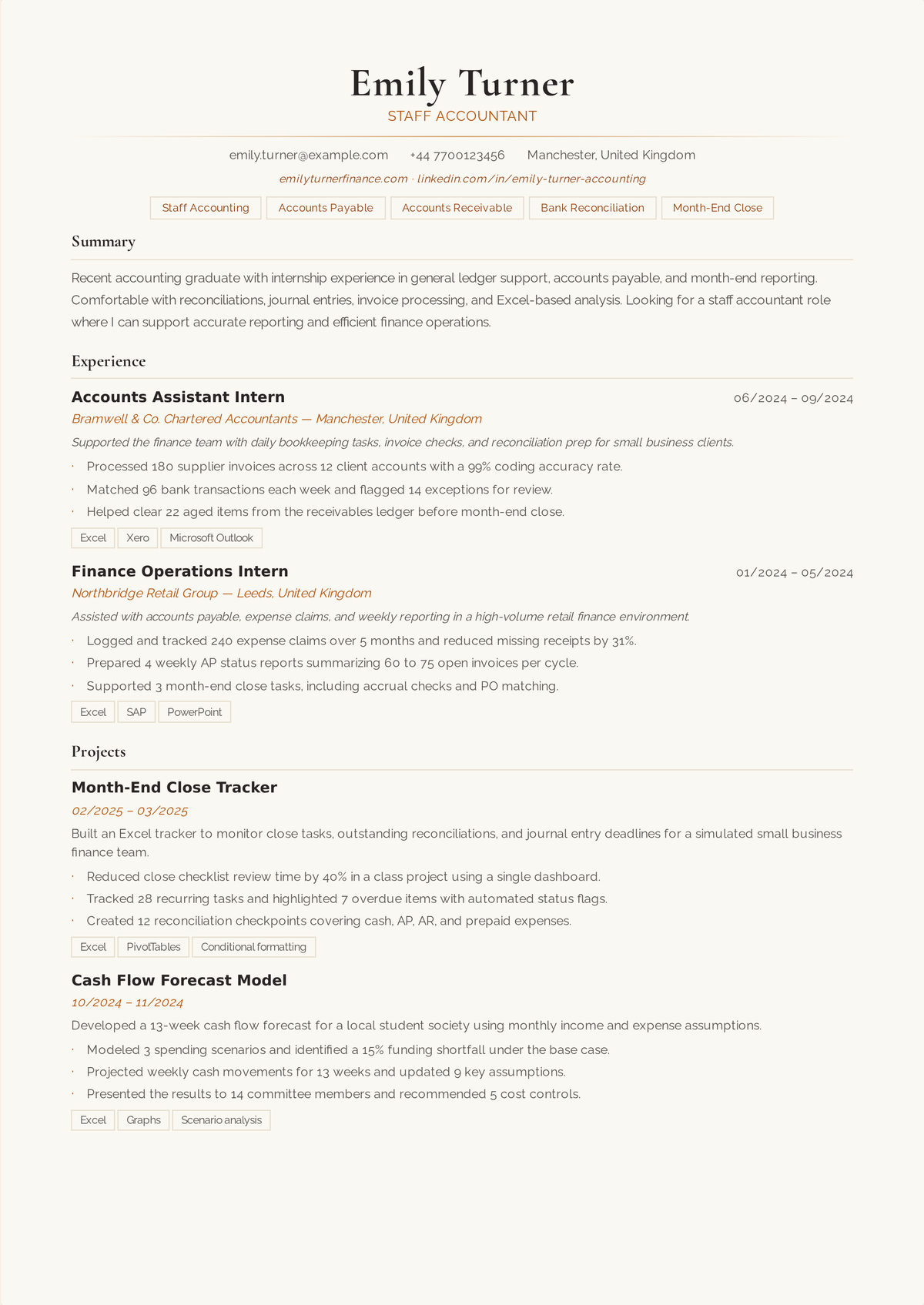
Why this resume works
- The degree and CPA status lead the page — even "CPA candidate, passed 2 of 4 sections" is a signal a firm values.
- It shows the fundamentals a staff role runs on: journal entries, reconciliations, AP/AR, and month-end close support.
- Even entry-level bullets carry numbers: accounts reconciled, close cycles supported, and a discrepancy caught and corrected.
- It names the systems a firm screens for — QuickBooks, Excel, an ERP — and keeps the layout ATS-clean.
Staff / general accountant (mid-career)
A few years in, a general accountant owns the close rather than just supporting it, and this resume shows the shift. It leads with the CPA (or its progress) and then proves ownership: running the month-end and year-end close, preparing financial statements under GAAP, managing reconciliations and accruals, and being the person external auditors come to. The numbers are close time cut, reconciliation accuracy, audit adjustments avoided, and the scale of the books — revenue, entities, or accounts owned. It reads as someone a controller can hand a cycle to and stop worrying about.
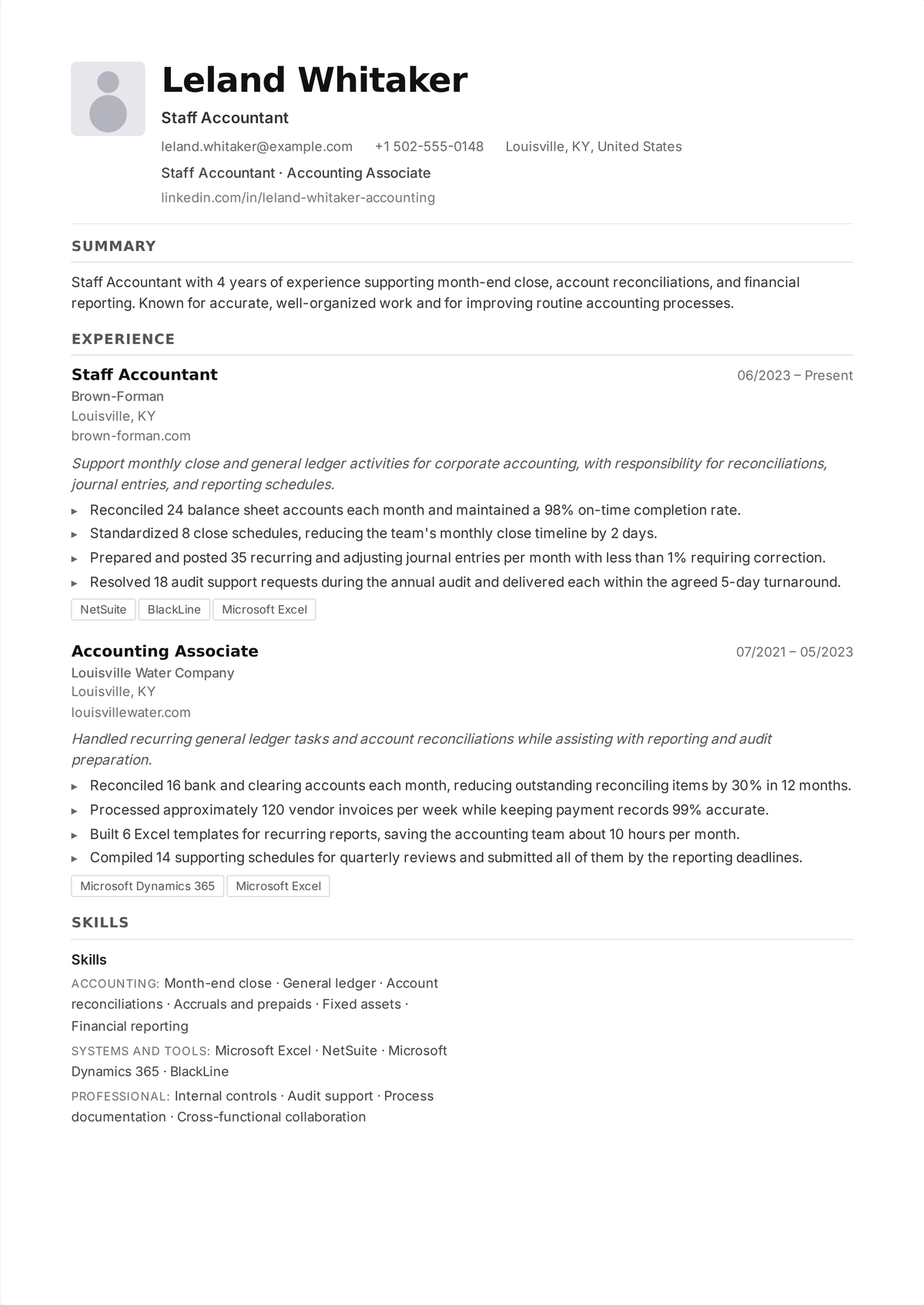
Why this resume works
- It leads with the CPA or its progress, the credential a controller checks for first on a general-accounting hire.
- It shows ownership: running the full close, preparing GAAP financial statements, and being the point of contact for external auditors.
- Duties become numbers — close time cut from 10 days to 6, reconciliation accuracy, and audit adjustments avoided.
- It quantifies scope: the revenue, entities, or account volume the accountant owns, so a hiring manager sees the level.
Tax accountant (mid-career)
A tax resume is about accuracy, deadlines, and savings, so this one leads with the credential and the returns it covers — individual, corporate, partnership, multi-state — then shows the work: preparing and reviewing returns, researching positions, managing filing deadlines, and handling notices or an audit. The numbers that matter are returns filed, tax saved or liability reduced for clients, deadlines hit through busy season, and penalties avoided. In public accounting it also shows the client load carried; in industry it shows the provision and compliance work for the company.
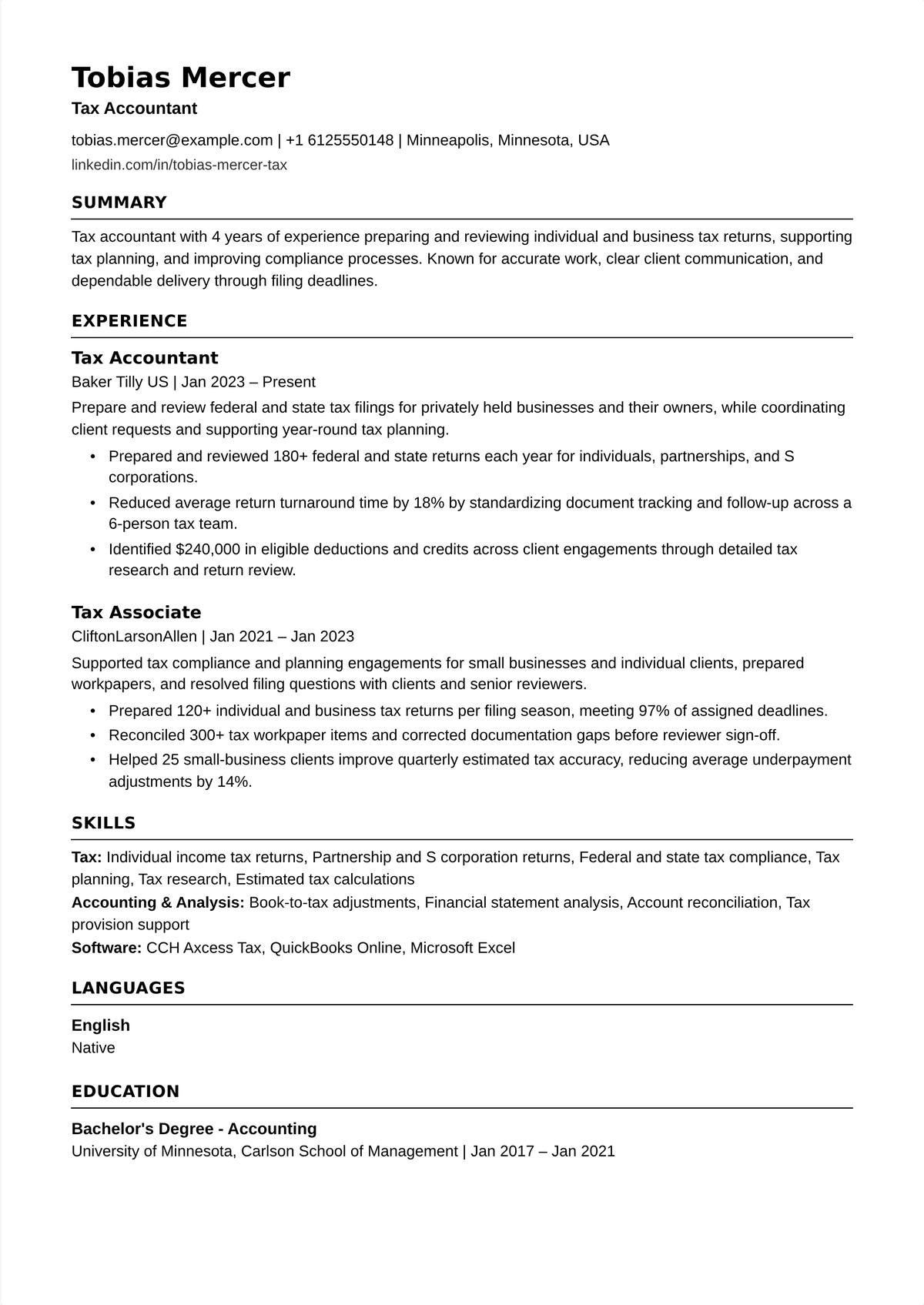
Why this resume works
- It leads with the credential (CPA or EA) and the return types covered — individual, corporate, partnership, multi-state — a tax posting screens for.
- It shows the full tax cycle: preparation, review, research, deadline management, and handling notices or an audit.
- Outcomes are concrete: returns filed, tax saved or liability reduced, busy-season deadlines hit, and penalties avoided.
- It names the research and software — tax code positions, and tools like UltraTax, Lacerte, or ProSystem — that signal real tax work.
Auditor (mid-career)
An audit resume is about risk, controls, and judgment. This one leads with the CPA and the audit standards it covers, then shows the work: planning and executing audits, testing internal controls, documenting workpapers to standard, and communicating findings to management. Whether the role is external (public accounting) or internal, the numbers are engagements completed, control weaknesses identified and remediated, findings that improved a process, and clean opinions delivered on time. It shows the independence and professional skepticism auditors are hired for, with a concrete example rather than a buzzword.
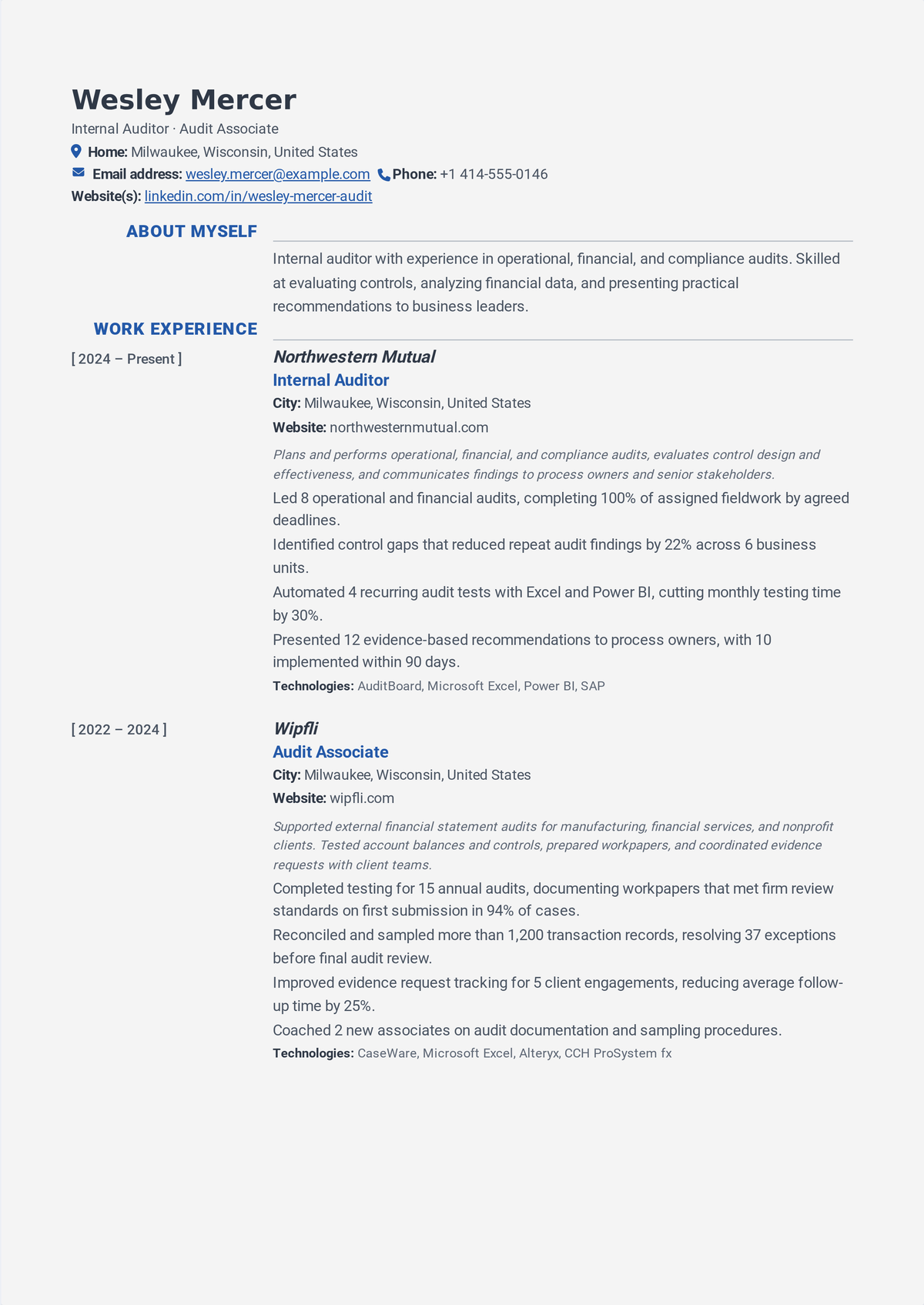
Why this resume works
- It leads with the CPA and the audit standards and frameworks (GAAS, SOX, COSO) that an audit posting screens for.
- It shows the audit cycle concretely: risk-based planning, control testing, workpaper documentation, and findings communicated to management.
- Outcomes are measured in risk terms: control weaknesses found and remediated, process improvements, and clean opinions on schedule.
- It demonstrates the independence and professional skepticism the role is built on with a concrete example, not a claim.
Management / cost accountant (senior)
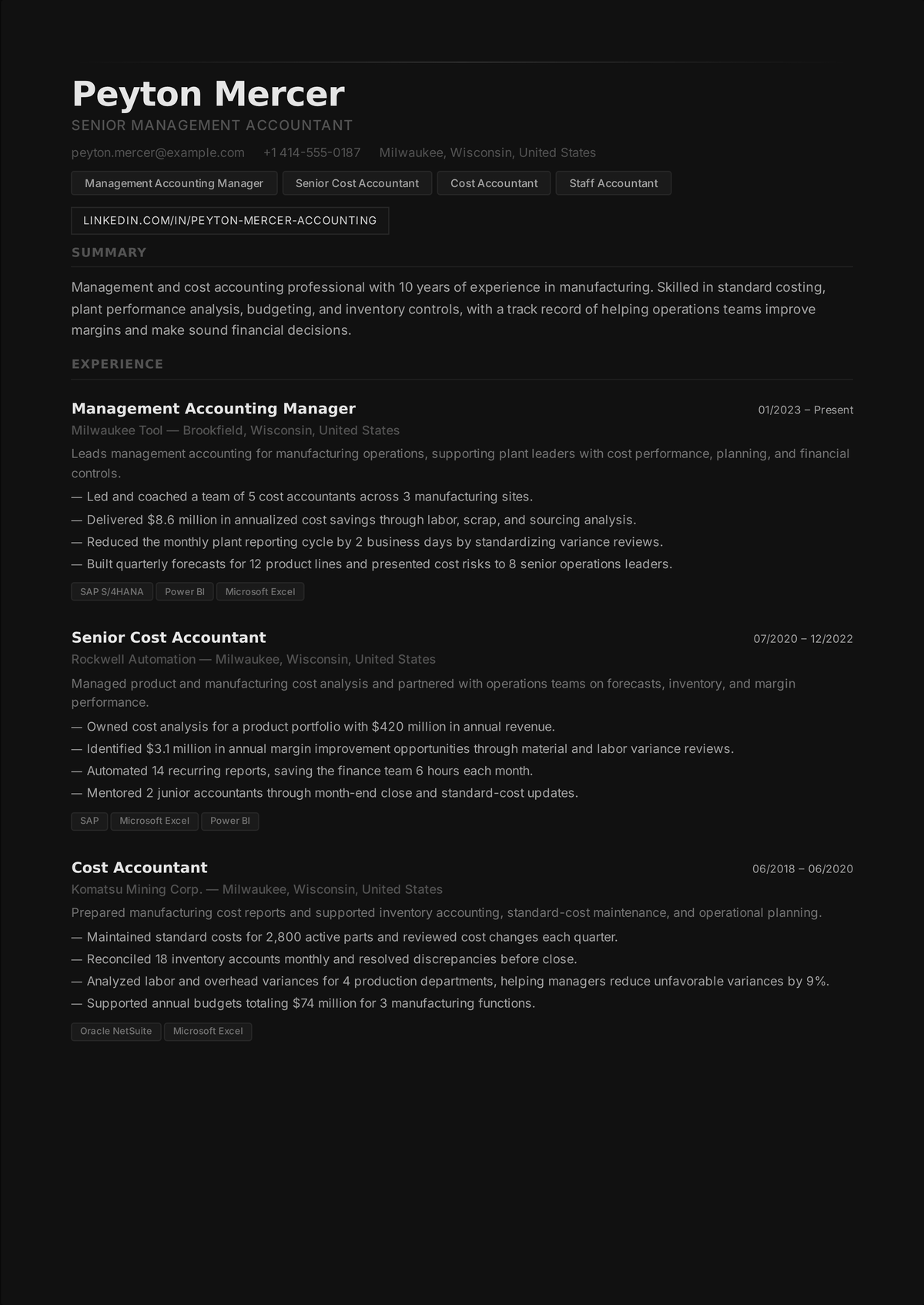
A management accountant's resume looks forward rather than backward — it's about budgets, forecasts, and the numbers leaders use to decide. This senior resume leads with the credential (CPA or CMA) and then shows the work that drives the business: building budgets and forecasts, analyzing costs and margins, reporting on variances, and partnering with operations to control spend. The numbers are cost reduced, margin improved, forecast accuracy, and decisions the accountant's analysis shaped. At this level it also shows leadership — owning a reporting function or managing a small team.
Why this resume works
- It leads with the credential (CPA or CMA), the signal a management-accounting or FP&A hire checks for first.
- It frames the role forward: budgets, forecasts, cost and margin analysis, and variance reporting that leaders decide from.
- Outcomes are business-level: cost reduced, margin improved, forecast accuracy, and specific decisions the analysis shaped.
- At a senior level it shows leadership — owning a reporting function or managing a team — that marks the step beyond individual work.
Two more roles round out the picture — the bookkeeping and payroll positions that keep a business running day to day, and that many accounting careers start from or specialize into.
Bookkeeper (entry level)
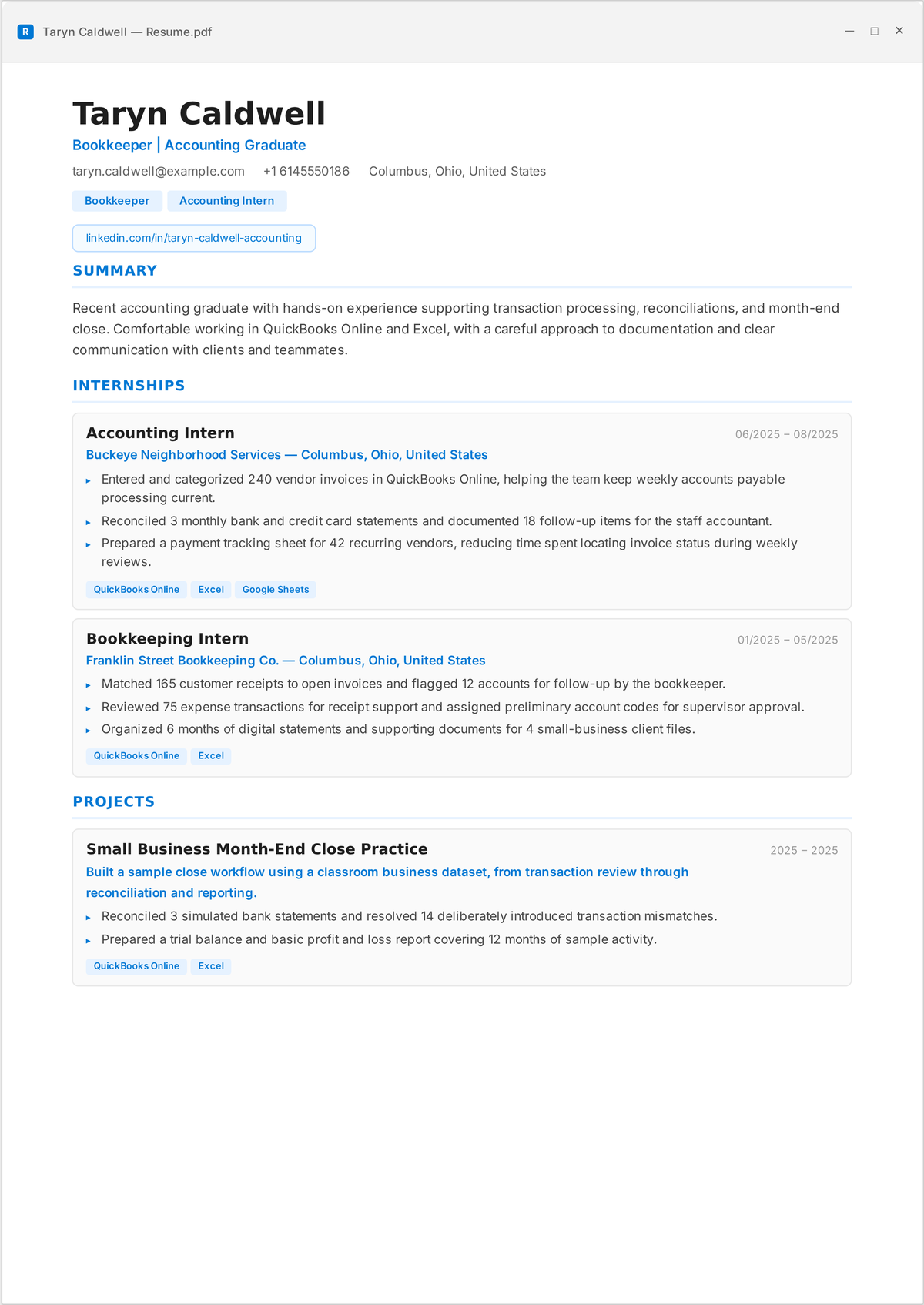
A bookkeeper keeps a business's day-to-day records accurate, so this resume leads with the systems and the scope: the accounting software run (QuickBooks, Xero), the number of clients or entities kept, and the cycle owned — recording transactions, reconciling bank and credit-card accounts, managing AP and AR, and producing monthly reports. The numbers are accounts and clients managed, reconciliation accuracy, invoices processed, and a clean, audit-ready set of books. For many people it's a step toward a full accounting role, so the resume signals any degree or CPA progress.
Why this resume works
- It leads with the software and scope — QuickBooks or Xero, the number of clients or entities — that a bookkeeping posting screens for.
- It shows the full day-to-day cycle: transaction recording, bank and credit-card reconciliations, AP/AR, and monthly reporting.
- It backs the role with numbers: accounts and clients managed, reconciliation accuracy, and invoices processed.
- It reads as a career in motion, signaling an accounting degree or CPA progress where one applies.
Payroll specialist (mid-career)
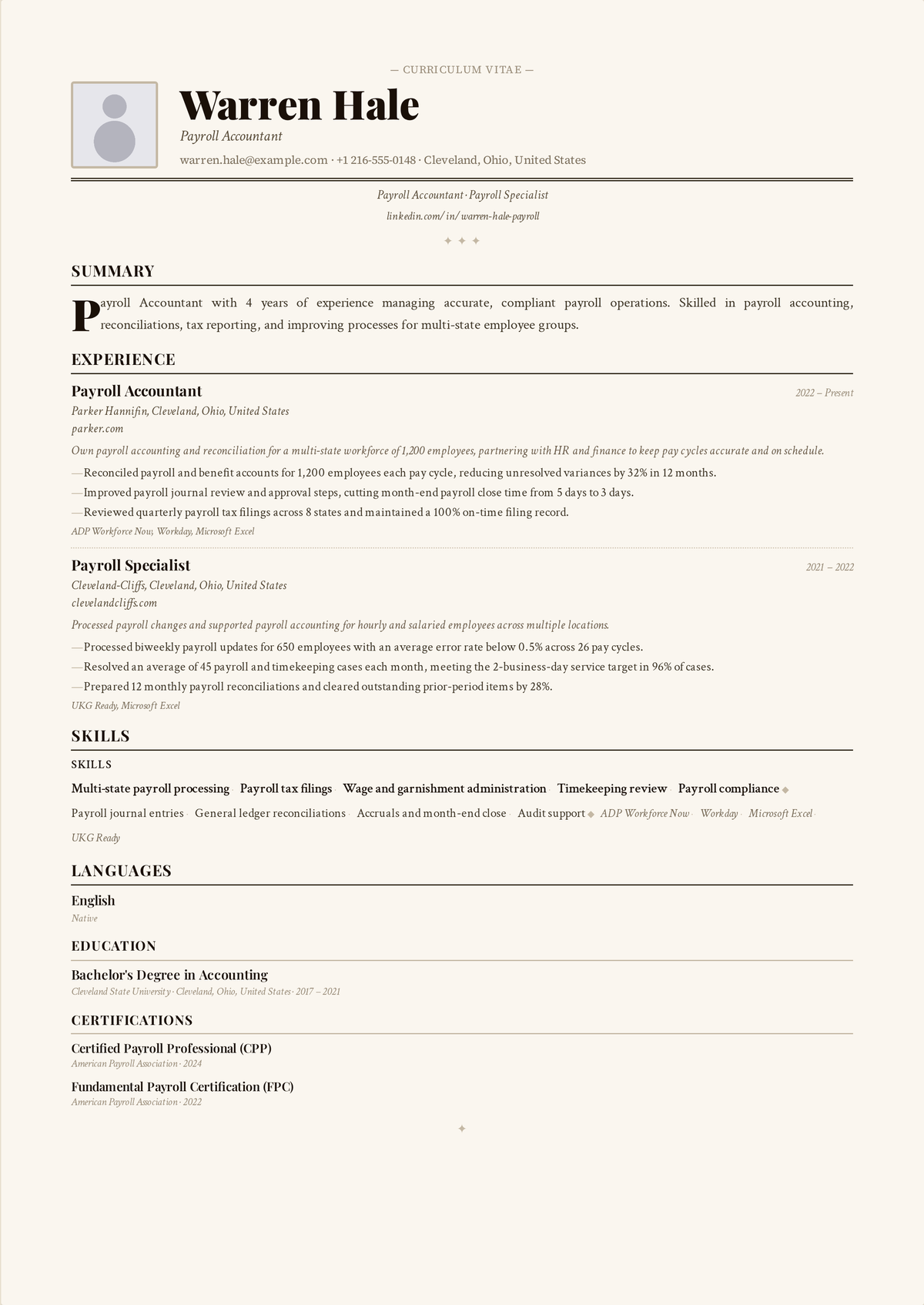
A payroll resume is about accuracy, compliance, and never missing a pay date. This one leads with the payroll systems run and the scale — employees paid across how many states or entities — then shows the work: processing multi-state payroll, handling taxes and filings, managing benefits deductions and garnishments, and staying compliant with wage-and-hour law. The numbers are employees and pay cycles handled, payroll accuracy rate, compliance with filing deadlines, and errors or penalties avoided. It's a role where a single mistake is visible company-wide, so the resume leads with a track record of getting it right.
Why this resume works
- It leads with the payroll systems (ADP, Workday, Paychex) and the scale — employees and states or entities paid — a payroll posting screens for.
- It shows the full scope: multi-state processing, payroll tax filings, benefits deductions and garnishments, and wage-and-hour compliance.
- Outcomes are accuracy-first: payroll accuracy rate, filing deadlines met, and errors or penalties avoided.
- It foregrounds the reliability the role demands, because a payroll mistake is visible across the whole company.
An accountant resume template you can copy
Here is a complete mid-career staff-accountant resume in plain text — single column, standard headings, real numbers. It's a template in the practical sense: swap in your own credential, employer, and results, and you have a resume a parser can read and a controller can scan in seconds.
David Okonkwo, CPA
Atlanta, GA · david.okonkwo@email.com · (404) 555-0147 · linkedin.com/in/david-okonkwo-cpa
Summary
CPA with five years in general accounting for a mid-market manufacturer, owning the full month-end close for a $120M-revenue entity. Cut the close from 9 days to 5 by automating reconciliations and standardizing the accrual process, with zero audit adjustments in the last two external audits. Seeking a senior accountant or accounting manager role.
Credentials & skills
Certified Public Accountant (CPA), Georgia (active) · US GAAP · Month-end close · Financial statement preparation · Account reconciliation · NetSuite · SAP · Advanced Excel (pivot tables, lookups, modeling) · SOX controls
Experience
Senior Staff Accountant — Peachtree Manufacturing, Atlanta (2022–present)
- Own the full month-end close for a $120M-revenue entity, cutting the cycle from 9 days to 5 by automating 30+ reconciliations in NetSuite.
- Prepare monthly GAAP financial statements and the audit package; delivered the last two external audits with zero adjustments.
- Standardized the accrual and prepaid process across 4 departments, eliminating recurring period-end errors.
- Mentor two junior accountants and review their reconciliations before close.
Staff Accountant — Lumen Services Group, Atlanta (2020–2022)
- Managed AP and AR for a $40M services business, reconciling 20+ GL accounts monthly at 100% accuracy.
- Caught and corrected a $180k revenue-recognition error before it reached the financial statements.
Education
BBA in Accounting, University of Georgia — 2016–2020 (150-hour CPA track)
Certifications
CPA (Georgia), 2022 · QuickBooks ProAdvisor (2021)
What makes this one work: the CPA sits right in the name line and again under the summary, the summary names a concrete control win (9 days to 5, zero audit adjustments) in its second sentence, and every experience bullet carries a number a controller could verify. The layout is deliberately plain so an applicant tracking system extracts each field cleanly.
Put the CPA — or your exact progress toward it — where a recruiter can't miss it. If you're licensed, add it after your name ("David Okonkwo, CPA") and in a credentials line. If you're a candidate, say exactly where you are: "CPA candidate, passed FAR and REG, sitting for AUD in Q2." That's far more valuable than leaving it off, because firms track candidates on a timeline. The same goes for a CMA, EA, or ACCA — name the credential, the status, and the jurisdiction.
The skills to put on an accountant resume
Accounting skills split into the technical knowledge, the systems you run, and the controls and compliance a firm depends on. List the ones the posting actually asks for, in its own words, name the exact software, and back the important ones with a bullet that shows the skill producing an accurate, on-time result.
| Skill area | What to put on the resume |
|---|---|
| Core accounting | GAAP (or IFRS), month-end and year-end close, financial statement preparation, reconciliations, accruals |
| Specialty knowledge | Tax prep and research, audit and internal controls, cost accounting, budgeting and forecasting, payroll |
| ERP & software | NetSuite, SAP, Oracle, QuickBooks, Xero — plus the tax or payroll software for your specialty |
| Excel & data | Advanced Excel (pivot tables, lookups, modeling); SQL or a BI tool is a growing plus |
| Controls & compliance | SOX, internal controls, segregation of duties, audit support, regulatory filings |
| Credentials | CPA, CMA, EA, ACCA, or CIA — list the credential, its status, and jurisdiction |
Skip skill bars and star ratings. A screening tool reads "four stars in GAAP" as nothing, and a controller reads it as filler. A short, honest list of named skills and systems plus one bullet that shows the skill producing an accurate, on-time result does more than any graphic.
How to write each section of an accountant resume
Put the credential and its status first
In accounting, a credential moves you up the stack, and its progress matters almost as much as the finished license. If you're a CPA, put it after your name and in a credentials line with the state and active status. If you're a candidate, say exactly where you are — "CPA candidate, passed FAR and REG, sitting for AUD in Q2" — because firms hire and track candidates on a timeline and leaving it off reads as no progress at all. The same applies to a CMA, EA, ACCA, or CIA: name the credential, the status, and the jurisdiction. Then list the degree, and note the 150-hour track if you're on it, since it's a CPA prerequisite in the US.
Turn duties into accuracy and savings
"Responsible for the month-end close" describes a task. "Cut the month-end close from 9 days to 5 and delivered two external audits with zero adjustments" describes an accountant worth hiring. Accounting is judged on accuracy, timeliness, and control, and a resume that names those stands out in a stack of duty lists. The numbers that carry weight: close time cut, reconciliation and audit accuracy, cost reduced or margin improved, tax saved, discrepancies or fraud caught, and the scale of the books — revenue, entities, or transaction volume. Pull them from your close packages and audit results, and only claim what you can defend in an interview.
Before: Responsible for reconciling accounts and the monthly close. After: Reconciled 30+ GL accounts and cut the month-end close from 9 days to 5 by automating recurring entries in NetSuite.
Before: Prepared tax returns for clients. After: Prepared 120+ individual and corporate returns through busy season at 100% on-time filing, identifying $95k in client tax savings.
Name the exact systems you've run
Accounting departments run on specific software, and a posting usually names the ERP or package the team uses. List the exact systems you've worked in — NetSuite, SAP, Oracle, QuickBooks, Xero, and the tax or payroll software for your specialty — rather than a vague "accounting software," because a parser and a controller both scan for the real names. Add your Excel depth honestly (pivot tables, lookups, modeling), and if you've touched SQL or a BI tool, say so — data skills are an increasingly common differentiator in accounting roles.
Use the keywords the posting and the ATS scan for
Firms and companies run applications through an applicant tracking system that parses your resume and matches it against the posting. Systems vary — some screen out a missing must-have like the CPA, many just rank candidates for a recruiter — but a parser-safe file written in the posting's own words gives you the best odds either way. Reuse the posting's exact language where it's honest: if it says "GAAP," "month-end close," "SOX," or "NetSuite," use those terms rather than synonyms. Keep the layout parser-safe: single column, standard headings (Summary, Experience, Education, Certifications, Skills), a real-text PDF, no photo, no graphics boxing in your history. You can check what a parser actually pulls from your file with Prezumi's free ATS resume checker, and the ATS-friendly templates start you from a layout that already passes.
Accountant salary insights
Accounting pay rises with the credential, the specialty, and whether you're in public accounting or industry. The ranges below are illustrative U.S. figures meant to show how compensation shifts by role; your actual figure depends on location, firm size, and credential. The CPA is the single biggest lever — it typically adds a meaningful premium and opens senior roles. For current national medians, the U.S. Bureau of Labor Statistics Occupational Outlook Handbook is the citable source.
| Accounting role | Typical U.S. salary range (illustrative) |
|---|---|
| Bookkeeper | $42,000–$58,000 |
| Payroll specialist | $50,000–$70,000 |
| Staff accountant | $55,000–$75,000 |
| Senior accountant (CPA) | $75,000–$100,000 |
| Tax / audit manager | $95,000–$140,000 |
| Accounting manager / controller | $110,000–$160,000+ |
Two things move these numbers most: the CPA and the move from staff to manager. The license typically adds a premium and is effectively required to climb past senior accountant into management, and the step from doing the close to owning a function and a team is the biggest single jump. On the resume, that means leading with the credential and its status, and foregrounding any ownership — a function run, a team managed, a process you designed — that justifies the level you're targeting.
Build your accountant resume in Prezumi
Prezumi holds your accounting history as one profile and renders it into any of 55+ templates, so you write the credential, the systems, and the results once. Import an existing resume to skip retyping, pick an ATS-friendly template that keeps a clean single column, and export a text-based PDF for free. When you apply to a specific firm, the AI editor rewords your real entries to match that posting (it can only reshape the details you entered, so it won't invent a close-time number), and the ATS checker confirms the file parses before you send it. If this is your first accounting job, our first-job resume guide shows how to fill a resume with internships, coursework, and the CPA track instead of years on the job, and the student CV examples use the same one-page approach. For the letter that goes with the application, the free cover letter generator works from your resume and the posting.
FAQ
Should I put my CPA on an accountant resume?
Yes, prominently. If you're licensed, add "CPA" after your name and list it in a credentials line with the state and active status. If you're a candidate, say exactly where you are — "CPA candidate, passed FAR and REG, sitting for AUD in Q2" — because firms hire and track candidates on a timeline, and leaving your progress off reads as no progress. The same applies to a CMA, EA, ACCA, or CIA: name the credential, its status, and the jurisdiction.
How do I write an accountant resume with no experience?
Lead with your degree and CPA track, then treat internships, relevant coursework, and any accounting-adjacent work as experience. Give each a real entry with the fundamentals you practiced — journal entries, reconciliations, AP/AR, close support — and a number where you can (accounts reconciled, a discrepancy caught). Name the systems you've used (QuickBooks, Excel), and if you're on the 150-hour CPA track, say so. Our first-job resume guide walks through filling a resume when you don't have years of paid work yet.
What are the most important skills on an accountant resume?
Core accounting knowledge (GAAP or IFRS, the close, reconciliations, financial statements), the ERP and software you've run (NetSuite, SAP, QuickBooks, and the tax or payroll tools for your specialty), advanced Excel, and controls and compliance (SOX, internal controls). List the specialty skills the posting names — tax research, audit and control testing, budgeting and forecasting, payroll — and back the important ones with a bullet that shows them producing an accurate, on-time result rather than leaving them as a bare list.
How do I quantify accounting work on a resume?
Name accuracy, timeliness, control, and money. The numbers that carry weight are close time cut, reconciliation and audit accuracy (zero audit adjustments is powerful), cost reduced or margin improved, tax saved, discrepancies or fraud caught, and the scale of the books — revenue, entities, or transaction volume. Write them with context — "cut the month-end close from 9 days to 5" — and only claim figures you can defend, since an interviewer will ask how you achieved them.
What's the difference between a tax, audit, and general accounting resume?
A tax resume leads with the return types you cover and is measured on filings, research, deadlines met, and tax saved. An audit resume leads with the standards and controls you work under (GAAS, SOX, COSO) and is measured on engagements, control weaknesses found and remediated, and clean opinions. A general accounting resume leads with ownership of the close and GAAP financial statements. Lead with the specialty the posting is hiring for, and name the credential either way.
How long should an accountant resume be?
One page for entry-level and most accountants with up to roughly ten years of experience; two pages are justified when a decade or more of directly relevant work, with real scope and leadership, genuinely fills them — a controller or senior manager with a long record. Keep it dense and specific; a controller scanning a stack would rather see one page with clear accuracy and savings numbers than two padded with every task.
Should an accountant resume include a photo?
No, for jobs in the US, UK, Canada, and most of Europe. Firms don't need a photo, many prefer applications without one to avoid bias, and a photo can trip up an applicant tracking system. A few countries do expect a photo on any CV; follow local convention if you're applying somewhere that clearly asks for one, but leave it off by default.
Should I list the accounting software I've used?
Yes, by exact name. Accounting departments run on specific systems, and a posting usually names the ERP or package the team uses, so list the real products you've worked in — NetSuite, SAP, Oracle, QuickBooks, Xero, and the tax or payroll software for your specialty — rather than a vague "accounting software." Both the applicant tracking system and the controller scan for the specific names. If you've used a tool the posting lists, make sure it appears in your skills section and ideally in a bullet.
How do I make my accountant resume ATS-friendly?
Use a single-column layout, standard section headings (Summary, Experience, Education, Certifications, Skills), and a PDF that contains real extractable text rather than an image. Reuse the exact keywords from the posting where they honestly apply — "GAAP," "month-end close," "SOX," the system names — and leave out photos, columns, and graphics that scramble parsing. Prezumi's free ATS resume checker runs real text extraction on your file and shows you what a parser pulls out, so you can confirm it reads cleanly before you send it.
Do I need separate accounting experience for a bookkeeper or payroll role?
Not necessarily — those roles value demonstrated accuracy and system fluency as much as a degree. For a bookkeeping resume, lead with the software (QuickBooks, Xero), the number of clients or entities you've kept, and a clean, audit-ready track record. For payroll, lead with the payroll system, the scale (employees and states paid), and your accuracy and compliance record. Both are strong standalone careers and common entry points into fuller accounting work, so signal any degree or CPA progress if you're heading that way.
About the author
Zubair Baqai is an AI engineer and the founder of Prezumi. He started it after researching what gets candidates interviews at companies like Google, Meta, Microsoft and Amazon. He writes Prezumi's guides on resumes, ATS screening and CV formats. About Prezumi
Your job-search toolkit
Free tools for every step of a job application. No signup.
- Write a tailored cover letter — Upload your resume, paste the job description, pick a style, and get a cover letter matched to the role in under a minute.
- Turn your resume into a website — Convert your resume into a live personal website with a matching online resume and one shareable link for recruiters.
- Check if ATS can read your resume — Upload your PDF and get an instant score for text extraction, reading order, sections, contact info, and content strength.
- Write a resignation letter — Fill in your name, role, and last day, pick a tone, and get a clean, professional resignation letter to copy or download as a PDF.
- Convert to a Harvard resume — Reformat any resume into the Harvard career-services layout used by students and recent grads — preview instantly, download the PDF free.
- Translate your CV — Translate your resume between English, Spanish, German, French, Italian, Portuguese, Turkish, and Arabic — layout and dates kept intact.
- Fix weak resume wording — Find buzzwords, weak verbs, vague bullets, and missing metrics. Get a 0–100 wording score and stronger rewrites.
- Convert to a Europass CV — Turn any resume into the Europass-style format European employers expect — preview instantly, download the PDF free.
- Convert GPA & grades — Convert between US GPA, percentage, letter grades, UK honours, ECTS, and 10-point CGPA — and see if you graduated cum laude.
